Antennas may look simple—just a piece of metal in the air—but they are surprisingly sensitive to their surroundings. Nearby metal objects and trees can dramatically affect how an antenna performs, sometimes improving it, sometimes hurting it, and occasionally turning a perfectly good antenna into an expensive yard ornament.
Radio waves don’t exist in isolation. Every antenna interacts with its environment. Houses, gutters, vehicles, power lines, aluminum siding, steel towers, wet leaves, and even your neighbor’s rusty trampoline all become part of the antenna’s “neighborhood.” Whether those neighbors are helpful or troublesome depends on distance, size, conductivity, frequency, and a bit of radio magic that sometimes seems suspiciously close to black magic.
Metal Objects: Friends, Enemies & Uninvited Participants
Metal is usually the most significant environmental influence on an antenna. Conductive materials interact strongly with radio frequency energy. In many cases, nearby metal effectively becomes part of the antenna system whether you intended it or not.
A metal object near an antenna can reflect, absorb, or reradiate RF energy. This can change the antenna’s radiation pattern, feedpoint impedance, and resonant frequency. Sometimes the effects are mild. Sometimes they are dramatic enough to make an antenna behave as if a committee designed it.
A classic example is the mobile HF antenna mounted on a car. The vehicle body actually serves as part of the antenna system, acting as a ground plane or counterpoise. Remove the metal car body and performance tanks. In this case, nearby metal is beneficial.
But metal can also create problems. Suppose a vertical antenna is mounted too close to a metal gutter or tower leg. The antenna may become detuned because the nearby conductor alters the electromagnetic field around it. The resonant frequency shifts, SWR changes, and the radiation pattern may be distorted. An antenna tuned perfectly in the driveway suddenly behaves differently when installed next to the house.
This is why antenna manufacturers often recommend a minimum spacing from metal objects. A few feet can matter, especially on higher frequencies like VHF and UHF where wavelengths are shorter. At 440 MHz, a quarter wavelength is only about 6.7 inches. A nearby metal pipe or railing can have a surprisingly large effect.
HF antennas are affected as well, although the suggested distances are greater because the wavelengths are longer. A 40-meter dipole near a metal roof may experience pattern distortion, increased losses, or strange directional behavior. You might think your antenna is omnidirectional until all stations from the west disappear into the ether.
Towers & Support Structures
Ironically, antennas are often mounted on metal towers, which themselves affect performance. Tower interaction is a well-known issue in antenna design.
For example, a Yagi antenna mounted too close to a tower may develop asymmetrical radiation patterns because the tower reradiates energy. The boom-to-tower spacing matters. This is why large contest stations carefully engineer antenna placement and sometimes use nonconductive mounting sections.
At VHF and UHF, small changes in geometry can significantly alter gain and front-to-back ratio. That beautiful computer-modeled radiation pattern may vanish once real-world metal is introduced.
Of course, hams have a traditional engineering solution for this problem: “Let’s put it up and see what happens.”
Trees: Nature’s RF Sponge
Trees are more complicated than metal. They are not highly conductive like aluminum or steel, but they contain water, sap, minerals, and organic material that interact with RF energy. The result depends heavily on frequency and moisture content.
At HF frequencies, trees often have modest effects unless the antenna is literally buried in dense foliage. Many wire antennas operate reasonably well in trees. In fact, trees have supported countless dipoles, end-fed wires, loops, and experimental contraptions since the dawn of amateur radio. Entire generations of hams have considered pine trees to be legitimate antenna accessories.
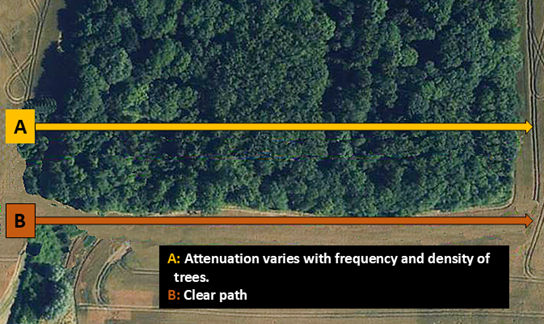
However, trees are not invisible to RF. Leaves and branches absorb some energy, especially when wet. Water is particularly lossy at higher frequencies. After rainfall, antennas in trees may show measurable changes in tuning and signal strength.
At VHF, UHF, and microwave frequencies, trees become much more problematic. Dense foliage can attenuate signals significantly. A line of wet trees between two 70-centimeter stations can significantly weaken signals. Microwave operators regard trees with roughly the same affection sailors have for icebergs.

Seasonal Changes
An antenna system may behave differently throughout the year. Ever notice how UHF handheld radios work great in winter and mysteriously worse in summer? Leaves are often the culprit. A fully leafed-out forest can absorb and scatter RF energy surprisingly well.
In winter, bare branches contain less moisture and have less surface area, which can slightly improve signal propagation. In spring and summer, fresh leaves and increased sap content can increase RF absorption. This sometimes leads operators to believe their antenna has stopped working. In reality, nature redecorated the propagation path.
Rain adds another layer of complexity. Wet trees can detune nearby antennas and increase signal attenuation. If your SWR changes every time it rains, the antenna may be too close to foliage.
Multipath & Reflections
Both metal objects and trees can create multipath propagation. Signals bounce off surfaces and arrive at the receiving antenna slightly delayed and from different directions.
At HF, this effect is usually minor because ionospheric propagation dominates. For VHF and UHF, however, multipath can cause flutter, distortion, fading, or signal cancellation. For those of you old enough to remember analog TV broadcasts, they were often subject to “ghosting,” a form of multipath interference caused by signals arriving at the antenna via two or more paths with different delays.
Urban environments filled with buildings and metal structures are notorious for this. Mobile operators often notice signals changing dramatically over just a few feet of movement. One spot gives full quieting; another has marginal reception.
Trees can contribute to scattering, especially in windy conditions. Moving branches create constantly changing reflection and absorption patterns.

Can Metal & Trees Ever Help?
Surprisingly, yes.
Metal reflectors are intentionally used in antenna design. Yagis depend on carefully positioned metal elements to shape radiation patterns and increase gain. Ground screens improve vertical antennas. Reflectors behind antennas can effectively direct RF energy.

Trees can also be useful support structures. A well-positioned dipole in a tall tree often outperforms a poorly placed antenna in the clear. Height usually matters more than perfection.
Many excellent HF antennas have lived happily among trees for decades. Understand that nearby foliage may slightly reduce efficiency or alter tuning but doesn’t necessarily ruin performance.
Sometimes operators obsess over minor environmental effects while ignoring much larger issues such as feedline loss, poor grounding, or insufficient antenna height. A mediocre antenna high in a tree often beats a perfect antenna mounted six feet above the ground next to aluminum patio furniture.
Minimizing Problems
Several practical steps can reduce environmental interaction:
- Keep antennas as far from large metal objects as practical
- Avoid running antennas parallel and very close to metal gutters or siding
- Use nonconductive support materials when possible
- Maintain clearance from dense foliage, especially at VHF/UHF
- Retune antennas after permanent installation if necessary
- Expect seasonal variation in antennas installed near trees
- Prioritize antenna height and placement over EZNEC perfection
And perhaps most importantly: test in the real world. Antenna modeling software is useful, but reality is always best.
Nothing’s Perfect
Nearby metal and trees affect antennas, sometimes dramatically. Metal objects can detune antennas, distort radiation patterns, and alter impedance. Trees can absorb RF energy, especially when wet, and become increasingly troublesome at higher frequencies.
Yet amateur radio history is filled with successful stations operating under imperfect conditions. Antennas have been installed in attics, forests, apartment balconies, and improbable backyard arrangements that appear to violate both physics and zoning regulations.
The ideal antenna site—a wide-open field with perfect conductivity and no obstructions—isn’t always available to us. Most operators learn to work with real-world compromises. In fact, much of amateur radio involves discovering how to make imperfect antennas work surprisingly well.
And if all else fails, remember the oldest antenna troubleshooting technique in existence: stare thoughtfully at the antenna, change absolutely nothing, and announce, “I think it’s working better now.”
The post Ham Radio Tech: Do Nearby Metal & Trees Significantly Affect Antennas? appeared first on OnAllBands.
OnAllBands