Editor’s Note: OnAllBands is pleased to post a series of articles written by accomplished amateur radio contester and DX Engineering customer/technical support specialist Kirk Pickering, K4RO. The articles, originally published in the National Contest Journal from 2008-2011 and updated with current information, offer valuable insights for both contesters new and old.
***
Welcome back to Contesting 101. In the last installment, we covered basic antennas for contesting. We discussed the importance of target areas and how we might use the patterns of simple antennas to work to our advantage. Knowing where to orient our antennas is important, but we also must know when we are most likely to have propagation to a target area on a given band.
One of the things that makes contesting interesting is the challenge of maximizing the use of available propagation. Not every band is open to every direction at every time, and the successful contester must learn which bands at what times can produce the best results. There are hundreds of books and thousands of articles devoted to the study of propagation, as well as propagation prediction tools. The reader is encouraged to explore the many resources available. In this brief article, I will attempt to cover very basic HF propagation as it relates to contest operating.
Follow the Sun
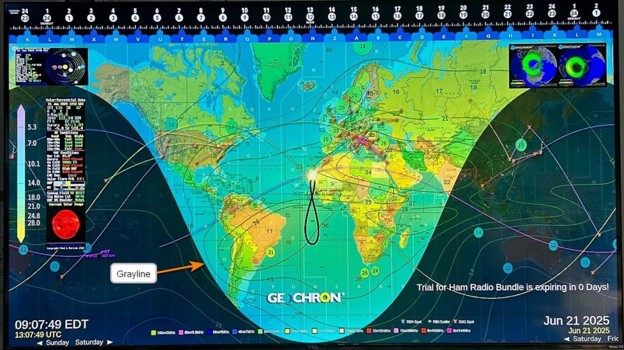
One of the best indicators we have for understanding propagation is the position of the sun relative to our location on earth. As the earth rotates along its axis, the sun illuminates one half, while the other half remains in darkness. Every rotation, of course, takes 24 hours and is how we define a calendar day. Different tools have been created over the years to help us understand the position of the sun, starting with the sun dial. As contesters, we are interested in seeing how the earth, as a whole, is illuminated. There are paper graphical tools to help such as the “DX Edge,” which was sold decades ago. Today, the Geochron Digital Atlas 3 4K World Clock with special Ham Radio Bundle includes real-time propagation layers for operators that allow tracking of the gray line and other benefits.

There are also three-dimensional globes which show the sun’s illumination on the earth. With the advent of the computer age, we now have programs such as Geoclock and various websites to help “show us the light” across the planet. Of particular use are programs capable of presenting maps in an azimuthal equidistant projection, centered on our location.
Editor’s Note: Some current propagation tools and resources are discussed in these OnAllBands articles, “Propagation Paths—The Long and Short of It” and “HF Propagation at the Equinox.”
The Ionosphere
The reason that we are so interested in the position of the sun is because of its effect on the ionosphere, a belt of charged particles surrounding the earth in the upper atmosphere. The ionosphere has a different composition when lit by the sun, compared to when it is not lit. The sun-lit area might typically have four layers, with the D-layer closest to earth, the E layer above that, and the F1 and F2 layers above that. In the areas of darkness, the D and E layers essentially disappear, and the F1 and F2 layers combine into a single F layer at night.
The density of these layers changes not only with the position of the sun, but also with the number of sunspots and the resulting solar radiation on any given day. Knowing that the layers exist is certainly interesting, but what really matters to contesters is the effect that the ionosphere has on radio propagation. In general, the more highly ionized the layers, the more they support the refraction (bending) of higher frequencies. More ionization also means more absorption (attenuation) on lower frequencies. The refraction of HF radio waves in the ionosphere is responsible for the “skip” phenomenon, allowing the magic of worldwide propagation to occur.
Follow the Maximum Usable Frequency (MUF)
One feature of the ionospheric refraction phenomenon is that different frequencies bend at different angles. Some angles are so slight that the radio wave does not return to earth. Generally, the higher the angle (more toward the zenith, or straight up) the shorter the skip. Likewise, the lower the angle (toward the horizon) the longer the skip. For a given target direction, there is an upper frequency limit at which communication can occur. This limit is called the Maximum Usable Frequency, or MUF. Propagation tends to be best at the MUF, so it is important for the successful contester to be aware of the MUF at any given time. (Editor’s Note: The Geochron bundle mentioned above provides MUF visualization.)
Learn by Operating
It simply can’t be said enough. The best way to learn about propagation is to be in front of the radio as much as possible during contests and any other time that you can operate. Each hour will present different conditions as the earth rotates along its axis. Some contesters describe DX contests as “watching the earth turn.” We will go through an example of a typical DX contest effort from middle Tennessee. The exact times and band openings will be different for each location, but hopefully this will give an example of the kinds of patterns to look for. For the purposes of demonstration, we will assume some decent conditions for our example contest, with enough solar flux to support reliable openings on 10 meters to Europe. We will only describe one solar day. Note that in a 48-hour DX contest, conditions often will vary considerably between the two days, but the same general patterns apply.
Typical DX Contest Openings
0000-0200z—Contest Start Time
The sun has set in middle TN, but because of the decent solar flux, western paths are still open on the high bands. There is plenty of sunlight illuminating the path between TN and JA, and JA signals are loud on 15 meters. The only signals heard on 10 meters are from South America, an indication that the MUF toward JA is somewhere above 21 MHz but below 28 MHz today. No signals from Europe are heard on 10 or 15 meters. The path of complete darkness between TN and EU means that the denser layers of the ionosphere have dissipated, and the MUF to EU is well below 20 MHz. We are hearing some EU on 20 meters and hearing EU quite well on 40 meters. As a single operator, we must make a choice: work JA on the high bands or work EU on the low bands. I would probably milk the 15M opening to JA first and then switch to 40M for EU after the high bands close to Asia. The openings to Asia are rarer and less reliable from middle TN. The same opening might not exist on day two, so we will choose to “make hay while the sun is shining.”
0200-0400z
The high bands have closed to Asia, and the only target population center open is Europe on 40 meters. Eighty meters is also starting to open to Europe—especially eastern Europe. Our sunlight map program shows us where the terminator or gray line is located. The gray line is the area between sunlight and darkness—either dawn or dusk—which constantly turns across the globe as the earth spins. Stations located along the gray line often experience enhanced propagation as the terminator crosses over. The astute contester will keep their eye on the gray line and pick up some nice multipliers on the low bands. ‘
0400-0600z
As the sun comes up across the European continent, signals on 80 and 160 meters reach their peak signal strength. With a careful eye on the gray line, it should be possible to work several European countries on 80 and 160 meters.
0600-0800z
With the sun completely up in Europe, the 80 and 160 meter bands are no longer open. The D and E layers have reappeared over EU in the presence of sunlight, and these layers act like a sponge, absorbing signals below 5 MHz. There is still good propagation to EU on 40 meters, so we work what we can on that band.
0800-1000z
Some propagation to Europe is still available on 40 meters, but it is dying out. The D and E layers have become denser with more sunlight over Europe, and absorption begins to attenuate 7 MHz signals. We are still in complete darkness in middle TN, and the high bands are essentially closed in all directions. This is a good time for some aggressive search and pounce on the low bands for the many Caribbean and South American multipliers.
1000-1200z
The sun has now set in Asia, so the D and E layers are disappearing between TN and Asia. We are beginning to hear signals from Japan on 40 meters. As our local sunrise approaches in middle TN, we prepare for our own gray line opening. The period immediately surrounding sunrise is our best (and only) chance to work any Asian stations on 160 meters. We spend a lot of effort on 80 and 160 meters while our brief gray line opening lasts, looking for the rare multipliers which only are heard during this window.
1200-1400z
The sun is up now in TN, and the high bands are open to Europe. Often if conditions are good, there will be a strong opening on 20 meters first. Sometimes the morning opening comes on so fast that it can be disorienting. One minute there are hardly any signals at all, and the very next minute, the band is jam-packed wall-to-wall with signals. Sometimes the biggest opening from TN is on 15 meters. This is the time I want to be established on a good run frequency, “shoveling” European QSOs into the log as fast as possible.
1400-1600z
The high bands are still open to Europe. The name of the game is run, run, run Europe. It is the primary population center, and the majority of our QSOs will come from EU. We also might see stations appearing on 10 meters. The path between TN and EU has been illuminated by the sun long enough for the ionosphere to support an MUF as high as 30 MHz. If there is ANY opening on 10 meters, we take advantage of it to the fullest extent.
1600-1800z
It turns out we were lucky this year. Ten meters is wide open and remains that way up until the sun begins to set in Europe. Signals are unbelievably loud because we are operating right near the MUF. There is very little local QRM because most U.S. stations are skipping over us, and we can’t hear them at all. When the band is open, there’s no meter like 10 meters.
1800-2000z
With the sun setting in Europe, the MUF starts to fall, and 10 and 15 meters begin to close down in that direction. Twenty meters is still well open to Europe and beyond. We will also start to hear more African and Caribbean stations, as the sunset terminator line moves westward across the Atlantic Ocean. South American stations are plentiful and loud on 10 and 15 meters. There is still plenty of sunlight on those paths, plus North-South (also called trans-equatorial) propagation is very reliable, regardless of solar conditions. This is one of the reasons that stations near the equator can be so competitive.
2000-2200z
Twenty meters is still the band for working Europe. Because of the relatively high solar flux, the MUF has stayed at or above 15 MHz, and we enjoy great conditions on 20 meters toward Europe. 10 and 15 meters remain well open to the southern directions.
2200-2400z
As we approach the end of the first day, we start to hear Asia coming in on the high bands. The sun has been ionizing the directions to our west, and high bands are supporting a good run to JA on 15 meters. 20 meters is still open to EU, but we will concentrate again on the Asian opening since it tends to be much shorter in duration. We make sure to check 10 meters frequently (including calling some CQs) for any openings to the rare Asian multiplier areas. If the MUF creeps high enough, we might be able to have a short run to Japan. Europe will be pounding in again on 40 meters soon, so we will milk the high band Asian opening for all we can until that path is closed.
Day two may follow a similar pattern, or it may not. Depending on our QSO and multiplier totals, we may need to spend more time on a particular band to fill in some gaps. If we are a smaller station, we will have more luck calling CQ the second day. The big gun stations have likely all worked each other by then and will be looking for anyone new to work on day two.
That’s all for this installment. See you on the bands, and don’t forget to submit your log to the sponsor, no matter how many QSOs you made. It helps you, helps the sponsor, and helps the sport of contesting.
The post Ham Radio Contesting 101: Basic Propagation for Contesting appeared first on OnAllBands.
OnAllBands