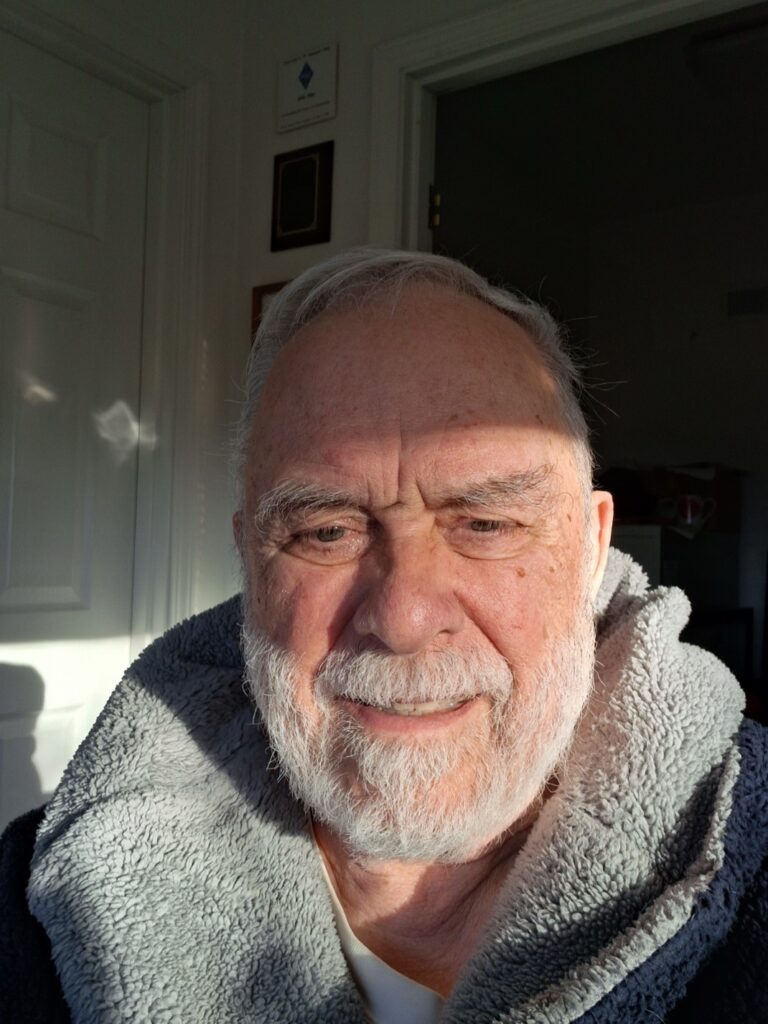
OnAllBands is thrilled to feature articles from noted author and amateur radio DXing legend Bob Locher, W9KNI. Bob will be sharing his favorite DXing memories along with insights on what it took to capture the rarest of the rare.
Be sure to read part 1 of this series—his account of making contact with Gough Island, ZD9—in this OnAllBands article.
***

Virtually all my life, I have been a student of geography. I was never that interested in the politics of a place. My interest was more imaginative—waves breaking on a coral strand, ice flows and penguins, steamy jungles, endless sand dunes and the like. Chasing DX redefines the term “Armchair Traveler” for myself and others. Ham radio DXing has always been the perfect catalyst for my imagination.
I always tried to have good equipment for DXing, but another treasured possession was a really good atlas that included maps of the oceans and the islands on them. Whenever I worked a juicy bit of DX, my next move was invariably a session with the atlas. It also had the benefit of being a gift non-ham family members could understand. (But you will surely have a better result if you select the atlas you want. Most atlases have great coverage of their home country, while the rest of the world is an afterthought. But true world atlases do exist. Shop for a good one.)
So, for me, working an exotic new country or a remote island was always a thrill.
Thinking about it, I came to realize that the discovery of a new island for a Westerner was always an adventure, whether the island had a native population or not. And indeed, hundreds or thousands of years earlier, there had to be a first discovery by someone who founded the native population. Mostly, such stories are lost, except for the DNA footprints in the passages of time. Nonetheless, it was all—and still is—fuel for my fertile imagination…
Looking South
It was the late 1970s. I was living in a Chicago suburb and working hard to build up a DXCC count. My site was not a very good one—a low spot—but it was what I had. I had a 40-foot tower and a two-element cubical quad on top. I had a homebrew amplifier good for 600 watts output, essentially the legal limit in those days. I had just gotten my Extra Class license, so I had full access to all of 20 meters.
On an October evening, I was tuning 20 meters, looking for a new one. I quickly discovered conditions were lousy, thanks to some sort of solar event or magnetic storm. There were no signals at all from the Eastern Hemisphere, unlike most days. Looking over the North Pole was fruitless—no signals. This is a typical pattern for auroral or magnetic storms. But usually, the normal propagation paths to Central and South America stay open. I decided to turn my antenna to South America and began a careful tune of 20-meter CW. I still needed Paraguay and Bolivia. Maybe I could get lucky there.
That path proved to be open, as I had hoped. I heard Brazilians, Argentines, and one signal from Uruguay, none of which I needed. Signal strengths were reasonably good, but there were only a few stations on the band. I was not really that surprised, though, considering it was very late at night at local time in those countries. People not crazy enough to be DXers were asleep in their warm beds.
This is the part of the band that virtually all CW DX is found in. I checked the phone part of the band. Again, I heard a couple stations in contact speaking Spanish. I listened carefully, knowing little of Spanish or Portuguese. I did manage to copy calls—Argentines and a Brazilian. Nothing new there.
I went back to the CW band, mentally starting to figure I’d throw in the towel for the night. The bottom 30 kilohertz offered little change from earlier—very little activity. I decided to check the next 30 kilohertz higher, outside the usual DX window on 20-meter CW. That segment seemed even more empty. I tuned up to 14.060 kHz, then started back down, turning the knob the other way. Huh? There was a signal at 14.055, decent copy, an honest 569 signal.
I listened for a moment. The station seemed to be rag-chewing at a comfortable speed…and in English. I continued tuning down but only for a moment. Bells were going off in my head. I turned the receiver back to that frequency and station. To use the vernacular of today, “What’s wrong with this picture?” Hmmm. I know I had tuned cross that frequency within the last three minutes and had heard nothing.
But I was hearing a fellow rag-chewing with someone else—obviously someone else I could not hear. And during the whole operating session I had heard no American stations above about S-3 at all. Ergo, it seemed very likely that the station was a non-American but fluent in English, so probably not South American. I listened to the contact while trying to figure anything out. I had not long to wait: “OK George. Got to QRT here now. Commercial schedule in two minutes. Best to Sarah. Cheers mate. G3XXX de VP8GL 73.” Wow! VP8— the Falkland Islands. New for sure, but he was going QRT.

I looked at the clock: 9:29 local time. Obviously, his commercial schedule was on the half hour. I waited on frequency with bated breath and heard the traditional “dit dit.” I knew I had only one shot— kind of a long one, but that was all I had. I called, matching his speed, “VP8GL de W9KNI W9KNI 579 579 BK.” Yessss! “W9KNI 579 579 73 VP8GL QRT.” I responded, “TNX, WILL QSL 73 did dit.” I got back his “did dit” so he copied that. I was good! I whooped and gave a fist pump in the air.
After I finished logging it, I got out the tool of the DX Community of those days: “The Radio Amateur DX Callbook.” I looked him up and got another shock, albeit it a very pleasant one. He was not on the Falklands at all—he was on the much rarer South Georgia Island! South Georgia! The island already lived in my consciousness thanks to having read about the great and heroic Antarctic misadventure of Ernest Shackleton and his crew. South Georgia figured very prominently in the accounts. And indeed, the famous man was buried on South Georgia.


The glow of my success mixed with icy shivers up and down my spine. This was truly “armchair traveling” at its very best! I headed for bed. It took me a long time to get to sleep, still immersed in a golden glow. But as I finally slipped away, I suddenly came to a realization—I still needed the Falkland Islands.
Some Notes
- Fellow “OnAllBands” author, Violetta Latham, KN2P, will be a part of a major DXpedition to South Georgia Island in March 2027, one of two Americans on the trip. The call will be VP0SG. Click here to visit the official website.
- Until about three years ago, VP8 was the correct prefix for South Georgia. A change has been made in callsign allocations, and the new prefix for South Georgia is VP0.
- If you want to read a thrilling account of the Shackleton expedition, I recommend “Endurance” by Alfred Lansing.
- Cubical Quad antennas: The quad was a fairly common DXing antenna in the last part of the 20th century. They were relatively low cost, needed only a light-duty rotator, and competed well with two-element Yagis. But also, they made very good tri-banders. They had their faults; they were difficult to put up because of their geometry, and they rarely survived any kind of ice storm. They have since been replaced in most cases by hexbeams. Hexbeams have the same operational advantages, require less parts, and are MUCH easier to assemble and install. That said, well-designed larger aluminum Yagis are superior and much longer lasting, but at greater expense, requiring stronger towers, beefier rotators, etc. But hexbeams offer a lower cost entry to expanded DXng.
The post Legendary DXer Bob Locher, W9KNI, Presents Tales from a Serial Sniper Part 2, “Looking South” appeared first on OnAllBands.
OnAllBands