Hi everybody! Let’s talk about what to bring and what to leave behind on a POTA activation. If you’ve been activating for any length of time, you’ll probably agree that some items earn a permanent place in your activation while others are better off staying home.
Your plans for the day will dictate what gear you should take along. Let’s say I’m planning an all-day rove to activate multiple parks. I love this kind of trip; just me, the GPS, and the open road, looking for an out-of-the-way spot to set up and operate.
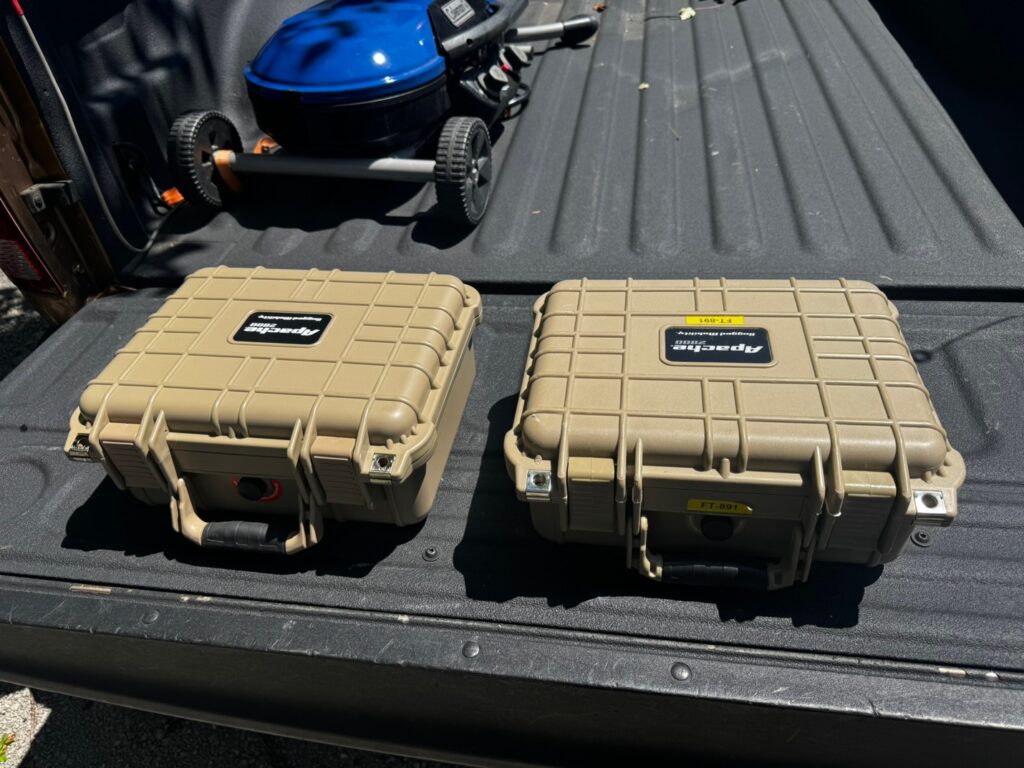
For trips like this, I grab multiple batteries, my mobile antenna, and two equipment cases. One case holds the rig, headphones, power cables, and other essentials. The second carries my Heil boomset and my N3ZN iambic paddles. Those two cases, along with my computer bag holding my laptop and iPad, make up the bare minimum for my activations.

If I’m planning a multi-day trip, I may even bring the primary rig from the home shack as a backup. Most of the time, though, the QRP rigs that ride in the back seat are adequate as backups. I also carry a box containing wire antennas, rope, and extra feedline. If I’m camping, I’ll throw in my Wolf River Coil as well. It’s an excellent option when I want to get on 80 meters from the campsite.
For an all-day trip, a small cooler is a must. It contains a few cold drinks and plenty of ice. Sometimes I’ll grab a sandwich along the way and toss it in there, too. By late afternoon, I’ll finish the rove by finding a local restaurant before heading home or to my stop for the night.

Now let’s look at a completely different scenario.
The lawn is mowed, the chores are finished, and I have a couple of hours to spare before dinner. That’s a perfect opportunity to visit one of the nearby parks in my area for a little walking and a quick activation. Fortunately, there are several parks within a short drive from my home QTH.
For this type of outing, I’ll take a single battery, my mobile antenna, the computer bag, and the rig. I leave the cooler at home, opting to grab my water bottle as I’m heading out the door.
Portable operating is all about finding the balance between being prepared and carrying unnecessary weight. Experience will quickly teach you which category each piece of gear belongs in.
One item that should always make the trip, however, is a basic first aid kit. Customize it to fit your own needs, and don’t forget mosquito and tick repellent. You’ll probably appreciate both long before you need the spare coax.
Gear That’s Earned Its Keep
Over the years, I’ve accumulated plenty of accessories. Some go with me on nearly every activation while others spend most of their time taking up space in the garage.
My favorite accessory is probably my folding wagon. It has proven invaluable for activations that require a bit of a hike from the parking area. It carries a surprising amount of equipment and folds up small when not in use. I chose one with oversized wheels, which handle sand and loose dirt quite well.

Another favorite is my Cliq chair. It’s compact and lightweight. Since it folds down very small, I can store it neatly beneath the rear seat of my truck. It even doubles as a makeshift operating table when necessary.
Editor’s Note: You’ll find several types of foldable chairs for portable operating available at DX Engineering.
I also own two telescoping masts: a Nomad 23 from DX Engineering and a Spiderbeam mast. Along with those, I have a couple of hitch receiver mast mounts for my truck. They’re a great solution whenever there aren’t any convenient trees or other supports nearby.


I also have a potato gun for launching antenna lines into trees. It usually only comes along on camping trips when I expect to leave an antenna in place for several days. Pumped up to around 35 PSI, it’ll easily launch a plastic projectile 75 feet into a tree. I built mine from plans in the March 2009 issue of “QST.” If you do a search on the author’s callsign, W4SSY, you should be able to find the article.
DX Launcher compressed air cannons and slingshots for stringing wire antennas in trees are available at DX Engineering.

For most activations, though, I use a simple arborist throw weight. This is a small, shot-filled bag (they come in various weights). I bought mine online for around $20. With a little practice, you can toss it over branches 25 to 30 feet high, which is more than enough for the vast majority of portable antennas.
Logging
Let’s talk about logging.
If you’d like a more in-depth look at the various logging options available for POTA, check out my earlier article, “Ham Radio Portable Insights: Logging Options for POTA.” Whether you prefer a simple notebook that you transcribe later or a device running your favorite logging software, there really isn’t a right or wrong answer. Use whatever works best for you.

Last year, I started using Ham2K PoLo, and it has since become my primary logging program in the field. I also wrote an article introducing PoLo a few months ago, and since then I’ve learned quite a bit more about it. So, keep an eye out for a follow-up article in the near future.

If you are logging electronically, here’s a trick that I use. I’m very deliberate about backing up my log to the cloud before leaving each activation site. It only takes a moment and protects me against losing the log if the device fails or disappears. I still wait until I’m back home before uploading everything to POTA.
As you’ve probably gathered by now, I’m a firm believer in redundancy, especially when I’m traveling any significant distance from home. I like having backups for just about everything. Every now and then, I’ll even pull one of the QRP rigs out of the back seat just to give it some exercise. Honestly, I notice very little difference in the number of contacts I make with a QRP rig compared to my FT-891 running 30 watts.
And that wraps it up for this time. Thanks for following along. Now get out there and activate something!
73 de WG8X
The post Ham Radio Portable Operating Insights—POTA Activation Essentials & Gear You Can Keep at Home appeared first on OnAllBands.
OnAllBands