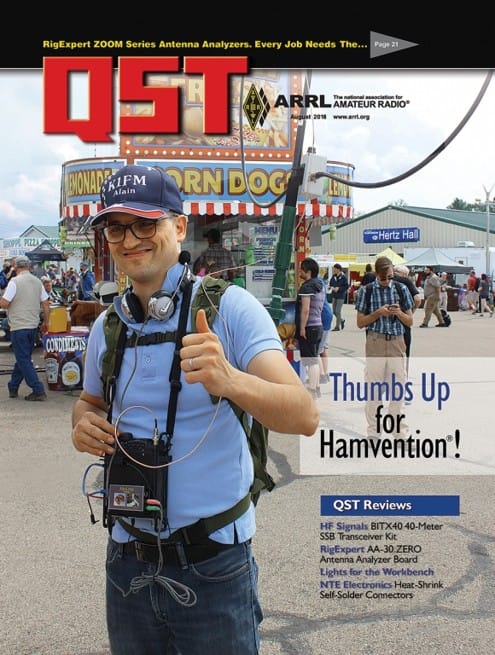
Most hams think of mobile operation as getting into a vehicle, turning on the radio, and heading down the road. Choosing portable operation means carrying a radio, battery, and antenna to a campsite, park, mountain, or other convenient operating location. But many of us forget another option: pedestrian mobile (PM) operation.
Pedestrian mobile means operating an amateur radio station while walking. Instead of sitting at a picnic table or behind the steering wheel, you become the mobile station. Your radio, power source, antenna, and accessories travel with you. You become the operating position, antenna support, and transportation system all in one.
What Is HF Pedestrian Mobile?
An HF pedestrian-mobile station is a portable radio setup designed to operate on the high-frequency bands while you’re on foot. You might carry the equipment in a backpack, mount it on a frame, or distribute it between a shoulder bag and a belt. The arrangement depends on the radio, antenna, and how you operate.
A typical setup includes a compact HF transceiver, battery, antenna, and possibly a tuner, headset, or key for CW operation. Some operators use a loaded vertical antenna attached to a backpack or lightweight support pole. Others experiment with compact magnetic loops and other antennas designed to fit into a small operating package.
Pedestrian mobile differs from setting up a portable station at a park or campsite. With conventional portable operation, you arrive, erect the antenna, sit down, and operate. Pedestrian mobile keeps the station moving with you.
Of course, nobody says you have to walk continuously. Stopping occasionally to catch your breath, adjust an antenna, or answer a CQ is perfectly acceptable. The radio won’t report you for taking a break.
Why Carry a Radio on a Walk?
Amateur radio offers endless opportunities to experiment with antennas, propagation, and operating techniques. Pedestrian mobile adds a new dimension by combining radio with outdoor activity.
You can take your station along a park trail, around a campground, or through a quiet rural area. An ordinary walk becomes an operating adventure. Instead of wondering how far you’ve traveled, you may find yourself wondering how many contacts you can make along the way.
Another advantage is the opportunity to escape neighborhood radio-frequency noise. Computers, switching power supplies, LED lighting, and household electronics can raise the noise floor enough to make weak HF signals difficult to copy. Moving away from those sources can make a noticeable difference, although noise levels vary with location.
You can also experiment with how your surroundings affect antenna performance. Moving a few hundred feet may change local noise levels, ground conditions, or the antenna’s relationship to nearby objects. Climbing to a hilltop may improve coverage in some directions, particularly when the terrain slopes away from the station.
Unlike a laboratory experiment, a white coat is optional.
The HF Challenge
HF pedestrian mobile is more demanding than carrying a small handheld radio. Batteries and transceivers must be compact enough to carry comfortably, while the antenna must remain practical, reasonably efficient, and safe to use while walking.
My first encounter with an HF pedestrian-mobile operator was at Hamvention several years ago. He was walking through the flea market with a long wire trailing along the ground, perhaps 25 to 30 feet long. A packboard on his back held a Yaesu 100W radio on top and a battery on a lower shelf, with a loaded vertical antenna attached to the side. I wondered how many would absent-mindedly step on the trailing radial. Hopefully, there was a banana plug or quick release on the other end.

HF pedestrian mobile may not match the performance of a well-equipped home station, but that’s part of the appeal. Making contacts with modest power and a compact antenna forces you to think carefully about equipment, efficiency, and propagation. You quickly discover which accessories are essential and which ones take up space.
Choosing an HF Radio
A compact, low-power transceiver is generally the first choice for today’s HF pedestrian-mobile operator. QRP radios, typically operating at five watts or less, are attractive because they offer useful HF capability without requiring a large battery. Some even come with a rechargeable internal battery.
You can find a few radios, such as the Xiegu 6100, 6200, and Elecraft KX2, KH1, that are fairly lightweight and can function as handhelds. These combine built-in batteries, tuners, internal microphones, and support smaller telescoping antennas for 40 meters and up. There are also dozens of other QRP radios that are relatively small and come in assembled or kit form. Examples include the QRP Labs QMX, USDX+Plus V2, and (tr)uSDX by PE1NNZ and DL2MAN.
There’s also a group of slightly larger QRP radios, such as the familiar Yaesu FT-817/818, Yaesu FTX-1 Field, and Icom IC-705, which use a hand mic and add 2m/70cm bands. The ELAD FDM-DUO shares the same weight and footprint class, with 160-6 meter coverage.

Want more power? Move up to a mobile 100W HF radio. Some have detachable control panels, such as the Icom IC-7100 or Yaesu FT-891, FT-857D, and FTX-1 Optima.
Modern solid-state technology has made portable HF equipment much more manageable. Fortunately, you no longer need to carry a 35-pound military radio on your back like the WWII vintage SCR-300.


However, higher output power means greater battery demands, particularly during voice transmissions. It also generates heat and can increase the weight of the overall station. A radio capable of 100 watts doesn’t have to be operated at full power, but carrying the battery needed to support that power may defeat the purpose of a lightweight walking station.
Batteries: Every Ounce Counts
The battery can be one of the heaviest parts of a pedestrian-mobile station. Lithium-ion and lithium iron phosphate (LiFePO4) batteries are popular choices because they provide useful capacity without the bulk of older battery technologies.
A 100-watt radio doesn’t have to run at full power, but carrying the battery needed to support that power may defeat the purpose of a lightweight walking station. The goal is to carry enough energy for the planned outing without turning a pleasant radio walk into a weightlifting competition.
Antennas: The Biggest Challenge
HF antennas present the main challenge for pedestrian-mobile operation. A full-size dipole is efficient, but you won’t want to carry it while walking a wooded trail. A compact antenna is easier to manage, but smaller size often means lower efficiency or a narrower bandwidth.
Sometimes you have to make compromises, and here are several options worth considering:
Loaded vertical antennas: A shortened vertical uses loading coils to make an antenna physically shorter than a full quarter wavelength. Options include Comet HF monoband mobile antennas, Hustler HF mobile resonator antennas, and Hamsticks. These are compact, but loading coils and short radiators generally reduce efficiency, especially on 40 meters.
Portable collapsible antennas: Elecraft offers the AX1 and AX3 portable antennas, with optional accessories for additional band coverage. These are designed for compact portable operation and can be useful with compatible QRP radios. Check their band coverage and mounting requirements before purchasing.
Loop antennas: Small loops, like the 16-inch Moonraker Whizz, offer multiband or single-band operation in a compact package. Alpha’s EMCOMMLOOP is about three feet in diameter and weighs 1.5 pounds. It can be adapted for a short lightweight mast or tripod mounting. If using high power, be sure to keep some distance between you and the loop.

Motorized screwdriver antennas: The Yaesu ATAS-120A is another antenna to investigate if you already use compatible Yaesu equipment. Its need for a suitable RF ground or counterpoise may make it less convenient for walking than simpler lightweight antennas.
Whatever design you choose, test it before heading out, and keep wires clear of walking hazards. Remember that a low SWR doesn’t necessarily mean an antenna is efficient. A lossy antenna can show an acceptable match while converting too much of your precious battery power into heat rather than RF.
Don’t Forget the Counterpoise
A vertical antenna needs an appropriate RF return path. Depending on its design, this may be provided by radials, a counterpoise wire, or another suitable arrangement. Simply attaching a vertical to a radio doesn’t guarantee efficient radiation.
A trailing counterpoise wire is a straightforward solution, but it can snag on rocks, brush, and your own feet. A compact, purpose-built counterpoise may be easier to manage. A rigid counterpoise comprising a short helical element at right angles to the vertical element is worth considering. You can make them using a one-inch diameter PVC pipe wrapped helically with ¼ wave of wire, tuned for each band.
Which HF Bands Work Best?
- 40 meters is popular because it supports regional contacts and, under favorable conditions, longer-distance communication. Evening operation can be particularly useful for contacts hundreds of miles away. The drawback is that an efficient 40-meter antenna is relatively long, so compact designs involve compromises.
- 20 meters is another excellent option. During favorable propagation, even a few watts can reach stations thousands of miles away. Its shorter wavelength also makes antennas easier to manage than comparable 40-meter designs.
- 17, 15, and 10 meters can be rewarding when propagation cooperates. Their shorter wavelengths allow smaller antennas, and good solar conditions can produce impressive long-distance contacts. However, these bands can be much less reliable when propagation deteriorates.
For a first HF pedestrian-mobile project, 20 meters is a sensible starting point, with 40 meters worth adding if regional contacts are a priority. A multiband radio helps, but a single-band antenna may outperform a complicated system that is hard to carry or tune.
Power, Propagation & Expectations
Pedestrian mobile demonstrates an important HF lesson: Power isn’t everything. A few watts can travel thousands of miles when propagation is favorable. Conversely, a hundred watts won’t rescue a signal when the band is closed or conditions are poor.
HF communication depends heavily on the ionosphere, frequency, time of day, season, and solar conditions. Signals may be refracted back toward Earth, allowing contacts far beyond the local horizon. A compact station on a quiet trail can sometimes outperform a more powerful station surrounded by electrical noise.
A hilltop may also offer advantages, particularly if the terrain slopes away in the direction of transmission. However, the effect depends on the antenna’s radiation pattern, its height, the ground, and the surrounding terrain. Experimentation is part of the fun.
Should You Try HF Pedestrian Mobile?
HF pedestrian mobile combines radio experimentation, outdoor activity, technical problem-solving, and adventure. You can begin with a compact QRP radio and lightweight antenna, then refine the setup as you learn what works.
Start with short walks and familiar equipment. Practice changing bands, adjusting the antenna, checking the battery, and operating safely without becoming distracted by the radio. Avoid transmitting while crossing roads or navigating hazardous terrain. If the antenna or its counterpoise creates a snagging hazard, stop and reposition it before continuing.
You can also combine pedestrian-mobile operation with Parks on the Air®, Summits on the Air, or other portable-radio activities. However, the rules of each program may distinguish between operating while moving and operating from a designated location.
The attraction is simple: You carry your station rather than carry it somewhere and sit beside it. And when a station several thousand miles away answers your CQ, you may stop on the trail—not because you’re tired, but because you want to be ready for the next QSOs.
The post Pedestrian Mobile Ham Radio: You Can Take It With You appeared first on OnAllBands.
OnAllBands