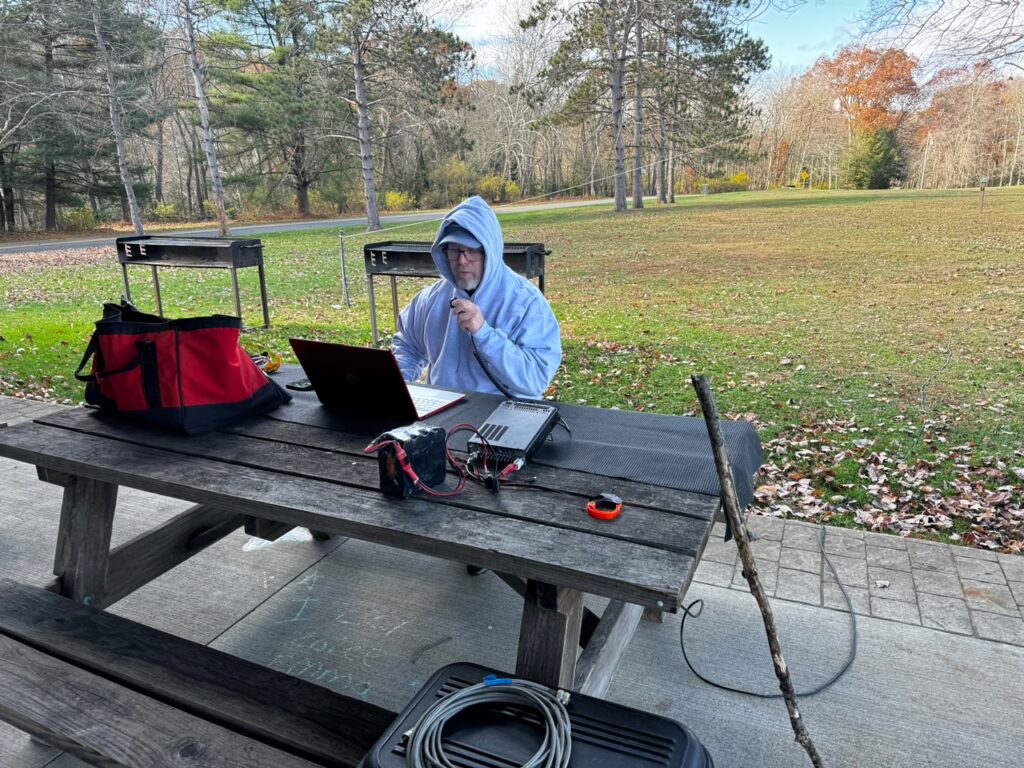
Hi everyone! This week, let’s talk about operating with friends, otherwise known as group operating.
Group operating can mean different things to different folks. To some, it conjures ideas of a bunch of friends getting together in a rented pavilion, making a day of it. For others, perhaps it’s picking up a friend and heading out to some new-to-you park for a morning of radio fun.
Sure, it’s fun to get outdoors to do a Parks On The Air® (POTA) activation, but it doesn’t have to be a solo activity. POTA offers great opportunities to get out with friends, enjoy the outdoors, and share knowledge and experience.
A group activation can be a completely different experience, combining operating, teaching, experimenting and plain old socializing. That teaching and mentoring aspect is what amateurs have traditionally called Elmering.
The group activations that I’ve done normally fit into one of these examples:
A Two- or Three-Person Activation might involve a couple of friends heading to a new location and sharing one station. We normally pass the microphone back and forth so each operator genuinely participates in making contacts. Simply being present at an activation isn’t the same as operating; proximity is not participation.

Another option is meeting a friend at a POTA reference. He might run SSB while I operate CW. Running multiple stations in close proximity makes you think hard about various challenges, such as what steps to take to avoid interference between the stations. These can include keeping some distance between the stations, running lower power, and using bandpass filters.
Club Outings: I’ve done several group outings with my local radio club—the Portage County Amateur Radio Service (PCARS). We’ll rent a park pavilion and operate POTA for the day. As per custom, food is involved. No one ever leaves hungry from one of these group outings. These normally occur on a Support Your Parks (SYP) Weekend, but they can pop up at any time. Simply put the word out that you will be at such and such park at this time and invite other members to come out to operate. It’s as easy as that.
By the way, Support Your Parks Weekends are seasonal POTA activities held four times each year (the next one is Oct. 17-18). Other portable programs hold similar activity events, but SYP gives POTA operators a particularly good excuse to organize a club outing. Our club gets out for each one, even in January. You need to be either dedicated or crazy to set up outdoors in Northeast Ohio in January!

POTA Get-Together or Meetup: These are always fun, but it’s usually more about socializing and comparing equipment than about how many contacts we can make. Most of the get-togethers and meetups seem to be a state or regional thing.

A successful group activation doesn’t need to be complicated, but it does benefit from a little planning. Regardless of how many people participate, it helps to decide what you want the activation to accomplish.
There’s the Social Outing, where radios are almost secondary; everyone gets together to have fun and socialize. These are great and are sometimes unplanned.
For instance, do you camp? Next time you camp at a state park, take a walk around the campground and see how many fellow hams you meet.
The New-Operator event is great. Invite someone to come out activating with you. Maybe a new ham, a non-ham, or even a seasoned ham who might be looking for something new to become addicted to. In other words, give someone who has never activated POTA a chance to get on the air.
Technical/Experimental Day: I know a few hams who are constantly experimenting with their POTA setups. Maybe they’re tweaking go-kits, antennas, or power systems. Or perhaps you are messing with a new mode or band for POTA. The Technical/Experimental Day concept is great for this because you get to see what your friends are working on and compare notes in the field.
Emergency/Public Service Training: Speaking with a representative from the Fulton County Radio Club here in Ohio today, I heard a great idea for group operating. Their approach is an interesting one: They purposely seek out some of the most godforsaken areas they can find to operate from. The idea is to practice setting up and operating under less-than-ideal conditions, building skills and experience that could prove invaluable during an actual emergency.
Contesting: Maybe you would like to try to rack up a serious bunch of contacts? Try setting up multiple stations, use multiple bands/modes, and see how many QSOs you can make from a park! Better yet, do this for the weekend of your state’s QSO Party. You can amass a serious number of QSOs while trying to beat last year’s score. Lots of states now have State Parks On The Air contests as well.
Though not affiliated directly with POTA, the contacts made from a state park can be uploaded to your POTA account as long as your park has a POTA number.
Here in Ohio, the Ohio State Parks On The Air Contest tends to be a big deal. You can read more about it in the recent OnAllBands article, “Get Ready for the 19th Annual Ohio State Parks On The Air Contest.”
Lastly, some folks set up a group activation as a Club Promotion/Public Demonstration (Think Field Day). What a great way to introduce visitors to both amateur radio and POTA.
Choosing the Right Park
Choosing a location for a group activation is pretty simple. All you need for a solo or two-, three-person activation is a way to get there and a minimum number of services. You can even get by without trees to hang your antennas from.
A group activation is a bit of a different animal. Since you are planning for a larger group, there are a few more things to consider.
- Is parking adequate?
- Are there restrooms?
- Are there picnic shelters/tables to operate from?
- Is there room to erect and spread out antennas?
- Is there cell coverage? (It isn’t a must-have, but it is nice for spotting purposes.)
- Is the park open?
- Is there food nearby, or should we bring our own?
- Are reservations or permits needed?
- Will this be a day activation or a weekend camping/socializing get-together?
Remember, a park that’s perfect for one or two people may be terrible for 12. Someone needs to coordinate things, but it doesn’t have to become Field Day.
We’ve had great luck just renting a shelter and advising everyone to run what you brung. Having one person be a central point of contact is great. This ensures that you won’t have five rolls of coax but no radios. Or worse yet, five bowls of potato salad and no main course. It’s great if everyone can do low power to minimize interference between the stations.
Keeping the Stations Happy
Anytime more than one station is on the air, the possibility exists for inter-station interference. Whenever you are setting up in a group environment, here are some things to look at to ensure “happy stations.”
Antenna Separation: Whenever possible, try to keep your antennas as far apart as possible. Aligning your horizontal antennas at right angles to each other isn’t a bad idea if you can do it.
Operating on Different Bands: Keeping all stations from operating on the same bands is a great idea. Even if you are on 40M CW and your buddy is on 40M SSB, the possibility for interference exists.
QRP or Reduced Power: Reducing the station power will help to reduce interference between stations. The less power, the better, but I try to stay at 30W or less.
Bandpass Filters: If you are planning to do group activations often, a set of bandpass filters can be a good investment. Mark them plainly and make sure they are used on the bands they are designed for. Transmitting on 40M with a 20M filter in line won’t do your signal much good, nor will it help the life of the filter.
Coordinating Bands and Frequency Changes: We like to do a quick poll of the other stations before changing bands during a group activation. There’s nothing more frustrating than changing bands only to find another station from your group already there.
Testing the Arrangement Before a Larger Event Such as Field Day: Testing this stuff during a group activation will put you a step ahead when it’s time for Field Day.
Logging and Callsigns
At our group activations, we like to keep things simple. Some folks will operate under the club callsign, while others will use their own. There’s no right or wrong way to do this. It’s whatever works well for you and your group.
I’ll share a note on spotting here. If there are several stations sharing one callsign but operating on different bands, spotting can get confusing. The best way to deal with this is to add a suffix to the callsign when you spot yourself.
POTA’s documentation recommends identifiers such as K8BF/R01, K8BF/R02 and so on. You may see other suffixes being used, and we’ve used band identifiers such as K8BF/20 and K8BF/40 ourselves in the past. However, going forward, I’ll be sticking with POTA’s recommended /R01 convention. Remember that these suffixes distinguish the spots only; the station still transmits and logs the club callsign as K8BF.
Perfect for Beginners
Another plus to group activations is that it gives the new operator a chance to learn in a low-pressure environment. They can make their first HF contact, try new modes, learn about logging, and so much more! I think a huge takeaway for a group activation is that the new operator realizes that portable HF doesn’t require a truckload of equipment. They can learn and ask questions while having fun!
Remember, sometimes sitting under the pavilion talking with friends is the activity. So, invite your non-ham friends out as well.
But, even with all the fun to be had, don’t forget safety!
Be aware of hazards in the area (or above). Amateur radio operators have been killed when their antennas contacted overhead power lines.
Also, be aware of hazards you could be creating during setup. Make sure your stations and antennas are well laid out and marked properly. Watch for those trip hazards!
For more safety tips, have a look at “POTA Safety: Planning for a Safe and Successful Ham Radio Activation.”
If all goes well, this could easily become a regular activity for your club. If all doesn’t go well, take time to figure out why. Obviously, you can’t change some things, like the weather. But you can definitely change how you prepare for it.
And mix it up a bit. Try holding themed activations: QRP Day, CW Day, Antenna Experiment Day, Support Your Parks, etc. You can combine POTA with a picnic or club meeting and invite neighboring clubs. This could become a great entry point for members who don’t normally attend traditional club activities.
Remember, it’s not just about the activation. Get out and have fun, be available to answer questions, train new operators and, to repeat myself, HAVE FUN!
A club POTA activation can fill the gap between a regular club meeting and Field Day. It’s much easier to organize than Field Day but considerably more interactive than sitting through another club meeting.
Ten contacts may qualify the activation, but the real measure of a successful club POTA outing might be how many people leave wanting to do it again.
So till next time, 73 DE WG8X
The post Ham Radio Portable Insights—Tips on Holding a Successful Group POTA Activation appeared first on OnAllBands.
OnAllBands