There is so much talk in our hobby about making that rare DX or a faraway contact using resonant beams and vertical antennas. While that’s great—and I think most of us find these contacts exhilarating—there are so may rabbit holes in this hobby beyond DXing. As I often say about amateur radio, if you can’t find your area of interest, you better check your pulse.
One of my rabbit holes is highlighted every year on the fourth Saturday in April. That’s when the Ohio Section ARES sponsors NVIS Day.
You may have read my articles on EmComm—one of my amateur radio passions. Like many other niches, EmComm has some quirks about it that require unique equipment and skills. We’re not trying to reach around the world; we’re making contacts around the corner.
The antenna is at the heart of what’s different about the EmComm arena. You’re longer looking for a very low angle of takeoff but rather a steep takeoff angle. Enter the NVIS (Near Vertical Incidence Skywave) antenna. Note: “Near vertical” refers to the radiation angle, not the antenna configuration.
The idea here is first-mile communications. That means getting messages and traffic “out to” and “in from” a non-affected area to the affected area of a bad day incident. This may be a state or regional relay station, your state Emergency Operations Center, or a National Traffic System net. In this situation, we’re not talking about getting the signal to the farthest station. It’s about getting it to the “right” station.
I often explain NVIS as being like a garden hose. If you take the hose and point the nozzle just a little above horizontal, you can, with great accuracy, spray your little sister sitting under a tree with her friends 35 feet away. However, if you take that same hose and nozzle and turn it 90 degrees vertically, the results are vastly different. Now everyone within ten feet gets wet, but your sister and her friends remain dry.
In the ham radio world, it works like this. I have always used horizontal wire antennas, usually in a sloper configuration of some sort. They have served me very well. I am able to check into state traffic nets, regional MARS nets, and even national CAP nets. I can pretty easily get DX contacts in North, Central and South America, Europe, and Western Africa. But Southeast Asia and VK land have eluded me.
If you’ve been reading my articles, you know I recently erected a DX Commander Signature 18 Nebula eXtreme HF Multiband Vertical Antenna. The first contact I made on it was an Australian station. Then reality set in. Time came that day to check into the Ohio Single Side Band Net, which is a part of the National Traffic System. Opening time came and went and I could hear nothing. I could not hear a single station in the state of Ohio.
It hit home: Most of my day-to-day operating was done using NVIS! Don’t get me wrong—I am super glad to have the DX Commander and will continue to enjoy making those DX contacts with it, but it must be an addition to my NVIS system. It’s like that wrench you use less regularly but could not do without.
So this year for NVIS day, we decided to focus on two styles of antenna. We would erect the DX Engineering 8040 NVIS and the Alpha Antenna HF/VHF/UHF MagLoop EmComm. We were able to electrically separate them far enough away to have two stations operate without any complications.


The Alpha went up quite easily and worked very well. Within minutes, we were able to start making contacts. It was easily tuned, and some new loop users were able to see the benefits of its directionality. Win number one!
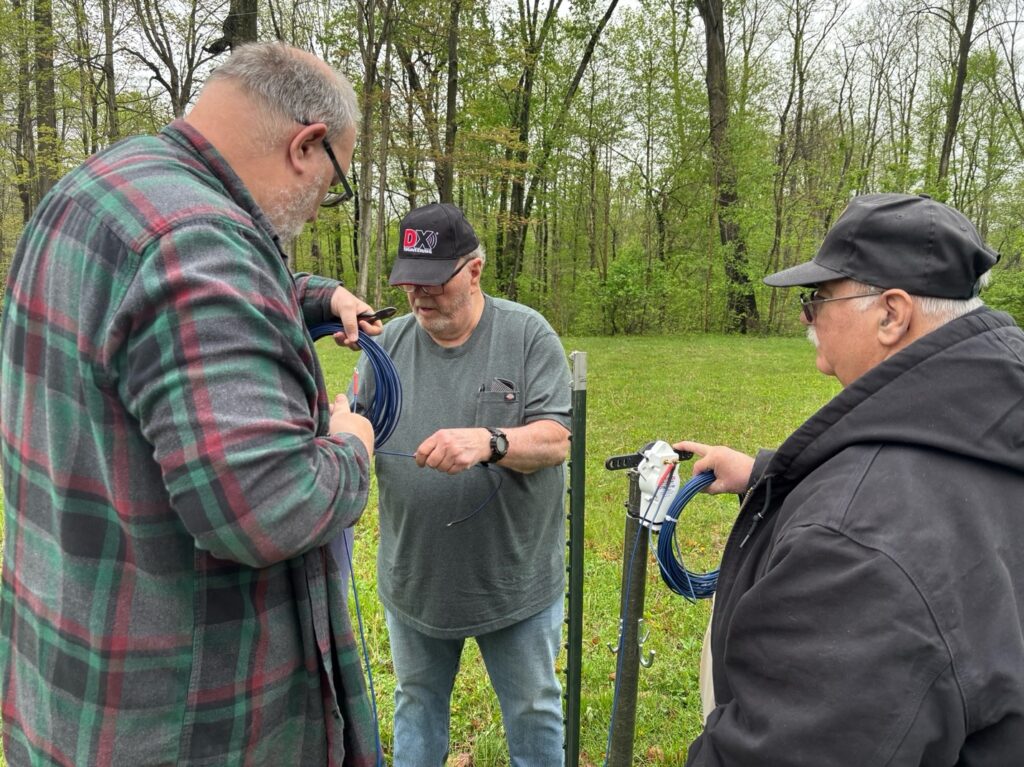
The DX Engineering antenna was a kit, so it took longer to erect. But being a kit, there was much opportunity for discussion and education. I will say this: If you are considering this antenna, just account for the sheer size of the footprint it has on the ground, especially the 80M dipole portion. I would say lay out an area 150 feet by 150 feet.
Being two resonant dipole antennas on one mast at 90 degrees to each other, it is very efficient. But you have to be willing to take the time to properly tune it. This is the part very few people enjoy, but it will provide you with years of enjoyment if you don’t take shortcuts. An antenna analyzer like the RigExpert STICK-PRO makes it much easier to tune the elements.
When it was all said and done, the DX Engineering antenna was erected and tuned. After lunch, final tuning was done and it was ready for use. Another nice feature of this antenna is that if your state’s EmComm plan is for, let’s say, 40 and 20M, you just tune the two dipoles for those bands. This is a great- performing antenna for making contacts all over the Midwest and beyond. Win number two!
When you start learning about antenna theory, antenna building can become addicting. I encourage you to start experimenting with building your own antennas. Wire antennas are extremely inexpensive to build, and you can learn a ton.
Until next time, 73 de AC8OW.
The post Ohio NVIS Day 2026: A Tale of Two Different but Effective Antennas appeared first on OnAllBands.
OnAllBands