Most of us are aware of the challenges when trying to explain our hobby to non-ham friends and acquaintances. Should we call it a public service hobby? An electronics hobby? A social hobby?
Explaining that amateur radio is “all of the above” options plus a few more can also be a challenge. At some point, the best choice seems to be just brushing off ham radio as a “nerd” hobby and seeing the confused stares from your audience quickly subside.
This option, however, doesn’t help solve the problem of the ham community getting smaller and the mean age getting older, especially when those opting not to explain it represent the younger segment of the hobby.
How we explain and talk about amateur radio matters if we want the hobby to continue to thrive.
Like many hams, I have been guilty of brushing off questions regarding what amateur radio is or providing an incomplete answer. But after a few years of practice (attending a small public high school as an involved amateur radio operator has provided this opportunity), I’ve been able to improve how I answer the question, “What is it that you post about on Instagram all the time?” without saying, “Oh…just one of my hobbies.”
An effective tactic for answering this question is stripping down the hobby to its most basic activity: talking to people. You can also put this into specific contexts. For example, “Talking to people by using satellites” or “Talking to people around the world,” which can help provide a good transition into what exactly you do with the hobby as well.
It can also be helpful to tailor your description to topics in which your friend is knowledgeable and has an interest. Since an explanation of amateur radio may be hard to comprehend for someone who isn’t involved in technical activities or doesn’t know much (if any) amateur radio jargon, explaining it in terms of what they’re already familiar with can be useful.
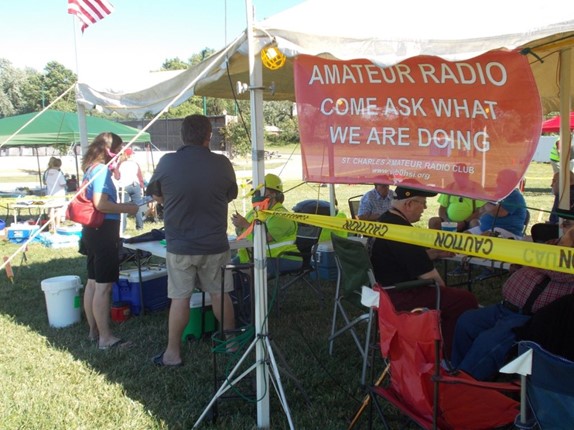
Another approach—when possible—is to simply let them experience amateur radio rather than trying to explain it. The concept of talking to a bunch of strangers using very technical-looking equipment can seem completely absurd to many, particularly the younger generations (despite the fact that is essentially what we do with our phones). Having the opportunity to show people exactly what it means when we say we’re “talking to people on the air” can make it a little less intimidating and seem a lot less crazy. This is also helpful for explaining aspects of the hobby that may not be as obvious or well understood by the public (e.g., satellites, digital modes, and fox hunting).

If you’ve gotten past the point of simply explaining to a friend what the hobby is but still aren’t sure how to actually discuss it with them, this can also be a challenge. We naturally want to share our hobbies and things we enjoy with our friends, family, and acquaintances, but it’s not always enjoyable to talk about these things when you need to explain every other word you use.
For the majority of my time in high school, my friends’ reactions to my amateur radio stories were either, “Oh, your nerd hobby again” or telling me afterward they hadn’t understood any of it, but it sounded great. So, I’m familiar with the challenges of trying to share your enjoyment of ham radio with people who don’t understand it. I’ve found the best solution to this problem is telling the story without any amateur-radio-specific vocabulary and relating it to topics your audience is already familiar with. While it can sometimes be nice to share parts of our hobby with our non-ham friends, it can be more fulfilling to expand our circle of ham acquaintances and share there instead.
That’s not to say we should avoid talking about the hobby with non-amateur radio operators. We should, in fact, do the opposite. Talking about ham radio is one of the most common ways for non-operators to become interested in it, and while it can be frustrating sometimes, it’s well worth the effort.
My high school recently hosted an exam session, and a significant portion of my classmates earned their Technician license. As a result of hams talking about the hobby, 14% of my graduating class are now licensed amateur radio operators. Talking to non-hams about amateur radio can have a huge impact and may even inspire your friends and acquaintances to get their licenses as well.
The post Youth Insights: Tips on Explaining Amateur Radio to Your Non-Ham Friends appeared first on OnAllBands.