As one becomes involved with amateur radio, it becomes apparent that “community” and “support” are two of the most important values of the hobby. These are closely followed by teaching and learning. With these being the key values of amateur radio, it’s only natural that various organizations within the hobby offer scholarships to young hams pursuing higher education.
With scholarships ranging from $500 to $25,000, the generosity of amateur radio clubs and groups is virtually unmatched by any other hobby. Providing scholarships seems to be the perfect way to give back to the community.
If you’re a young ham heading to college soon, or even just considering it, looking into the various scholarships in the amateur radio community is well worth your time. Just meeting the first requirement— having an amateur radio license—narrows the pool of applicants immensely. This gives you a better chance of being selected for an amateur radio scholarship compared to the random scholarships that you find on websites where thousands of your peers are applying!
Many of the amateur radio scholarships have further requirements beyond being licensed. For example, the YLRL (Young Ladies Radio League) offers two scholarships for female amateur radio operators who are pursuing a four-year degree, and one for female amateur radio operators pursuing a two-year degree. Read more about YLRL scholarships here.
Fortunately, the application process for almost all amateur radio scholarships is incredibly streamlined. The vast majority of scholarships offered for amateur radio use a common application facilitated by the ARRL Foundation and their scholarship committee—this is where all young hams should start their journey. To apply for all of the scholarships that are managed by the ARRL, you should fill out the ARRL Foundation application in the online program “Kaleidoscope.”
The first few pages of the application consist of questions about your plans for school. These are followed by questions that determine your eligibility for specific scholarships. For example:
- “Are you proficient in CW?”
- “Are you interested in/active in contesting?”
- “What class of license do you have?”
After answering these questions, you’ll have the opportunity to elaborate on your amateur radio experience, what the hobby means to you, and how you plan to incorporate it into your studies or life in college. In addition to answering these questions, you’ll be asked to submit a few letters of recommendation from people in your community and/or former/current educators. After submitting your application, you may also be invited to virtually interview for some of the larger scholarships.
While the ARRL manages the vast majority of scholarships in amateur radio, there are a few managed by clubs and organizations. For example, the YLRL scholarships mentioned above are run by the YLRL, and the application is separate from the ARRL Foundation application. To apply for the YLRL scholarship, fill out and submit the online application on their website.
The ARRL Foundation typically takes applications from fall until late December (the 2026 scholarship cycle ran from October 30, 2025, to December 30, 2025). The YLRL scholarship application for next year opens on February 1, 2027.
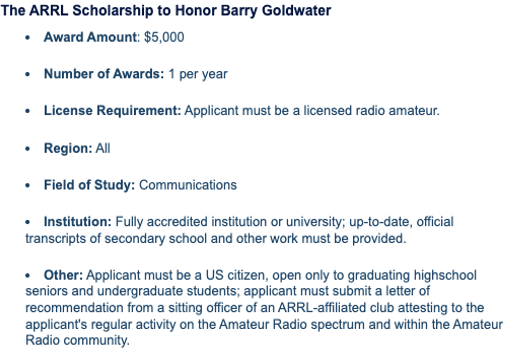
Click here for descriptions of available scholarships through the ARRL Foundation.

Here are a few tips for young hams applying for amateur radio scholarships:
- While the only “requirement” for many of them is that you have a license, the more active you are in amateur radio, the more likely you are to receive a scholarship. Get licensed, stay licensed, and get involved.
- Make sure you stay on top of deadlines and keep in touch with anyone who is also contributing to your applications (e.g., those providing recommendations). Late applications will not be accepted, and your recommenders are just as busy as you— just be sure to send a few reminders if needed.
- Ensure that you complete all parts of your application. Many require your transcript to be uploaded, and almost all require letters of recommendation.
- If you have questions or need something clarified, don’t be afraid to reach out! Sending an email to the support person is definitely worth what you could receive in scholarships—and it only takes a few minutes.
Amateur radio opens plenty of doors for those who knock. An amateur radio scholarship opportunity is another door in a sense—one backed by incredible generosity and hope for success from the groups that contribute. If you’re a young ham considering or planning on higher education, I strongly recommend that you take a look at the various scholarships that are available and apply for them.
The post A Young Hams Guide to Amateur Radio Scholarships appeared first on OnAllBands.
OnAllBands