Edge of Space Sciences (EOSS) and Intro2Space will launch a balloon with an APRS payload on April 18th. The balloon will launch from Metro State University of Denver in Colorado and carry an APRS beacon utilizing callsign AEØSS-4. In addition to the APRS playload, the balloon will carry an ADS-B beacon and sonar experiment.
Edge of Space Sciences (EOSS) formed in 1990 and has been launching high altitude balloon experiments on behalf of universities, colleges, high schools and middle schools for over 26 years.
[UPDATE] by Ren, PY8WW. The 8R/PZ5TW DXpedition, operated from Corriverton, Guyana, has now been successfully completed. During the activity, nearly 19,000 QSOs were made with stations worldwide across multiple bands and modes. All QSOs have already been uploaded to the Logbook of The World (LoTW) for confirmation. Many thanks to all stations for the contacts […]
Team consisting of LB4VE, LA8JKA, LA7HNA, LA7IPA and LB0NJ will be active from Svalbard (QTH: JW5E club station) during April 21-24, 2026. QRV on 80-10m; CW, SSB, FT8 / FT4; QSL via Club Log OQRS.
Social media has proven to be a rather controversial topic in the amateur radio community, particularly among older generations. I’ve heard remarks such as “social media is ruining ham radio” and “these kids and their social media” countless times.
I can certainly understand where these comments come from. I use some social media platforms, so I have a firsthand idea of why this has become a controversial topic today. What is missing from these negative generalizations is that everything is unhealthy without moderation, and social media is no different.
With these thoughts in mind, social media does have a place in the world today, even in an amateur radio context.
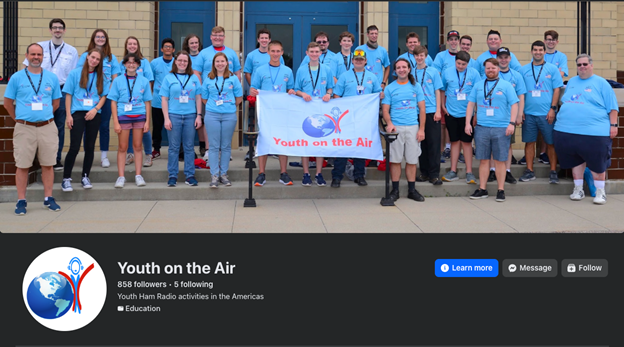
Like any other community of people, amateur radio operators have established numerous groups on social media which help to connect people despite their geographical disparities. As I mentioned, I am a social media user, and though I do not appreciate every aspect of it, I am immensely grateful for how it has connected me to the community of young (and older) hams. After following YOTA (Youth on the Air) and other amateur radio accounts when first creating a profile, I found a number of other young hams who have since become some of my closest friends. I also learned about other opportunities for youth in amateur radio.
These community groups (the list seems endless) can also be a very valuable resource. There is a group for almost any part of the hobby—contesting, satellites, Dayton Hamvention®, CW, and even segments for straight key enthusiasts, bug users, and other subtopics. There are also plenty of support groups for anyone who has questions about a specific issue. You can find many groups dedicated to clubs and organizations, where members can share opinions and advice. This makes social media a good place to speak about things you feel strongly about or feel you could help to improve.
I also recognize that arguments frequently arise in these groups. This is a valid reason to consider whether social media is really beneficial to hams, though arguments will surface regardless of the platform or setting.
The role of social media in amateur radio can also be considered a tool to bridge the gap between hams and the general public. Amateur radio is a technical, jargon-heavy hobby, which can make it challenging to share with the public without significant explanation of terms and norms. I’ve run the YOTA Americas social media accounts for a few years. When creating content to post, I consider how amateur-radio-friendly it is for non-hams and beginners since a large portion of the community that interacts with our social media pages is new to the hobby. Others are likely parents of young hams who may have little or no experience with amateur radio. By focusing on helping amateur radio become more accessible for people who are looking to get involved, social media can be a great way to spread the enjoyment and magic of the hobby.
I encourage anyone who is skeptical of social media’s role in amateur radio to consider the good it can do to help others find our hobby and let those who have already found be introduced to a community where they can find support and meet people with common interests. Communication has always been the goal of ham radio. Social media, even with its faults, opens up a door to many new methods of communication that can help us enhance the hobby for future generations of amateur radio operators.
Editor’s Note: You can check out news, videos, interviews, product announcements, technical information, and more about amateur radio from DX Engineering on Facebook and Instagram.
[NEW ACTIVITY] – Team consisting of LU1FM, LU1HF, LU2JCW, LU3FR, LU3VED, LU6FOV, LU7HN, LU8VCC and LU9FHF will again be active from Tarija (FG78pl) as CP7DX. QRV on 160-2m, incl 60m; CW, SSB & FT8; QSL via LU1FM; Participation in the CQ WPX CW Contest. [OCTOBER 29, 2025] – Argentinian team will again be active from […]
[REFRESH & AUDIO] – Operating until April 18th, Darren, VK4MAP (ex-3D2RAT, A31DJ, T2X, KH8/VK4MAP, T32K, H44DX, H40DA + other calls) is active from Liquica District, on the outskirts of Dili, Timor-Leste as 4W6DA. He also plans to QRV from Atauro Islad, OC-232 as 4W6DA/P during his stay. Operating mainly on 10m SSB, he will also […]
[UPDATE] by XQ7IR. Finally more cargo than expected is ready to be shipped to Robinson Crusoe Island. That’s because I’ve added some monoband yagi antennas and a dual-band cubical quad antenna for 12 & 17m, along with a long list of radio gear. Everything is prepared to be sent to the city port of Valparaíso […]
The Linton News is reporting that ITU Corporation has acquired the Cushcraft and Hy-gain brands from MFJ Enterprises. ITU will move manufacturing from Mississippi to a recently purchased facility in Linton, Indiana and will bring 50 new jobs to the area.
I am thrilled to pass the torch of these legendary antenna brands to Dave & Kambi Carpenter and their team at ITU Corporation. —Martin F. Jue, MFJ President
[DX NEWS INFO] – Good news! Team S21DX have plans to carry out this IOTA DXpedition in November this year after it was postponed late last year. See their website for full details. — DX-WORLD is the official media partner for S21DX. [DECEMBER 11, 2025] – We regret to inform you that our planned S21DX […]
Over the past few years, FT8 has become very popular. How popular? To the point that if I ask a recently licensed ham if they operate on digital modes, the response is often, “You mean FT8?” The popularity has almost made FT8 and digital modes synonymous. No doubt, FT8 is great for simple contact-making or contesting.
Today I’m going to discuss some different digital modes that serve a deeper purpose than making contacts. We’ll look at ways to pass messages, forms, and other data back and forth beyond simply a signal report. Don’t get me wrong, you could put a message in the text fields of FT8 and pass other messages, but it is not a common practice.
In the event of a cell phone or widespread communication system failure, we like to brag that ham radio still works. And that is true, but do you know how to pass messages and traffic in both voice and digital? There is a system for that, and you need to be familiar with it if you expect to be able to use it in a real-world emergency.
The first software I use is Winlink Express. Winlink Express is “Global Radio Email®.” I can use it to send and receive email over an RF protocol rather than via the internet. It truly works in an infrastructure-free environment.
(Image/Winlink Express)
When properly installed and set up, email and predefined EmComm forms can be sent and received through VHF/UHF/HF gateways around the globe. If my local gateway is down, I simply search for available gateways around the world. This is all done via RF through the Winlink Express program.
The Winlink Express program interface looks like many other email interfaces with an inbox, outbox, sent items, and so on. You can even attach documents to your email. For all intents and purposes, it is exactly what you would expect from an internet-based email client.
Additionally, you can have what they call peer-to-peer communications. This is like an RF-based chat client. You connect to another station through one of the gateways and send “Instant Messages” back and forth. Keep in mind, it is still amateur radio, so there is no privacy or encryption.
In addition to the Winlink Express program, you will need a modem. This can be a software modem such as VARA or a hardware modem such as the PX DRAGON. Although the hardware modems are considerably more expensive, they are exponentially faster.
Most modern transceivers have a built-in soundcard that will connect to the PC via a simple USB printer cable. If you use a transceiver without a built-in soundcard, you will need an interface device like the Digirig Mobile and appropriate cables.
Winlink Express is a great tool. Plus, you can get it up and running with little to no money out of pocket. I would encourage you—if you are interested in bad-day communications—to consider adding Winlink Express to your toolbox.
We’ll be taking a look at FL Digi in a future post.