Yuri, RI1ANY is now QRV via QO-100 satellite from Novolazarevskaya Station (JB59vf). After some test SSB contacts, today he operated FT8 and FT4 modes. He does not speak fluent English nor he has pileup experience, so please be patient. He is assigned to this base for a full year, so there will be plenty of […]
Author: NA4DA
-
ARRL Announces Change in Central Division Leadership
Brent Walls, N9BA, has resigned as Central Division Director of ARRL The National Association for Amateur Radio®, citing professional and personal commitments. He served as Director since 2025, and before that as Vice Director beginning in 2021.
“Serving in the capacity of Division Director has been a truly rewarding experience and the highlight of my amateur radio journey,” said Walls in a mess…
-
Ham Radio History: How RTTY Became the First Mainstream Digital Data Mode
Radio Teletype (RTTY) became a popular digital mode in amateur radio through a mix of postwar circumstances, technical curiosity, and a group of operators who looked at a 180-pound machine and thought, “This would look cool in my radio room.” Its growth reflects both the experimental spirit of ham radio and the fact that, sometimes, if it makes noise, prints letters, and connects to a transmitter, hams will find a way to make it communicate with the world.
History of RTTY, Part 1
The origins of RTTY can be traced back to the late 19th and early 20th centuries with the invention of teleprinters, also known as teletypewriters. These machines sent typed text over wires using electrical signals encoded in standardized formats, such as the Baudot code. By the 1920s and 1930s, teleprinters were already well established in wireline communications, particularly for news agencies, government operations, and business.
However, early experiments in transmitting teleprinter signals over radio faced several challenges. Noisy radio frequencies were prone to interference, making reliable transmission of digital signals difficult. But soon, engineers discovered that frequency-shift keying (FSK)—a method where two distinct tones represent binary states—was particularly robust against noise. Instead of transmitting simple on/off signals (as in Morse code), RTTY used two tones to represent “mark” and “space,” corresponding to binary 1s and 0s. This made the system far more reliable over long distances and under poor propagation conditions.
But the real breakthrough for RTTY came during World War II. The military needed secure, fast, and reliable communication methods that could operate over long distances without relying on physical infrastructure. RTTY met this need perfectly; it allowed typed messages to be sent quickly and automatically, reducing human error. Also, RTTY systems could be encrypted, adding a layer of security that voice communications often lacked.
RTTY for Hams
The story really picks up after World War II. During the war, governments produced massive amounts of teleprinter equipment for communication networks. When peace returned, much of this gear was declared surplus and sold at a low price. Never ones to ignore a good deal, amateur radio operators quickly scooped them up. Teleprinters, which had once been the size of a small refrigerator and about as quiet as an impact drill, suddenly became accessible to everyday hams.
At the same time, hams were ready for something new. Morse code (CW) had been the backbone of amateur radio for decades, and voice communication was becoming more widespread. But both required real-time listening and interpretation. RTTY offered something different: you could type a message, hit a key, and it would magically appear on someone else’s machine miles—or even continents—away. It was like texting, but with a very heavy phone.
In the late 1940s and 1950s, small groups of enthusiasts began experimenting with RTTY on amateur bands. These early adopters shared tips, schematics, and war stories (sometimes literally) through newsletters and radio clubs. A community formed and they standardized operating practices, including a 170 Hz shift and a baud rate of 45.45 for 60 WPM machines.
Watch this video of the Teletype Model 26 KSR (Keyboard Send-Receive) at the Museum of Communications in Seattle, Washington:
The technical challenge of RTTY also made it irresistible. Amateur radio operators love tinkering, and RTTY gave them plenty to tinker with. Operators had to figure out how to generate and decode frequency-shift keyed signals, interface mechanical devices with electronic circuits, and keep everything synchronized. It was equal parts engineering project and MacGyver-type improvisation. If something broke, you didn’t call tech support; you grabbed a screwdriver and hoped for the best.
One of RTTY’s biggest advantages was its reliability. Voice signals could fade, distort, or disappear entirely under poor conditions, leaving operators repeating “Say again?” RTTY, on the other hand, used distinct tones that could often be decoded even under less-than-ideal conditions. As long as the signal made it through in some form, there was a good chance the message would print correctly. This made RTTY especially popular for long-distance (DX) communication. It turns out that when you’re trying to talk to someone halfway around the world, having your message arrive as readable text instead of static is a big plus.
The evolution of technology in the 1960s and 1970s also contributed to RTTY’s continued growth. While early systems relied on mechanical teleprinters, later developments introduced electronic terminals and more compact equipment. Solid-state electronics made RTTY setups more reliable and easier to maintain. The introduction of personal computers in the late 20th century further transformed RTTY operations. Software could emulate teleprinters, generate tones, and decode signals, eliminating the need for large machines. This made RTTY accessible to a much wider audience.
RTTY also changed the social dynamic of ham radio. Because communication was typed, it became more structured and less dependent on quick thinking or smooth talking. You didn’t need a great speaking voice or perfect timing—you just needed to type. It also helped bridge language barriers, since written text is often easier to interpret than spoken words accompanied by QRM. However, it also introduced a new problem: the occasional operator who typed…very…slowly…while everyone else waited.
Contesting played a major role in RTTY’s popularity. Ham radio contests are events where operators try to make as many contacts as possible, and RTTY turned out to be a perfect solution. Standardized messages could be sent quickly and accurately, enabling high-speed operation. Dedicated RTTY contests began to appear, drawing participants from around the world. For many operators, the appeal was simple: more contacts, less shouting into a microphone, and fewer chances to accidentally say something embarrassing on the air.
RTTY or Not
RTTY’s limitations eventually became apparent. It used a relatively wide bandwidth, was a bit inefficient, and lacked advanced error correction. As digital signal processing and personal computers became more accessible in the late 20th century, newer modes began to outperform RTTY. However, by that time, RTTY had already secured its place in history as the first widely adopted digital radio communication mode.
More efficient digital modes like FT8, PSK31, and JS8Call began to appear, offering better performance. Modern modes can operate at or below the noise floor, but RTTY requires a relatively strong, clear signal. As for bandwidth, PSK31 uses only 31 Hz, while RTTY typically uses 170 Hz or more, making newer modes far more spectrum-efficient. The new digital modes use computer soundcards and software such as WSJT-X or Fldigi, eliminating the need for old mechanical teletype machines or dedicated hardware TNCs. While RTTY is still used in contests, modern digital alternatives are more popular for weak-signal work, keyboard-to-keyboard ragchews, and quick data exchanges
Despite digital improvements, the charm of the original machines never fully disappeared. Some enthusiasts still enjoy restoring and operating vintage teleprinters, partly for nostalgia and partly because nothing says “I love RTTY” like maintaining a device that sounds like a slow-firing machine gun, punctuated by bells.
RTTY Nitty-Gritty
Ultimately, RTTY became the first mainstream digital data mode due to a convergence of factors: the availability of teleprinter technology, the development of robust transmission methods such as frequency-shift keying, wartime communication demands, and the ease of adaptation to existing communications infrastructure. Its widespread use in military, commercial, and amateur radio applications established it as a foundation in the evolution of digital communications. Consider it the “grandfather” of modern digital modes in ham radio.
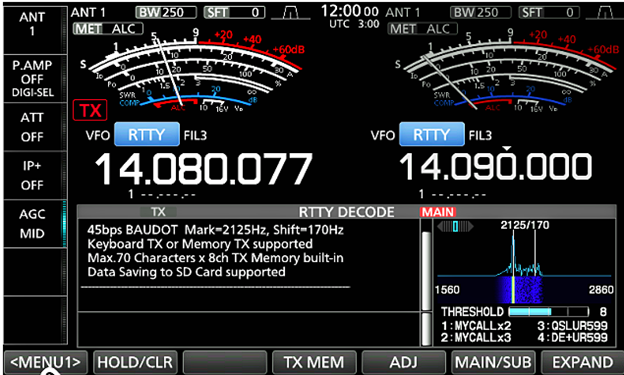
Even today, in an age of advanced digital modes and lightning-fast communication, RTTY remains in use. Most modern transceivers, like the Icom IC-7610, even have a built-in RTTY mode. It may no longer be the newest or most efficient option, but it holds a special place in the history of amateur radio. After all, it was one of the first steps into the digital world—and it did it with style, noise, and a lot of moving parts.

(Image/Icom) The IC-7610 has built-in RTTY decoders and encoders. Using a USB keyboard and the contents set in the RTTY TX memory, you can do basic RTTY operations without using an external device or software. (Image/Icom)
We can agree that Morse code arrived first. But as we examine the evolution of digital in amateur radio, it’s apparent that digital data modes such as PSK31, FT8, JS8Call, Packet Radio, and Olivia have their roots in RTTY rather than CW. RTTY is the bridge between the past and present of digital radio.
Want to learn more about RTTY basics?
Check this OnAllBands article written by Ed Muns, W0YK, “Getting Started in RTTY.”
The post Ham Radio History: How RTTY Became the First Mainstream Digital Data Mode appeared first on OnAllBands.
-
VK9BSA & VK9DEE – Cocos (Keeling) Islands
[VK9BSA QRV] – Mark, VK6BSA and Deena, VK6DEE are now based on Cocos (Keeling) Islands for a work assignment until May, possibly longer. During free time they will QRV as VK9BSA and VK9DEE on most bands using a FTDX-10 & amplifier.
-
Z66SP – Republic of Kosovo
[UPDATE] – by Maciek SP2RBA. Preparations are in full swing. We do not know what the propagation conditions will be like, but we will do our very best to make sure we are heard on CW, SSB, and FT8. Antennas are prepared for various operating scenarios. Hope to hear you soon. Website can be found […]
-
TJ1GD/P – Mondoleh Island, AF-095 – Cameroon
[UPDATE] – by Darek, TJ1GD/P. I am pleased to announce that Dragan, KØAP has generously stepped forward as the QSL Sponsor for my activation of AF-095. Thanks to Dragan’s support, high-quality QSL cards will be available to confirm our contacts. They can be received the same way as my other activations – SASE through SP3EOL […]
-
V47EM – St Kitts
Pete, G0TLE will again be active from Calypso Bay, St Kitts as V47EM during April 11 to May 1, 2026. QRV on 80-10m; CW & SSB. QSL via OQRS or direct. No bureau cards. Livestream here.
-
DX-World Weekly Bulletin
[#658] The latest FREE NON-SUBSCRIPTION DX-World Weekly Bulletin written by Bjorn ON9CFG is available to download. Click below to get the newest jam-packed edition which this week runs to 15 pages. Previous bulletins can all be found here. Please contact Bjorn with any updates or errors. DOWNLOAD THE LATEST BULLETIN =====