John, AE5X lets us know that he will be active from Albania as ZA/AE5X during October 8-30, 2026 (possibly longer). Holiday-style activity with POTA sites taking a priority. John also mentions he plans to operate from the old Radio Tirana transmitter site, which is now abandoned, and located near Shijak. Operation will be CW only […] This post appeared first on: DX-World Want to know more about it? Read More
Author: Source Author
-
DX-World Weekly Bulletin
[#677] The latest FREE NON-SUBSCRIPTION DX-World Weekly Bulletin written by Bjorn ON9CFG is available to download. Click below to get the newest edition which this week runs to 17 pages. Previous bulletins can all be found here. Please contact Bjorn with any updates or errors. DOWNLOAD THE LATEST BULLETIN ===== This post appeared first on: DX-World Want to know more about it? Read More
-
Guide to Amateur Radio Amplifiers 2026 Part 5: RM Italy
In Part 5 in our series on amplifiers available at DX Engineering, OnAllBands is featuring products from RM Italy—a company that has been manufacturing world-class amateur radio equipment since 1974. Based in Porretta Terme, Italy, the company produces a range of finely engineered, proven amplifiers for amateur radio enthusiasts around the globe.
Before we can get to RM Italy, check out these posts covering other amplifiers we’ve showcased:
Also, read “I’ve Got the Power. What Else Do I Need?” for insights into other upgrades you’ll need to consider when adding a high-power amplifier to your station.
***
Here are some of the RM Italy amplifiers you’ll find at DX Engineering.com:
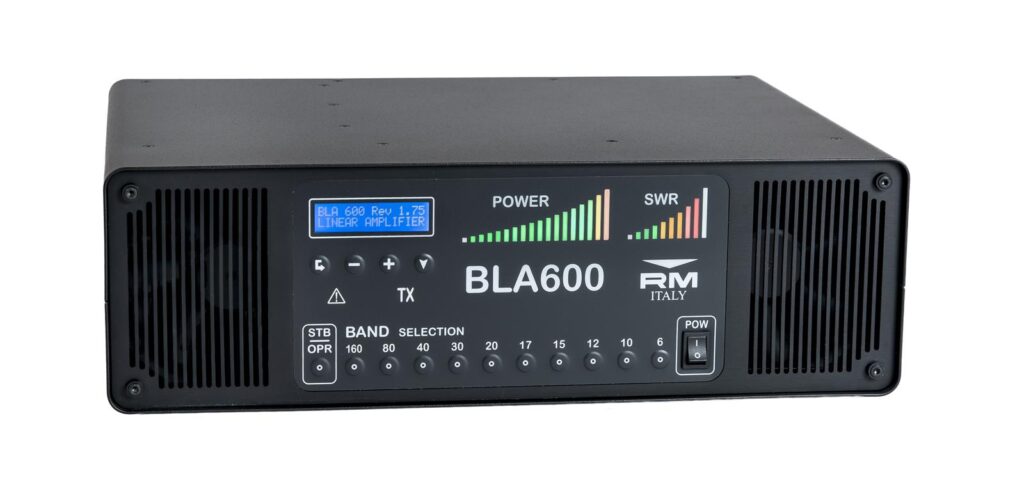
BLA600 Solid State Amplifier
This wideband, compact, automatic linear amplifier for 160 through 6 meters offers low input drive requirements (20 to 25W on 80-10 meters, 30 to 40W for 500W on 160M and 6M) and a host of other benefits. We’ll let James, a DX Engineering customer, explain further in his five-star review:
“First, the BLA600 is perhaps the simplest amp to put in service of any I’ve ever used, and there have been several in my ham radio lifetime. Literally all that is involved is to connect the keying line and output from your transceiver, connect the output to a resonant antenna, and you are ready to go live. Band switching in the amp is fully automatic.
“I’m getting a full 500-watt output on 75, 20, 17, and 10 meters with just 20 watts of drive. I’ve yet to try it on any other bands, but plan to test with 6-meter FT8 in the next few days. That said, the instructions for setup are clear and concise. If you read them before connecting things up (and you should do that), make certain your antenna has a low SWR, and keep the exciter drive at recommended levels. Your experience with this amplifier should be very good.”
Key features include:
- Weighing in at 47.4 lbs., this fully automatic 500W solid-state linear amplifier is suitable for seamless integration with all modern transceivers. It utilizes the rugged NXP/Freescale MRF6VP5600H 50V power MOSFET for high power and reliability.
- The BLA600 is capable of all modern modulation modes. It’s fully automatic, featuring instant RF frequency-reading for band changes and fast, reliable, and silent PIN diode TX-RX switching. This makes it ideal for CW QSK operation. A separately purchased transceiver to amplifier PTT keying cable is required.
- The amplifier has three antenna outputs that are easily configurable on a per-band basis.
- The amplifier’s RF deck has a large heat spreader and copper heat sink which provides an efficient cooling system. There are separate fans for the RF deck and LPF board/power supply for high-duty-cycle operation. Internally, all modules are mounted in a robust enclosure.
The BLA600 features a dual MCU control and an extensive array of protection circuits that look after the amplifier with rapid reaction time.

(Image/RM Italy) MLA-400V HF Amplifier
This amplifier covers 160 through 10 meters, providing up to 400 watts output on HF with only 35 watts maximum input. It’s a good choice for operators who want to bump their 100-watt radio to a higher power level. Featuring four Toshiba 2SC2879 arranged in a parallel push-pull configuration, the MLA-400 provides clean Class AB power output.
Low-pass filters with frequencies of 3, 4, 5, 8, 15, 22, and 31 MHz reduce unwanted harmonic output and may be selected automatically or manually. An onboard microprocessor controls all aspects of the amplifier including its various protection circuits. Protection is provided for excessive input power, excessive output power, excessive load SWR, out-of-band operation, and high temperatures.

(Image/RM Italy) BLA350 Plus HF Linear Amplifier
This amplifier is intended to be used with a low power transceiver that is capable of an RF output of approximately 10 watts maximum. The compact and fully automatic amplifier delivers up to 300 watts output when driven with less than 10 watts RF input. Internally, a dual microprocessor controls a variable speed cooling system.
On the front panel is a large, illuminated analog output power meter. Plus, the two-line 16-character LCD display shows amplifier operating parameters including frequency, filter selection, and PA temperature. This display also enhances quick navigation of the amplifier’s menu system. Appropriate operations for this amplifier are on HF antenna systems with SWR below 1.5:1.

(Image/RM Italy) Choose from these other RM Italy amplifiers at DX Engineering:
- MLA100 HF Amplifier: This unit covers 160 through 6 meters, providing up to 100 watts output on HF and 80 watts on 6 meters with only 5 watts maximum RF input. It’s a good choice for medium power operations with today’s low power (QRP) radios, including many brands of portable and SDR transceivers. This amplifier is intended to be used with a QRP transceiver that is capable of an RF output of approximately 5 watts maximum.

(Image/RM Italy) - MLA300 HF Linear Amplifier: This broadband linear amplifier is designed for operation from 160-10 meters, delivering up to 300 watts of average output power.

(Image/RM Italy) Also choose from RM Italy VHF and UHF amplifiers, as well as the SPS1050S Switching Power Supply.

The 50A SPS1050S switch mode AC to DC power supply features variable output voltage and is suitable for use with all electronic and telecommunication devices. It is equipped with illuminated voltmeter and ammeter, and a knob for adjusting the output voltage. (Image/RM Italy) The post Guide to Amateur Radio Amplifiers 2026 Part 5: RM Italy appeared first on OnAllBands.
OnAllBands
-
HK0/PY8WW – San Andres Island
[INFO] by Renato, PY8WW. I will be visiting San Andres Island, Colombia, from 3 to 7 September 2026, and during my free time I plan to operate as HK0/PY8WW. This will be a holiday operation, rather than a full-time DXpedition. I will be visiting the island primarily for vacation, and radio activity will take place only during available […] This post appeared first on: DX-World Want to know more about it? Read More
-

Ham Radio Youth Insights—My Visit to WRTC 2026 UK
What is the WRTC?
The WRTC (World Radiosport Team Championship) is best referred to as “The Olympics of Ham Radio.” The event takes place every four years in varying locations, and the objective is to create a level playing field for the top contesters to compete against each other to determine who is the best in the world.
The qualification period for the WRTC begins a few years before the event takes place. To qualify, hopeful competitors must take part in numerous predefined contests. By participating in these contests, they accrue points which are used to determine who attends the WRTC event as a competitor.
Once the selections of team leaders are made based on points, they select a team member to compete with them—every team competing at the WRTC is a pair. During the actual contest, the two-person teams are assigned referees who come with them to their sites and listen to their operating for the entire contest, much like a referee would watch and monitor the contestants at a sporting event. Since the objective of the WRTC is to put the top contesters on a level playing field, the contestants are provided with the exact same basic antenna setup. They must bring their own radios and other equipment, like laptops and keys.
My Road to WRTC 2026 UK
While the WRTC is a bucket list item for many contesters, it’s not very well known outside of the contesting sphere. I first learned about the WRTC in the summer of 2023 from a presentation at the YOTA camp in Ottawa. I was immediately fascinated. Before learning about the WRTC, I wasn’t involved in contesting at all. I participated in the ARRL School Club Roundups with my school’s club members and had done a few QSO parties but had never done a serious contest. It inspired me to give contesting a try. I participated in my first contest just a few weeks after learning about the WRTC– the IOTA contest that I did on the YDXA (Dave Kalter Youth DX Adventure) at K3LR. I had so much fun with this contest that I considered trying to qualify for WRTC 2026 as a competitor, but I decided that between balancing school and not having very much contesting experience under my belt, it would be best to wait.
I was still interested in the WRTC and contesting, so I started to participate in more contests and tried to learn as much about contesting as I could. I started to get to know the other hams who make up the contesting sphere in amateur radio and realized that even if I wouldn’t attend as a competitor, I would go to WRTC 2026 in England (July 8-13) to meet many of my contesting friends and see how the event was run.

(Image/WRTC 2026) As WRTC 2026 approached, I started to make plans about how I could attend. I eventually decided I wanted to volunteer to help with the event, so I joined the pre-event public relations team. I had a lot of fun bouncing ideas about how we could publicize it and improve the 2026 edition. I also decided that I wanted to help out at the event’s headquarters to get an even better idea of how the event was run and what went on behind the scenes.
I got in touch with organizing committee members to see if volunteering would be possible, and luckily it was. I excitedly agreed to help out with the event and made plans to travel there. I booked the Eurostar from Paris to London, but it ended up getting canceled a few days before I was planning to travel, so I quickly booked a flight so that I could still make it on time.
I arrived at the venue, checked into my room, and had dinner with a few acquaintances that I hadn’t seen in a while because I had been in Germany for my exchange year. After we had caught up a bit, the volunteer team got to work sorting the welcome bags for each attendee. A few hours—and a few hundred bags later—we finished up and headed to bed to get some sleep for the next day. After this first day there, it felt almost surreal for me to finally be at a WRTC. I went to bed eagerly awaiting the rest of the week.
Stay tuned to OnAllBands for details of KE8LQR’s weeklong experience at WRTC 2026 UK in Part 2 of her series. Also read her WRTC article on “How It Feels to Be a Young Ham in a Roomful of Experts.”
***
Editor’s Note: It takes an incredible volunteer effort to make the “Olympics of Ham Radio” happen. Watch volunteers build contest sites in this video from WRTC 2026 UK.
The post Ham Radio Youth Insights—My Visit to WRTC 2026 UK appeared first on OnAllBands.
OnAllBands
-
V5/HB9BFM – Namibia
Hanspeter, HB9BFM will be active from different locations in Namibia as V5/HB9BFM during August 26 to September 20, 2026. Mostly QRV from 16 – 19 UTC in Olivia 8/250 at 14072.000kHz center frequency. Sometimes 20m Varac. This post appeared first on: DX-World Want to know more about it? Read More
-

DXChrono Desktop is Now Available
The following is a press release from DXChrono:
Built by Peter Goodhall, MM9SQL, in Elgin, Scotland, it puts grey line, solar indices, live DX Cluster and PSK Reporter spots, Reverse Beacon skimmers, Summits on the Air and Parks on the Air, logging, satellites, and contest context on one full-screen 3D globe or 2D map. Special Event Station mode turns the same screen into a visitor display for club open days and field days, with event branding and a scrolling last-worked banner. Feeds can be Cloudlog or N1MM Logger+.
It runs on Windows, macOS, Linux, and Raspberry Pi 4/5. A one-time purchase of £15.00 including VAT covers a licence for up to five computers. The free web app at https://dxchrono.com/ stays free.
Buy and downloads: https://desktop.dxchrono.com/
Documentation: https://docs.desktop.dxchrono.com/Full press PDF
Source: DXChrono
Amateur Radio Daily
-
A Few Words from Rocket Machine Worx About New Color Options for Its Bulkhead Coax Connector Panels & More
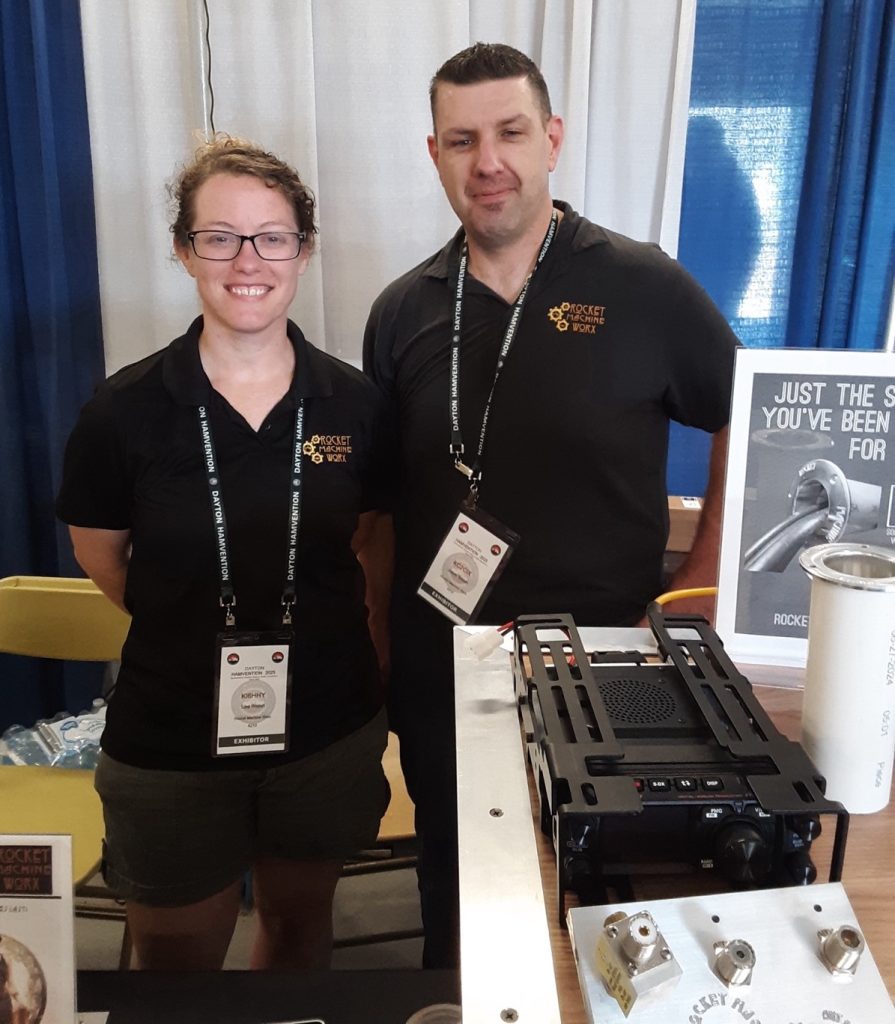
OnAllBands stopped by one of our favorite manufacturers, Rocket Machine Worx, at Dayton Hamvention® 2026 to talk with the small company that has big ideas about cable management and routing solutions for amateur radio stations.
The Millen, Georgia, amateur radio products manufacturer is operated by husband-and-wife Navy veterans and Extra class licensees Jason Welsh, KC2CIX, and Lisa Welsh, KI6HHY.

(Image/DX Engineering) 
On display at Dayton Hamvention 2026, the Rocket Machine Worx CableRing Cable Feedthrough ensures that cables are neatly routed through any surface, including floors and walls. It’s crafted from 6061-T6 aluminum for durability and a sleek finish. (Image/DX Engineering) OnAllBands spent a few minutes with Jason, KC2CIX, to talk about what’s new with the company, including the TravelPatch Coaxial Connector Panel (not available at last Hamvention) and the company’s range of bulkhead coaxial connector panels which are now available in different colors.
“We’re offering all our products in Cerakote®,” Jason said. “Cerakote, if you’re not familiar, is a baked-on ceramic finish. The advantage to that on our products is that—especially for the Window Wing kit installation—it’ll protect the backside of that against the elements for a very long time.”
Cerakote options are now available at DX Engineering for the MiniPatch and MicroPatch Bulkhead Coaxial Connector Panels. Look for more options as they become available.

Cerakote is engineered to resist wear, corrosion, and harsh environments, making it tough and long-lasting. See the tungsten MicroPatch Bulkhead Connector Panel above. Black, blue, and red options are shown below. (Image/Rocket Machine Worx) 
(Image/Rocket Machine Worx) 
(Image/Rocket Machine Worx) 
(Image/Rocket Machine Worx) 
Natural finish MicroPatch without Cerakote. (Image/Rocket Machine Worx) 
MiniPatch Bulkhead Coaxial Connector Panels at Dayton Hamvention 2026. (Image/DX Engineering) Could you tell us a little bit about some of the creative ways people are using your bulkhead coaxial connector panels?
“The MidPatch and the MiniPatch are most popular installed with the Window Wing Kit,” Jason said.

Rocket Machine Worx Window Wing Coax Feedthrough Mount Kits. (Image/DX Engineering) 
On display at Dayton Hamvention 2026 was a Rocket Machine Worx Window Wing Coax Feedthrough Mounting Kit with a Yaesu ATAS-120A Auto Active Tuning Antenna (not included in the kit). (Image/DX Engineering) “Aside from that, you can put a bracket on the 5/16-18″ holes and then mount that on your wall. We sold one of the MidPatches, which is the large six-inch square one, that’s going to get mounted on a wall because it looks cool and it’s very handy that way.
“Most creative is the TravelPatch. It really leaves everything to your imagination, your creativity, and your DIY craftsmanship to do your install.”

At 3-1/8 inches in diameter by 1/2-inch thick, the TravelPatch ensures sturdy mounting even on thin substrates. It is precision thread-milled to accept standard 5/8-24″ threaded SO-239 or N-Type bulkhead connectors. (Image/Rocket Machine Worx) “There’s an install of the TravelPatch on an RV shown on a video from The Travelin’ Ham.”
Watch the video below:
“I just sold a TravelPatch this morning that’s going to go onto a truck toolbox where the person is going to mount it on the lid. I’ve seen people mount them onto a brick wall, and they have two separate ones to separate their VHF and HF right into wall. Really, it’s left open to the imagination.”
How would you describe your company’s philosophy? What do you want to do for ham radio operators?
“For the community, I really want to provide you guys with quality stuff that’s made in America by my wife and myself in our shop. It’s CNC, engineering-level products using as many high-quality components as we can. And if the ones on the market aren’t up to our standards, then we’ll start to make them ourselves.”
Could you talk a little bit about the importance of your relationship with DX Engineering?
“DX Engineering changed our lives. Prior to this, we were doing job shop work, which is where we take a 3D model from an engineering firm and then we produce that component for them—because not everybody has the capability to machine things. That’s what our capability is. So that didn’t work out for us initially because we’re still having a daytime job. When DX Engineering picked us up, that gave us a solid foundation that really established our business. And that’s how we’re able to produce this. So, it was seriously life changing.”
Any final thoughts?
“Thank you for everybody who has went with Rocket Machine Worx to build your shop. We love you all. It means everything to us that you’re using products that I designed and that we machined in our shop.”
The post A Few Words from Rocket Machine Worx About New Color Options for Its Bulkhead Coax Connector Panels & More appeared first on OnAllBands.
OnAllBands
-
KH8WW – American Samoa
Yuris, YL2GM let’s DX-WORLD know that he and Eugene, EA5EL will be active from Aunu`u Island, American Samoa as KH8WW during September 10-24, 2026. QRV on various bands and modes. Website with full information will be available after September 1st. This post appeared first on: DX-World Want to know more about it? Read More
-

HFPilot App Estimates HF Propagation
The following is a message from HFPilot:
HFPilot is your go to app for estimating HF propagation – navigate the HF skies with confidence with an app that works offline, giving estimated frequencies and times for points around the world!
The goal of HF Pilot is to do for shortwave/HF radio what RepeaterSTART revolutionized for repeaters: Get propagation data, EVEN OFFLINE, install on your computer and know what hour to tune your radio, and connect with operators around the world.
The program is available from https://hearham.com/HFPilot. It is completely free and open source for Linux and Windows desktop, and there is also an minimal iOS and Android version available for $1.99.
Source: HFPilot
Amateur Radio Daily