One of the great frustrations of amateur radio is hearing a station loud and clear while the other operator seems completely unaware that you exist. You can hear her calling CQ; you can copy every word of the exchange with another station. But when you transmit, it’s like your signal has disappeared into a black hole.
You know your transmitter is working. Your antenna hasn’t fallen over. The SWR meter isn’t screaming mismatch. You may even be putting out several hundred watts. So why can you hear them, but they can’t hear you?
The simple answer is that radio communication is a two-way street, but radio propagation and equipment performance are not necessarily equal in both directions. Several factors can make the signal you receive much better than the signal you transmit to the other station.
Better Ears
The first possibility is your radio equipment. Modern receivers can be remarkably sensitive. Your receiver may be able to pull a weak signal out of the noise that another station cannot copy.
The same thing can happen with antennas. Maybe you’re using a directional antenna with some gain while the other operator is using a modest dipole or vertical. You may hear their signal because your antenna is doing a better job of receiving it.
Receiver noise is another factor. If your location has a relatively quiet noise floor, a weak station can sound surprisingly strong. But the other operator might be sitting under a mountain of electrical noise from power lines, computers, LED lighting, solar equipment, or some mysterious source of RFI designed to annoy radio amateurs.
From the other op’s perspective, your signal isn’t necessarily absent—it may be buried under the static.
Listening Somewhere Else
There’s also another simple explanation: You’re not transmitting where the station is listening. During a pileup, a DX station may announce “listening up five,” meaning he’s transmitting on one frequency but listening several kilohertz higher. If you continue calling on his transmit frequency, you may hear him while he never hears you.
Split operation is one of those things that seems obvious after you learn it, and somewhat mysterious before you do. It’s a simple strategy to spread out a crowd of stations, while keeping the calling frequency open—provided everyone follows the rules.
Antennas Matter
Antennas are rarely equal (even when they appear to be) because the surrounding environment significantly influences their performance. An antenna is only half a system; the environment around it is the other half. Suppose you are using a full-size dipole at 40 feet in an open rural setting, while the other operator has one like yours snaked through several trees on a city lot. His signal may arrive at your station with an S9, while your signal arrives at the other station considerably weaker.
Antenna polarization can also play a role, particularly on VHF and UHF. A vertically polarized antenna communicating with a horizontally polarized antenna can suffer significant signal loss. That’s why you see mobile commercial and safety forces using vertical antennas. You want your signal concentrated near the ground—a low takeoff angle—toward the horizon. RF energy shot upward at a high angle goes straight into space and is wasted on passing UFOs.
Propagation
We often imagine radio propagation as a simple highway connecting two stations, point A and point B. In reality, HF signals can take several different paths through the ionosphere, and the conditions along those paths can change.
It is important to make one distinction here: The propagation path itself is generally reciprocal. In other words, if a particular ionospheric path allows your signal to travel from Ohio to Europe, the same basic path may also support a signal traveling from Europe back to Ohio.
So why can one station hear the other much better? The difference is often in everything surrounding the propagation path. The two stations may have different antennas, antenna patterns, takeoff angles, polarization, and local noise levels. A signal that arrives at your antenna at S7 may arrive at the other station at only S2—or maybe at S2 but underneath an S5 noise floor. In that case, you hear him perfectly while he hears little or nothing from you.
Ionospheric conditions can make this effect even more noticeable. HF propagation can change with frequency, time of day, solar activity, season, and the location of the two stations. A path that is excellent one moment can weaken or disappear later. Different antenna radiation patterns and angles can also cause each station to take advantage of the available propagation differently.
On marginal paths, a difference of only a few decibels can determine whether a signal is copied or lost in the noise. Your receiver is measuring the signal arriving at your station; it tells you very little about the signal-to-noise ratio at the other station.
Power Can Be Misleading
Another common assumption is that if you can hear someone well, you should be able to work them at the same power. Not necessarily.
This is particularly noticeable during contests and pileups. You may hear a rare station working one contact after another, with every signal apparently booming into your shack. You call repeatedly and hear absolutely nothing in response. That doesn’t automatically mean the operator is ignoring you. He may not hear you because so many stations are calling at once.
Your transmitter might be running 100 watts, but that doesn’t guarantee a strong signal at the other end. Antenna efficiency, feedline losses, polarization, propagation, and interference all affect your signal. Conversely, a station you hear strongly might be running much more power or using a highly efficient antenna system, making power alone an unreliable measure of signal quality.
Crank up the power? Using an HF amplifier doesn’t automatically mean more or better contacts. Doubling your power output only adds a tiny increase in signal strength. Going from 100 watts to 200 watts is a half S-unit change, or 3 dB, something the other operator may barely notice. Or
in some cases, it could be just enough to rise above the noise.
Don’t immediately assume that more power is always the answer. Improving the antenna is the least expensive option and can produce a better signal. Reducing feedline losses or finding a better operating location can often do more than simply adding an amplifier.
Location Makes a Difference
Your physical location can greatly affect both transmitting and receiving. On HF, your location can influence ground losses, antenna performance, and local noise levels. Buildings, terrain, and trees can all affect the radio environment and your success making contacts.
My winter operating location in Arizona was located at about 575 feet above sea level, surrounded by mountains. Even with a 500-watt amplifier and a dipole 42 feet above ground, making QSOs could sometimes be challenging. But move a station near those 1,500-foot mountaintops with a similar antenna installation, and it’s a totally different situation.
In radio, a few hundred feet of elevation can be worth a lot more than a few hundred watts of wishful thinking. A hill standing between two stations can make the difference between a poor and successful contact. Unfortunately, your signal doesn’t get to vote on where the hill goes.
What Can You Do?
If you repeatedly hear stations that cannot hear you, start with the basics. Check your antenna connections, feedline, SWR, power output, microphone settings, and operating frequency. Make sure your antenna is appropriate for the band and that you’re actually using the right one.
If possible, ask a nearby ham to listen for your signal. A local radio check can quickly tell you whether the problem is your transmitter or the propagation path. This is also a good time to adjust your microphone level, compression, and equalization for best audio.
Remember, amateur radio isn’t always fair when it comes to QSOs. One station can boom into your receiver while your signal struggles to get through. Sometimes it’s equipment, sometimes antennas, sometimes propagation, and occasionally it’s because the other operator is listening several kilohertz away while you’re enthusiastically calling on the wrong frequency.
In other words, hearing someone is only half of the equation. Making a successful contact requires both stations to hear—and be heard.
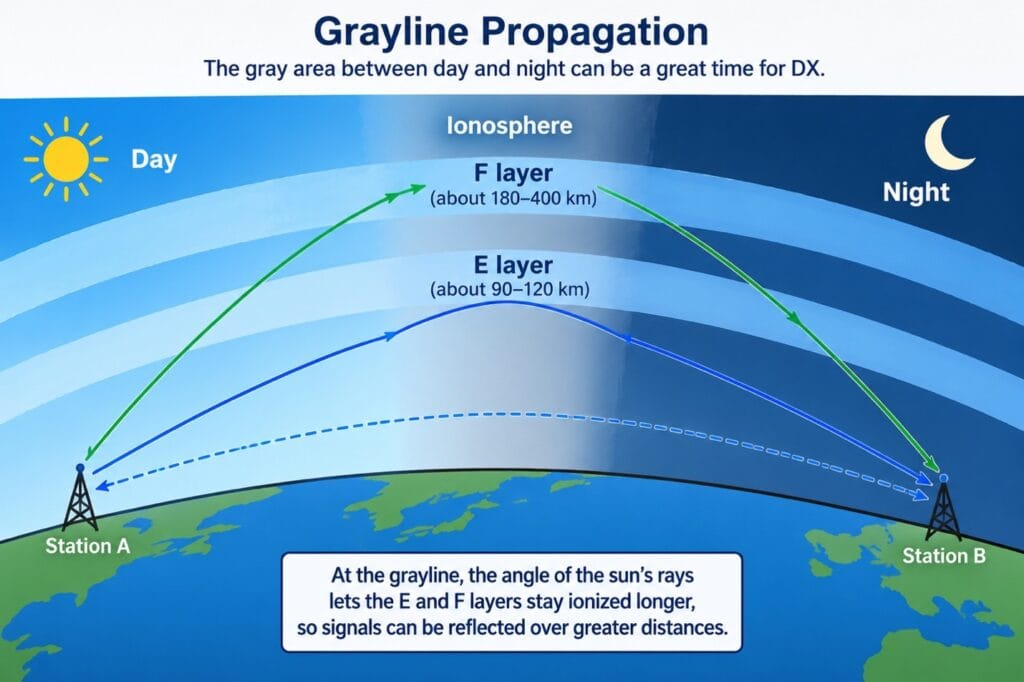
Shades of Grayline
Suffering from the propagation blues? Hop on the gray line.
Bands below 30 meters are perfect for exploring gray line propagation and making exciting DX contacts. In radio terms, the gray line is a narrow corridor of enhanced propagation. When your QTH is in the gray line, and your target station is also in the gray line—boom! The ionosphere enters a cooperative state, allowing long-distance communication with remarkably low power and minimal QRM.

However, this is a limited-time offer, lasting 15-30 minutes: once at dawn and once at dusk. It’s not guaranteed to diagnose, treat, cure, or prevent any weak signals.
For more details, see “Gray Line: The Twilight Zone of Radio Propagation” published in OnAllBands, July 2025.
The post Ham Radio 101: Why You Hear Stations That Don’t Hear You appeared first on OnAllBands.
OnAllBands