High-altitude ballooning (HAB) has long provided amateur radio experimenters with an accessible platform for testing airborne repeaters, long-range telemetry systems, and experimental communications payloads. Through successive flight campaigns, the Iowa State University Campus Amateur Radio Club (W0ISU), working alongside the High Altitude Balloon Experiments in Technology (HABET) team within Iowa State’s Make to Innovate (M:2:I) program, has progressively advanced its airborne communications capabilities through several generations of increasingly sophisticated payload architectures.
Attaching amateur radio equipment to high-altitude balloons is hardly a new concept. Hundreds of amateur radio operators have launched WSPR (Weak Signal Propagation Reporter) and APRS (Automatic Packet Reporting System) transmitters to support balloon tracking, propagation research, and environmental monitoring. However, incorporating FM and, more recently linear transponders, into these payloads opens an entirely different set of possibilities. Rather than simply transmitting telemetry or providing a conventional repeater, these systems effectively transform a balloon into what I like to call a “poor man’s amateur radio satellite.”
Much like the satellites operated by AMSAT, a balloon-borne transponder can facilitate communications between stations separated by hundreds of miles. The primary advantage is altitude. High-altitude balloons routinely reach elevations exceeding 120,000 feet, nearly three times the cruising altitude of a commercial airliner. At these elevations, the radio horizon expands dramatically, potentially providing line-of-sight coverage across hundreds of thousands of square miles. At approximately 100,000 feet, for example, the theoretical geometric horizon extends roughly 390 miles in every direction, corresponding to a coverage footprint of nearly 480,000 square miles.
The first experiments conducted by W0ISU in March 2024 relied on a relatively simple 2-meter simplex store-and-forward voice repeater. Although straightforward in concept, actual flight operations quickly revealed several limitations. Ground stations frequently encountered “doubling,” where multiple operators transmitted simultaneously over recorded playbacks or competing signals. Without a mechanism for managing simultaneous transmissions, completing orderly contacts became increasingly difficult as participation grew.


To address these shortcomings, W0ISU transitioned to dual-band FM crossband repeaters, which were flown on two separate missions. These systems were intentionally designed to remain inexpensive and relatively simple to integrate into the existing HABET payload architecture. Each consisted of two Baofeng UV-5R handheld transceivers, one operating on 2 meters and the other on 70 centimeters, interconnected through a commercially available repeater controller. The system received signals on 70 centimeters and retransmitted them on 2 meters. A dual-band handheld antenna, connected through a diplexer, provided the necessary antenna configuration for simultaneous reception and transmission.

The resulting system provided real-time, full-duplex communications across a multi-state coverage footprint, operating much like a conventional amateur radio FM satellite. Dozens of operators successfully accessed the repeater, with contacts extending from Ames, Iowa, to Indianapolis, Indiana, and Sioux Falls, South Dakota. Perhaps most surprisingly, the inexpensive Baofeng transceivers continued operating throughout the flights despite external temperatures that could fall below -70°F.
Despite the success of these experiments, conventional FM repeaters still presented an important limitation: the FM capture effect. When multiple stations transmitted simultaneously, the receiver generally favored the stronger signal, making it difficult for several operators to communicate through the system at once. I wanted to take the project a step further by developing a linear transponder capable of supporting multiple simultaneous conversations across a shared passband.
That opportunity came in May 2025, when I attended my first Dayton Hamvention®. Among the various presentations and demonstrations at the high-altitude balloon forum, one presentation particularly caught my attention. Carl Lyster, WA4ADG, discussed several linear transponders he had designed and constructed over the preceding years. He even played a recording demonstrating one of his systems in operation on a balloon.

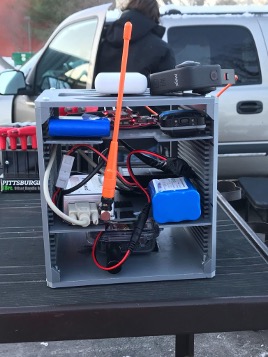
Following the presentation, I approached Carl to discuss the possibility of developing a similar system for W0ISU. After exchanging contact information, we began discussing the technical requirements and potential architecture for a balloon-borne linear transponder. Over the following months, Carl designed and assembled a compact, approximately six-inch-cube payload resembling a miniature CubeSat.
The resulting transponder featured a 10-meter uplink spanning 28.345–28.355 MHz and a 2-meter downlink spanning 144.345–144.355 MHz. Its antenna system consisted of a quarter-wave vertical radiator with four radials for the 2-meter transmitter and a long-wire vertical antenna for the 10-meter receiver. Power was supplied by eight AA lithium-ion (Li-ion) batteries. The original launch was scheduled for November 2025, but unfavorable weather, Thanksgiving break, and end-of-semester examinations ultimately delayed the flight.

Mission Overview & Technical Architecture
On May 2, 2026, at approximately 1300 UTC, the W0ISU/HABET team successfully launched the linear transponder from Ames. The mission carried a 10 kHz-wide, non-inverting linear transponder aboard a high-altitude balloon that ultimately reached an altitude exceeding 120,000 feet. An onboard digital telemetry beacon, operating on 432.300 MHz using the Horus Binary v2 protocol, transmitted the balloon’s GPS coordinates and altitude once per second. This continuous stream of telemetry allowed amateur radio operators across the Midwest to monitor the balloon’s trajectory and orient their directional antennas toward its approximate position throughout the flight.

Functioning much like a temporary communications satellite suspended in the stratosphere, the payload received signals on the 10-meter amateur radio band and retransmitted them in real time on 2 meters. Unlike a conventional repeater, which receives and retransmits a single FM signal, the linear transponder preserved the incoming modulation and allowed multiple stations to operate simultaneously across its available passband.
An important characteristic of the system was its non-inverting architecture. The frequency translation preserved the original sideband orientation, meaning an upper-sideband (USB) signal received on 10 meters appeared as an upper-sideband signal on 2 meters. This differs from the inverting transponder architecture commonly encountered on many amateur radio satellites, where the relationship between uplink and downlink sidebands is reversed.
Antenna design prioritized lightweight construction, mechanical simplicity, and broad azimuthal coverage. Both the 10-meter receiving antenna and 2-meter transmitting antenna utilized vertically polarized wire radiators suspended along the balloon’s flight train. The transponder provided approximately 1 watt of RF output power, which, combined with the balloon’s considerable operating altitude, enabled communications across a substantial portion of the Midwest.
Throughout the approximately two-hour flight, dozens of amateur radio operators across the Midwest successfully accessed the transponder, completing contacts over distances of hundreds of miles for as long as the balloon remained within their respective radio horizons. Operating activity peaked near the balloon’s apogee, its maximum altitude, when the expanded line-of-sight footprint provided the greatest opportunity for long-distance communications.
Particularly impressive was the transponder’s sensitivity: Operators, including members of the W0ISU club, were able to access the system using as little as 1 watt of uplink power through a simple dipole antenna. This demonstrated the effectiveness of the onboard receiver and showed that successful operation did not require expensive amplifiers or elaborate antenna systems.
Another unexpected advantage was the accessibility of the operating configuration. Amateur radio operators with relatively modest HF equipment capable of SSB operation could transmit through the transponder while using an inexpensive SDR receiver to monitor the 2-meter downlink, eliminating the need for a dedicated all-mode VHF transceiver or complicated satellite station setup. Beyond brief signal exchanges, some operators even took advantage of the relatively open passband to enjoy extended ragchews, demonstrating the transponder’s ability to support more than just quick satellite-style contacts. For approximately two hours, the balloon effectively served as a temporary regional communications satellite, connecting amateur radio operators across multiple states through a compact payload suspended in the stratosphere.
Looking Ahead
The successful deployment of the W0ISU linear transponder represented an important milestone in the evolution of the club’s high-altitude balloon communications experiments. What began as a relatively simple store-and-forward voice repeater in 2024 progressed through dual-band FM crossband systems and ultimately culminated in a 10-meter-to-2-meter linear transponder capable of supporting simultaneous SSB and CW communications across a shared passband.
More importantly, the experiment demonstrated that satellite-style amateur radio communications do not necessarily require an orbital spacecraft. A relatively compact, lightweight payload suspended more than 100,000 feet above the Earth’s surface can provide an enormous communications footprint, allowing operators separated by hundreds of miles to communicate through a common platform. With minimal Doppler shift, relatively modest power requirements, and an operating architecture accessible to Technician class licensees, stratospheric linear transponders offer an especially interesting opportunity for expanding participation in amateur radio.
The project also highlights the value of collaboration between amateur radio operators, university engineering organizations, and experienced experimenters. The combination of W0ISU’s operating community, HABET’s high-altitude flight infrastructure, and Carl Lyster’s transponder design expertise made it possible to move an idea from an initial conversation at Dayton Hamvention to a functioning airborne communications system.
Although this most recent flight was an important proof of concept, it is only the beginning. Future iterations could explore different uplink and downlink combinations, increased transponder bandwidth, improved antenna configurations, experimental APRS payloads (upcoming shortly), and longer-duration balloon platforms (also upcoming shortly). There is also considerable potential for incorporating these systems into educational flight experiments, giving students and amateur radio operators firsthand experience with RF engineering, propagation, antenna design, telemetry, and satellite-style operating procedures.
Ultimately, the goal is not simply to put another radio on a balloon. It is to make near-space communications more accessible, encourage experimentation beyond conventional terrestrial repeaters, and demonstrate what can be accomplished when amateur radio and aerospace engineering intersect. If a relatively inexpensive payload can provide communications capabilities resembling those of an amateur radio satellite, the possibilities for future stratospheric experiments are substantial.
For W0ISU and HABET, the May 2026 flight was an important step toward realizing that potential. What started as an idea for a “poor man’s ham satellite” has become a working platform for experimentation, and hopefully a foundation for many more flights to come. I want to once again thank Carl Lyster, WA4ADG, for his help and contribution to this and many more flights in the future.
The post Ham Radio Tech: Poor Man’s Ham Satellite—A Linear Transponder on a High-Altitude Balloon appeared first on OnAllBands.
OnAllBands