At first glance, amateur radio seems simple: talk into a microphone, press a key, make contacts. That’s the doorway. But once people step through it, many discover that operating the radio is only one part of what keeps them interested.
Ham radio is often called the hobby of a thousand hobbies because it’s not really one activity—it’s a sprawling group of interests that happen to share a common RF connection. You can enter ham radio through antennas and accidentally discover electronics, satellites, weather, emergency communications, contesting, digital modes, geography, propagation science, and enough other specialized interests to make Comic-Con pale by comparison.
Stay Tuned
Take antennas, for example. Some hams become so obsessed with antennas that the radio itself becomes almost secondary. They debate wire lengths with the intensity of philosophers arguing the meaning of life. They experiment with verticals, Yagis, loops, beams, dipoles, end-fed designs, magnetic loops, and configurations that seem to require either engineering credentials or an unusual level of optimism.
There’s a moment in ham radio when an operator says, “I just want to talk farther.” Six months later, they’re discussing feedline loss at three decimal places and measuring soil conductivity in the backyard. Massive antenna projects will follow. The only limits become property lines and your XYL’s tolerance.
Resistance is Futile
Electronics is another major rabbit hole. Many operators eventually ask questions about how electricity behaves and how simple components work together to create useful circuits. It usually starts with concepts like voltage, current, resistance, and power. From there, learners explore components such as resistors, capacitors, diodes, transistors, switches, and batteries.
Hands-on practice makes a huge difference. Some people start just as operators and end up building nearly everything they use on the air. Suddenly, the hobby becomes solder fumes, oscilloscopes, component drawers, and the realization that resistors multiply when left alone.
Electronics also teaches problem-solving, because troubleshooting is often part of the fun. Hobbies like ham radio, robotics, audio projects, and home automation become more rewarding once the fundamentals begin to make sense. When you really get good at this, you might try restoring classic tube radios from the 1930s.
Something in the Air
Then there’s propagation, the mysterious art of sending signals through an atmosphere that behaves like a moody teenager.
Propagation turns radio into a mix of meteorology, astronomy, and experimental science. Operators learn that the signal doesn’t care how expensive your microphone is. It cares what the sun, ionosphere, and local environment are doing today—hopefully reflecting signals.
HF operators learn about ionospheric layers, solar cycles, geomagnetic storms, gray line propagation, seasonal changes, and the strange feeling of being defeated by physics one minute and working another continent the next. This naturally leads to space—the final frontier.
Out of This World
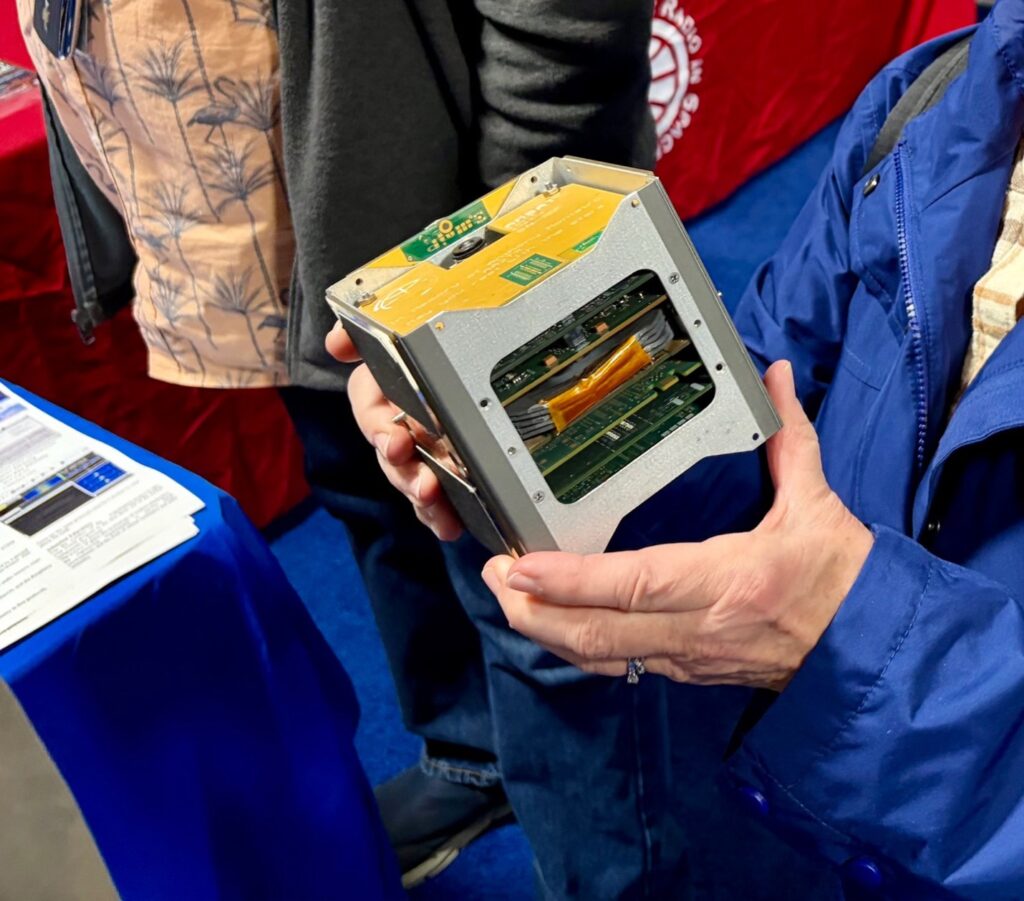
Ham radio has a strong community of satellite enthusiasts. People track orbital passes, calculate Doppler shifts, point antennas at moving objects, and casually communicate through tiny spacecraft while standing in their driveways wearing pajamas.
Satellite operation combines radio, orbital mechanics, scheduling, and geometry. Some operators move even farther into the sky and explore moonbounce (EME—Earth-Moon-Earth). This involves transmitting signals to the moon and receiving echoes back. It’s one of those activities that sounds impossible until someone explains the equipment requirements—and then it still sounds impossible. Ham radio has a habit of making the improbable feel normal.

Digital
Digital modes create another branch entirely. For decades, radio meant voice, Morse code, and analog communication. Then computers entered the shack and everything changed.
Ham radio digital modes use computers and radio equipment to transmit information via digital signals rather than traditional voice communication. These modes can transmit text, images, telemetry, keyboard chats, and even weak signals that are difficult to hear by ear. Popular digital modes include FT8, RTTY, PSK31, and JS8Call.
Modern setups often connect a transceiver to a computer using audio interfaces and software that handles encoding and decoding. Digital modes are especially popular for weak-signal work, long-distance contacts, contesting, and experimenting with new ways to combine radio and computing. They’ve become one of amateur radio’s fastest-growing areas. Now the hobby becomes partly software engineering and partly signal processing.
People who never imagined themselves caring about audio interfaces suddenly find themselves installing drivers at midnight and adjusting waterfall displays with the concentration of someone launching a spacecraft.
Get With the Program
Speaking of software, computers and ham radio have become deeply connected. These days, it’s not unusual to see a computer or two in the ham shack. Logging programs track contacts. Contest software automates exchanges. Digital applications decode signals. Some operators build dashboards, remote stations, automation systems, or entire software-defined radio setups.
At this point, someone can spend an entire weekend operating without ever directly touching a traditional radio. SDR rigs utilize processors that make them increasingly like computers rather than radios.
Ham Radio 911
Then there’s emergency communications and public service. Many people enter amateur radio because they want practical communication skills. Volunteer events, storm spotting, emergency preparedness, and local support communications all attract operators who enjoy service-oriented activity.
For these hams, the hobby is about reliability and community rather than chasing rare contacts. When all else fails, ham radio works is a mantra among emergency responders. Amateur radio shines when central infrastructure—like cell towers and the internet—goes down, because it operates entirely independently of the power grid.
The Thrill of Victory
Contesting is another world. Some operators treat contests as casual fun, others treat them with the seriousness of an elite sport. The objective may be to make as many contacts as possible within a time limit. This turns radio into strategy, endurance, optimization, and sometimes questionable amounts of caffeine. Remember, you’ve got to play to win.
Contest operators learn geography, operating efficiency, antenna selection, propagation prediction, and how to remain awake during hours that sensible humans reserve for sleep.
Hunting DX
There’s also DXing—the pursuit of distant contacts. DX operators collect countries, regions, islands, rare stations, and operating achievements. The excitement of hearing a faint signal from somewhere extremely remote creates a special kind of enthusiasm. Extremely remote means places like Bouvet Island, Sable Island, and Baker Island.
To outsiders, it sounds like, “You talked to someone?” To hams, it sounds like, “You worked a rare entity on 17 meters during a solar disturbance through a pileup using three watts?” Context matters.

The 2026 3Y0K team logged more than 100,000 contacts from Bouvet Island. (Image/3Y0K)
May the Morse Be with You
Morse code (CW) deserves its own mention because it’s effectively a separate hobby masquerading as a mode. Learning Morse introduces listening skills, timing, operating discipline, and a connection to the earliest days of radio. It also provides a reliable means of communication during less-than-optimal conditions.
Some people become fascinated by the rhythm, efficiency, and tradition of CW. Others decide digital modes are enough and leave Morse to the people who communicate at speeds that appear suspiciously close to telepathy.
Radio to Go
You’re not stuck at home—take your rig with you. Many hams enjoy mobile operation on HF/VHF/UHF while traveling or on the way to work. Some enjoy portable operation at mountain summits, on beaches, and at special events. POTA (Parks on the Air®) is one of the most popular and accessible ways to gather radio contacts while in the great outdoors.
Fox hunting is a radio direction-finding activity where operators search for a hidden transmitter, often called the “fox.” Participants track signal strength and bearing to locate the transmitter’s position. It combines radio skills with navigation, observation, and a bit of detective work. Some hunts take place on foot, while others use cars and become fast-paced mobile events.
One Thing Leads to Another
We’ve barely scratched the surface—there’s so much more.
Ham radio encourages curiosity about the world. That’s one reason ham radio survives across generations. People don’t usually stay for only one thing—they stay because when one branch becomes familiar, another branch opens.
The hobby of a thousand hobbies isn’t hyperbole. It’s a reflection of how amateur radio functions less as a single activity and more as a platform for exploration. For example:
- You can start with a microphone and end up learning RF engineering
- You can start with a wire antenna and end up studying atmospheric science
- You can start chasing distant signals and end up making lifelong friendships
Ham radio is a hobby that keeps revealing other hobbies hidden within it—each one connected by invisible waves and the same old question that every operator eventually asks: “What can I try next?”
The post Ham Radio: The Hobby of a Thousand Hobbies appeared first on OnAllBands.
OnAllBands