Don’t have the budget for a 100-foot tower and an OptiBeam OB17-4?
Why not use a wire?
Wire antennas are among the simplest, least expensive, and most forgiving ways to get on the air. A piece of wire strung between two trees can sometimes outperform a much more elaborate antenna—and it doesn’t require a crane, concrete foundation, or a conversation with the neighbors about why your backyard suddenly resembles the Roxborough Antenna Farm.
But not all wire is created equal. The best wire for a ham-radio antenna depends on how you plan to install it, whether the antenna will be permanent or portable, how much power you intend to use, and how much mechanical stress the wire will encounter. Fortunately, there are several excellent choices.
Solid Copper Wire
Solid copper wire is a traditional choice for many ham radio antennas. As the name suggests, it consists of one continuous copper conductor rather than multiple strands. It’s inexpensive, readily available, and an excellent electrical conductor. It’s the choice of Alpha Delta’s line of dipoles and slopers.
Solid copper works especially well for:
- Permanent antennas
- Dipoles and inverted-V antennas
- Fixed long-wire antennas
- Antennas that are not frequently moved
- Installations where the wire can remain under tension
One advantage of solid wire is that it is less likely to stretch than stranded wire. It also holds its shape well and attaches easily to many types of antenna hardware. The downside is flexibility. Solid wire can be awkward to handle when an antenna must be repeatedly assembled, taken down, or moved. It lacks POTA ability.
Solid copper wire also comes in different types. Soft-drawn, or annealed, copper is pliable and easy to bend or coil. However, it can permanently stretch or sag under mechanical tension, weight, or pulling forces. Hard-drawn copper is stiffer and harder to handle, but it can be useful for long spans where mechanical strength matters.
For a permanent station, hard-drawn vs. soft-drawn copper usually isn’t a major concern. Once the antenna is installed, the wire can sit quietly doing its job while the operator concentrates on making contacts.
Stranded Copper Wire
Instead of one solid conductor, stranded wire consists of many small copper strands twisted together. For portable operation, flexibility often matters more than having a perfectly rigid conductor. Lightweight, insulated stranded wire—such as DX Engineering Hi Visibility Antenna Wire—is a good choice for operators who frequently set up and take down their antennas. It packs easily, deploys quickly, and holds up well to repeated handling in portable operations.
Stranded wire works particularly well for:
- Portable antennas
- Temporary field installations
- SOTA and POTA operations
- Antennas that are frequently raised and lowered
- Long wire runs where flexibility is important
The tradeoff is that stranded wire can stretch more easily than solid wire. It can also be more difficult to attach securely to some antenna hardware. Adding a ring terminal or similar connector can make the connection more secure.
Lightweight silicone-insulated stranded wire has recently become popular with portable operators. It is extremely flexible, resists kinking, and can be coiled and uncoiled repeatedly. In other words, it behaves more like a cooked noodle than antenna wire.
Copper-Clad Steel & Other Alloys
Copper-clad steel (CCS) is popular when an antenna needs to be both lightweight and mechanically strong. CCS wire has a steel core surrounded by copper. The copper provides good RF conductivity, while the steel provides much of the mechanical strength.
CCS is particularly useful for:
- End-fed antennas
- Long-wire antennas
- Antennas supported over long spans
- Installations where low weight is important
- Permanent installations where minimal maintenance is desirable
Many portable operators also use lightweight copper-clad steel wire. DX Engineering Stealth Wire offers a useful combination of low weight and strength–62 feet weighing in at only 1 oz. It’s also a nearly invisible option for HOA installations.
The tradeoff is that CCS generally has greater resistance than solid copper and can be less forgiving of repeated bending. The steel core provides strength, but excessive bending can eventually damage the wire. If an antenna will be coiled, packed, deployed, and packed again every weekend, flexible stranded copper may be easier to live with.
Copper-clad aluminum (CCA) and copper-clad aluminum-magnesium (CCAM) are other options. These wires use an aluminum or aluminum-alloy core surrounded by copper. Their main advantages are reduced weight and reasonable mechanical strength. They can be useful when an antenna must span a considerable distance or when the supporting structure is relatively delicate.
Other Wire Options
Ordinary electrical wire can certainly be used for antennas, provided it suits the installation. Some hams use THHN wire because it is inexpensive and readily available at hardware and home improvement stores. However, some household wiring is unnecessarily heavy or difficult to handle.
Stainless-steel wire offers excellent mechanical strength and corrosion resistance, but its electrical conductivity is considerably poorer than copper. It can still be useful for guy wires, antenna supports, or situations where mechanical strength and corrosion resistance matter more than conductor efficiency.
For budget or short-term projects, basic stranded PVC-covered wire, leftover wire, or even salvaged speaker wire can work surprisingly well. The same principle applies to making radial wires for vertical antennas.
Size Matters
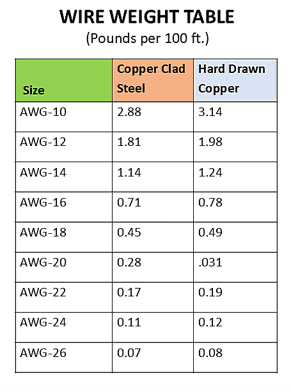
Wire size is another important consideration. Heavier wire generally offers greater mechanical strength and lower resistance, but it also weighs more and can be harder to install. For many HF antennas, 14- to 18-AWG wire provides a useful balance of electrical performance, strength, cost, and convenience.
Portable operators have different priorities. For POTA and similar operations, 18- to 26-AWG wire can provide an excellent combination of low weight and adequate strength. For QRP operation at 20 watts or less, 24- to 26-AWG Consolidated Wire is extremely light, easy to wind onto a small spool, and convenient to carry in a backpack.
Thin wire is also easier on lightweight fiberglass poles. A long, heavy wire mounted near the top of a pole can create considerable leverage, increasing the load on the pole. If you need extra mechanical strength, lightweight copper-clad steel can be a useful alternative to plain copper.
At around 100 watts, 18- to 20-AWG wire provides a good combination of durability and manageable weight. For higher-power installations, 12- to 16-AWG wire can provide additional mechanical strength and durability, particularly where the antenna will be exposed to weather for years.
Home installations can benefit from 12- to 16-AWG wire for durability and power-handling capability. DX Engineering Premium 14 AWG Antenna Wire is a good all-around choice, with UV-resistant PVC insulation that rolls out easily and doesn’t kink. It’s strong enough for virtually every wire antenna application and will handle full legal power.
There is usually no reason to choose extremely heavy wire simply because bigger sounds better. An antenna doesn’t automatically become a better radiator because it could double as a zip line. For a horizontal antenna such as a dipole, getting the wire higher can be far more important than making it thicker. The difference in wire loss may be only a fraction of a decibel, while gaining additional height can sometimes improve performance by several decibels.
Insulated or Bare Wire?
Bare copper has traditionally been used for many antenna designs. Copperweld® Antenna Wire is the ham’s choice when the antenna will be subjected to the tug-of-war between tree branches and high-wind, ice-loading environments. This copper-coated steel wire provides extra-high strength and performance without stretching, and it lasts for many years.

Copper-clad steel can provide high strength without excessive stretching, but it has its own handling issues. It can be stiff and springy, may try to retain its coil shape, and can unspool quickly. Handle it carefully to prevent kinks, which can weaken the wire. Gloves and safety glasses are a good idea when working with stiff wire.
Insulated wire has some practical advantages. The insulation protects the conductor from corrosion and reduces the chance of accidental contact. It can also make the wire easier to see during installation—or less visible if you choose a color that blends into the surroundings. The plastic coating can also make the wire easier to handle because it is less likely to snag on every branch, bush, and fence post it encounters.
One electrical difference is worth remembering. Insulation slightly reduces an antenna’s electrical length by roughly 3% to 5% because RF travels differently along an insulated conductor vs. bare wire. As a result, an insulated antenna generally needs to be somewhat shorter than a bare-wire antenna designed for the same frequency.
Rather than relying strictly on the standard formula, cut the wire slightly long, measure the antenna, and trim it for the desired resonance. You can always make wire shorter. Making it longer requires another piece of wire—and possibly a little creative soldering.
Don’t Forget the Mechanical Side
One of the biggest mistakes new antenna builders make is concentrating entirely on electrical performance while ignoring the mechanical side. An antenna can be outstanding electrically, but if it breaks the first time the wind blows, it isn’t much of an antenna.
Think about how the wire will be supported. A long antenna suspended between two trees can experience considerable tension. Wind, ice, snow, and falling branches can add even more stress.
Avoid pulling the wire extremely tight. A little sag is usually better than turning your antenna into a wire version of a violin string. Trees move, especially during storms, and an antenna with no flexibility has little room to accommodate that movement. Cut your antenna some slack.
Also remember that the antenna wire may not be the weakest part of the system. Insulators, rope, connectors, attachment points, poles, and even tree branches can fail first. Invest in good-quality parts to avoid breakage or failure.
Pulleys and counterweights can help support dipoles between trees that can move and sway in the wind. A hanging weight keeps just enough steady tension on the dipole legs to prevent sagging, while providing give if ice, snow, or heavy winds pull on the system. Some hams prefer heavy-duty springs or bungee cords instead of physical weights to absorb sudden kinetic shocks from violent storms without bouncing.

For more information, see “Ham Radio Tech: Protecting Antennas from Weather Damage,” OnAllBands, April 2026.
What About Radials?
If you are using a ground-mounted vertical, inverted-L, or another antenna that requires radials, wire selection also matters.
For permanent installations, 14- to 18-AWG stranded copper provides a good balance of strength, flexibility, and durability. Because radial current is very low, electrical performance differences between gauges are minimal, but thicker wire resists damage from foot traffic or lawn mowers while it settles into the turf.

Insulated wire can also last longer when placed directly in moist soil because the insulation helps protect the copper from corrosion and chemical reactions. Ground radials return RF current to the antenna system via capacitive coupling to the earth, so the thin plastic insulation doesn’t noticeably affect overall performance.
For portable operation, 20- to 22-AWG flexible wire or lightweight speaker wire works well because it is easy to roll up, deploy, and pack away. Lightweight wire is especially useful when you need many radials and every ounce in the backpack counts. One of my favorites is the DX Commander DX10, a flexible wire that works for both radials and antennas.
The Bottom Line
For most amateur radio applications, insulated stranded copper and copper-clad steel are excellent choices. Solid or annealed copper remains a simple and economical option for permanent installations, while stranded wire is easier to handle for portable and temporary antennas. Copper-clad steel offers an attractive combination of low weight and mechanical strength.
If you’re building your first dipole, don’t overthink the wire. A reasonably sized piece of copper wire, properly supported and cut to the appropriate length, can make an excellent antenna.
The real magic isn’t necessarily in the wire itself. Good antenna performance comes from getting the antenna to the correct dimensions, placing it as high and clear as practical, providing a suitable feed system, and getting it into the air successfully.
All things considered, the antenna wire should suit the job. Choose for electrical performance, but don’t ignore weight, flexibility, strength, weather exposure, and how often you plan to move the antenna. Sometimes the best antenna solution is simply a good piece of wire in the right place. And unlike a 100-foot tower, your neighbors may even forgive you for installing it.
The post Wire Wizard: Choosing the Best Wire for Ham Radio Antennas appeared first on OnAllBands.
OnAllBands