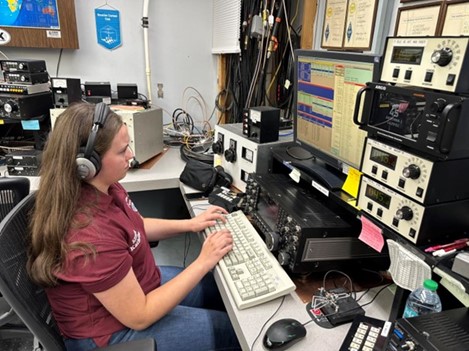
Setting goals is a great way to track your progress in anything. From practicing an instrument to becoming a better cook or learning a new language, it helps you see how far you’ve come from where you started.
I’ve found that goal setting in amateur radio can be challenging due to the rather “unmeasurable” nature of some parts of the hobby, but through creativity, goals can be set for anything that you would like to accomplish.
Some areas of ham radio are easier to set goals for by nature. Contesting and DXing top this list, along with anything that can be measured numerically. Even then, it can be challenging to know where to start and what is a reasonable goal, especially if you’ve never contested before. Here are a few goals you can start with:
- Making a specific number of QSOs
- Working a specific number or proportion of multipliers
- Keeping your error rate below a certain percentage
- Doing better than you did last time
DXing is similar in that it can be numerically measured. You can set a goal to work a certain number of countries or give yourself a due date to achieve your DXCC. Setting goals for CW is also relatively simple. Examples include achieving a desired WPM speed, operating in a particular event, having a ragchew, or learning to send with a different apparatus (e.g., going from a straight key to a set of paddles or from a set of paddles to a bug).
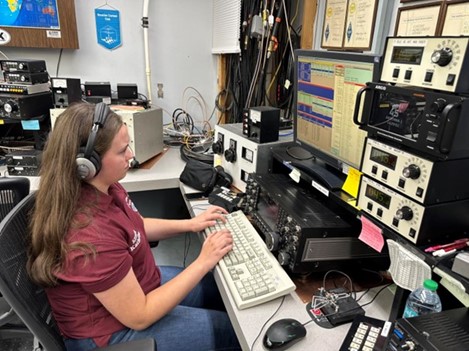
If you’re still looking for your favorite part of the hobby, you could set goals to attend more club meetings, take part in EmComm volunteer opportunities, meet more amateur radio operators in person or on the air, or try out modes you haven’t used.
These goal seem like they should be straightforward to achieve. But it’s important to remember to take your specific circumstances into account—like what equipment you have access to and what you’re naturally skilled at—when setting goals and looking at your progress. As with any goal, consider what is realistic given your abilities and the time frame you’ve set. Also know that since amateur radio is a hobby, it’s likely you may get busy and not be able to dedicate your full attention to achieving whatever goal is at hand. As a result, it may be a good idea to give yourself less rigid deadlines with the understanding that other activities may take priority.
Perhaps the most important part of setting and working toward your goals is not comparing yourself to other operators. This can be quite hard to avoid, especially for a young person who feels like almost everything in life (school, relationships with friends and family, general success) has you balancing on a tightrope while trying to manage it all. Comparing yourself to others just makes it harder for you to achieve what you want—and it has the tendency to take all the joy and fun out of the process.
Pursuing your goals in amateur radio should be enjoyable rather than stressful because, after all, it is a hobby. I can say with confidence that if you learn to focus on enjoying the journey of working toward your goals, you’ll notice much more progress than if you wait impatiently for the results.
The post Youth Insights: Tips on Setting & Achieving Ham Radio Goals appeared first on OnAllBands.