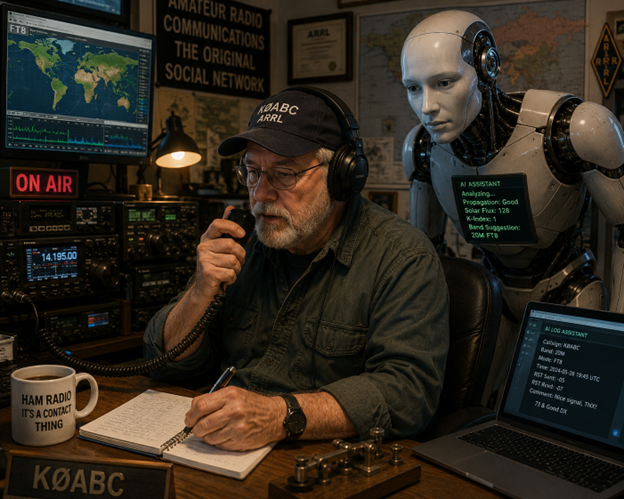
Artificial intelligence is on the brink of changing amateur radio. It will simultaneously make the hobby easier, smarter, more accessible—and perhaps more controversial. Hams have always embraced technology, from spark-gap transmitters to software-defined radios, but AI introduces a different kind of change. Instead of just improving equipment, AI can assist with thinking, analyzing, predicting, translating, decoding, and even operating. That creates both excitement and anxiety across the amateur community.

The Change Begins
The first major impact of AI on amateur radio will be automation. Hams already use computers heavily for logging, propagation prediction, contest scoring, digital modes, and station control. But AI will push this much further. Future logging programs won’t simply record contacts; they will analyze band conditions in real time, recommend frequencies, predict openings, and even suggest the best antenna for current propagation conditions.
Imagine a station where the software detects rising solar activity, predicts a six-meter opening to South America, rotates the beam antenna automatically, adjusts the tuner, and alerts the operator with a message that says, “If you hurry, you can work Brazil before dinner.” Many operators would welcome this. However, some may stare suspiciously at the computer and complain that the radio is becoming smarter than the owner.
AI will also dramatically improve signal decoding. Weak-signal communication has always been one of amateur radio’s greatest technical challenges. Digital modes such as FT8 already allow contacts with signals far below the noise floor. AI-based decoding systems could go even further by recognizing patterns buried deep in static and interference. Future systems may separate overlapping signals with astonishing precision, almost like giving radios selective hearing.
One current system, RM Noise, uses AI to remove noise from SSB voice or CW radio signals. The client program sends the radio’s noisy output to the AI servers, which remove the noise in real time and return the audio to the client for listening. The AI is constantly trained, using noise recordings, to improve performance.
These functions will especially help emergency communications. During disasters, signals are often weak, noisy, distorted, or interrupted. AI-assisted noise reduction and speech reconstruction could make difficult communications intelligible again. A barely readable transmission may become clear enough to coordinate a real emergency response. That capability could strengthen amateur radio’s continuing contribution to disaster communications.
Language translation is another area where AI may transform operating. Amateur radio has always been international, but language barriers still exist. AI-powered translation systems could eventually provide near real-time voice translation between operators speaking different languages. A ham in Ohio could casually converse with an operator in Japan without either person knowing the other’s language. The technology changes the QSO.
The Morse-impaired already know that decoding programs are built into some radios, such as the Yaesu FTDX10. But newer software like Morse Decoder AI uses machine learning to translate Morse code signals into readable text in real time, filter out background static, ignore slight timing inconsistencies, and correctly recognize complex radio call signs. Ditstorm Cypher is a new hardware solution with similar AI capabilities to decode and filter Morse code to achieve the best copy.
Contesting and DXing will also evolve. AI systems can already identify propagation trends, cluster spots, and optimize operating strategies. In the future, contest software may become a co-pilot. It could suggest band switching, identify multipliers, and optimize timing better than many humans can. Some operators will embrace this as the next evolution of competitive radio. Others will argue that contests should reward operator skill rather than computational horsepower.
This raises one of the biggest questions about AI and amateur radio: Where should automation stop?
The Human Factor
Amateur radio has always balanced technology with human skill. Operators generally accept tools that improve efficiency, but many still value the personal challenge of tuning signals manually, learning propagation, building antennas, and developing operating instincts.
If AI eventually handles everything from station setup to contact management, some fear the operator could become little more than a spectator pressing a transmit button occasionally to reassure themselves they still exist. Some already consider FT-8 an example of basically hands-off operation.
The debate resembles earlier arguments in the history of amateur radio. When packet radio appeared, some traditionalists objected. When digital modes became popular, others claimed keyboard contacts were “not real radio.” When spotting networks transformed DXing, critics argued that operators no longer had to search bands themselves. Yet amateur radio survived every technological change because experimentation is deeply embedded in the hobby’s identity.
AI may also encourage more experimentation and technical creativity. Hams are natural tinkerers. Many operators will undoubtedly begin building AI adaptive filters, intelligent rotator systems, and propagation-analysis tools.
Machine learning could help optimize antenna designs far faster than traditional trial-and-error methods. An AI system might analyze terrain, frequency, height, and nearby obstructions to recommend highly efficient antenna configurations tailored to a specific station location.
This could be particularly useful in difficult environments such as apartments or neighborhoods with restrictive homeowners’ associations. AI-based modeling tools may help operators squeeze every bit of performance from compromise antennas. Somewhere, a determined ham with a hidden attic antenna may finally gain an edge over physics—or at least negotiate a temporary truce with it.
Learning Curve
Another important impact will be education. Amateur radio has always been a gateway into electronics, communications, and engineering. AI tutors could help newcomers learn theory, troubleshoot equipment, and understand operating procedures more quickly. Instead of digging through dense manuals trying to understand why an antenna tuner behaves like an emotionally unstable air fryer, operators could ask an AI assistant for explanations tailored to their experience level.
This may help attract younger participants to the hobby, since amateur radio has long struggled with aging demographics. AI integration could make radio more appealing to people interested in software, networking, machine learning, and digital communications. The hobby could increasingly overlap with computer science and data engineering.
Autonomy vs. Operator Control
However, AI also has some downsides. Overreliance on automation may reduce hands-on technical knowledge. Operators who depend entirely on intelligent systems may lose some understanding of how radio actually works. If the software fails during an emergency, operators may discover that their smart station suddenly has the survival instincts of a city kid in the wilderness.
There are also ethical and regulatory concerns. Fully autonomous, AI-controlled stations could challenge existing amateur radio rules that require operator control and identification. Regulators may eventually need to define how much autonomy is acceptable. Can an AI answer CQ calls automatically? Can it conduct entire QSOs without human involvement? At what point does the station stop being amateur radio and start becoming a very polite telecommunications robot?
AI & the Hobby
Despite these concerns, AI is unlikely to replace amateur radio operators. Instead, it will probably become another tool—powerful, transformative, occasionally frustrating, and endlessly debated on repeaters and online forums. Amateur radio has always adapted to technological change while preserving its core spirit of experimentation, communication, and curiosity.
The essence of the hobby is not merely transmitting signals. It’s learning, exploring, building, communicating, and discovering what’s possible with radio. AI will change how operators accomplish those goals. Still, it won’t eliminate the possibility of making unexpected contact across the world or rag-chewing with an old friend.
Even in an era of intelligent radios and automated stations, there will still be something magical about a human voice traveling invisibly through space and arriving in another operator’s shack thousands of miles away. The equipment may become smarter, but the excitement of radio itself will remain a human thing.
The post How will AI Affect Amateur Radio? appeared first on OnAllBands.
OnAllBands