0. Updates!
Windows
Last week it was a Debian 13 update with security vulnerabilities plugged. This week, it’s Windows: Microsoft Plugs Nearly 400 Security Holes. One of the most fundamental ways to protect yourself is to keep your computer updated.
August 11, 2026: Microsoft today released updates to remedy at least 398 security vulnerabilities in its Windows operating systems and supported software, including one weakness that is already being actively exploited and two others that were publicly detailed prior to today.
HamClock OHB
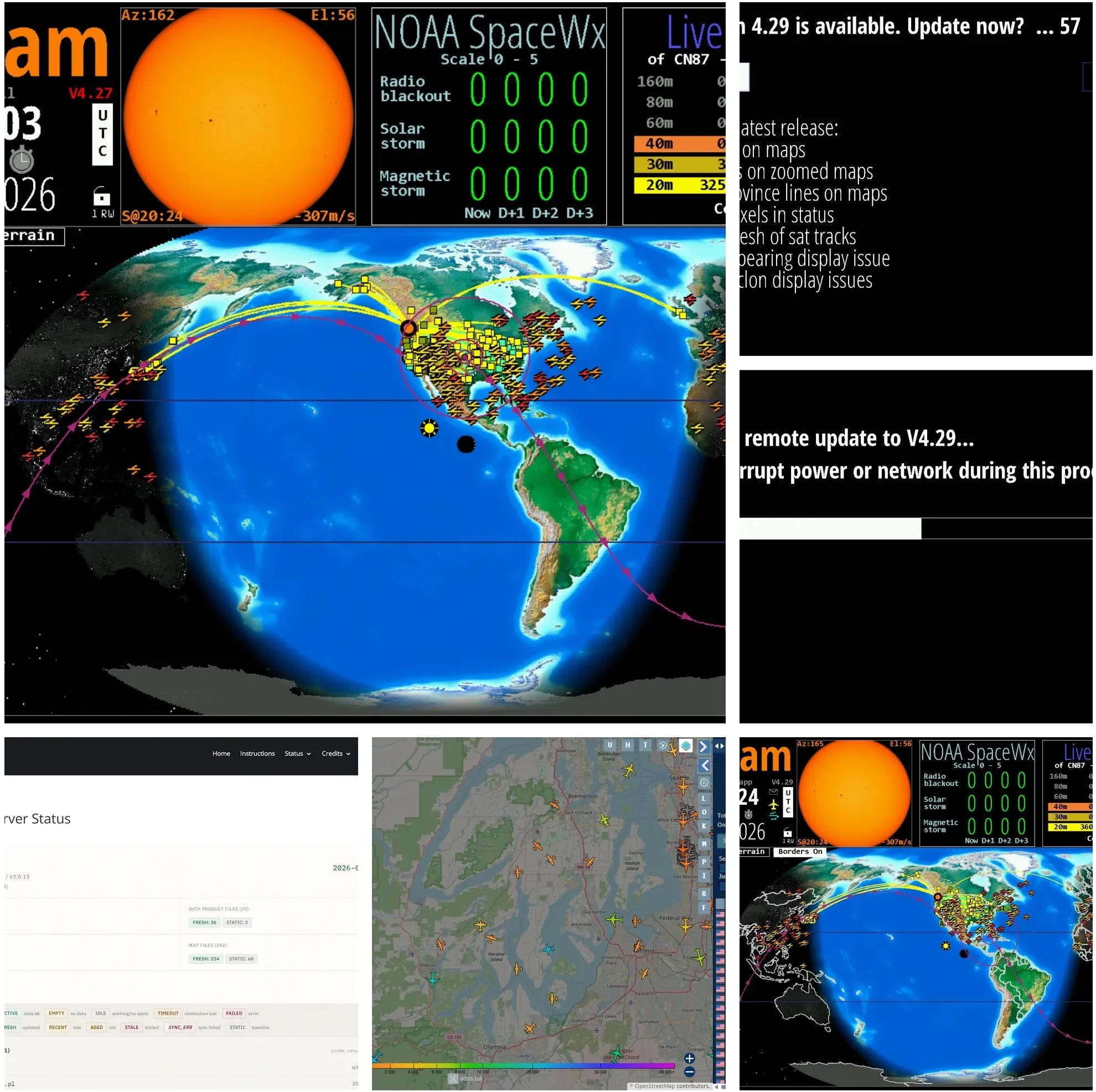
If the version number on your HamClock OHB display is red, an update is available. Click that red version number and follow the prompts to upgrade. Nice additions since I last upgraded:
-
An email icon that presents a link to the OHB status page. Useful.
-
An airplane icon that opens an ADSB flight tracker for your location. Interesting.
-
A blue wind icon that opens the Windy.com website.
Screens are presented as a collage below because inserting them all here would take up too much space:

1. QRV: Are You Ready?
It’s been a rather frustrating week. Usually, I’m gleeful when I find problems to fix. This week, I just wanted things to work…but they didn’t. Resolving issues this week dramatically diluted my writing time. That I do find frustrating.
And I’ll gripe a little bit (again) about Claude’s Sonnet 5 model because it jumps to conclusions. That ended up costing me several hours of time this week as I chased a couple of long, involved issues down dark and twisty rabbit holes, when time was in short supply. The Opus 5 model does much better but it also burns through my credits much faster. The problem here is really twofold: I don’t know Sonnet is going to make mistakes until it makes them, and I’d rather not spend the money on Opus if I don’t have to.
Huh. Here I am complaining about AI. I wonder if this is going to become the new normal on repeaters. You know the drill: what’s the weather, what equipment are you running, how is your health, and now, what have you been doing with AI?
I have to say, though: it is so very easy to overlook all the great help now available to me through the many AI engines available. I have far more successes than difficult detours. It feels a tiny bit uncomfortable to say this plainly, but I will: at this moment in time, I am grateful for AI.
2. New on EtherHam
-
Writing EtherHam Content: Untangling the Ball of Yarn — Meetings (and radio nets) rarely move in a straight line. Someone circles back to a point you thought was closed thirty minutes ago, and a strict outline can’t keep up. Thirty years of facilitating meetings taught me why; mind mapping taught me how to actually capture it. This piece walks through that shift — from a hallway conversation with a frustrated note-taker decades ago to the technique I still use today, turning a tangled ball of yarn of ideas into the straightened, sequential pieces you read on EtherHam.
-
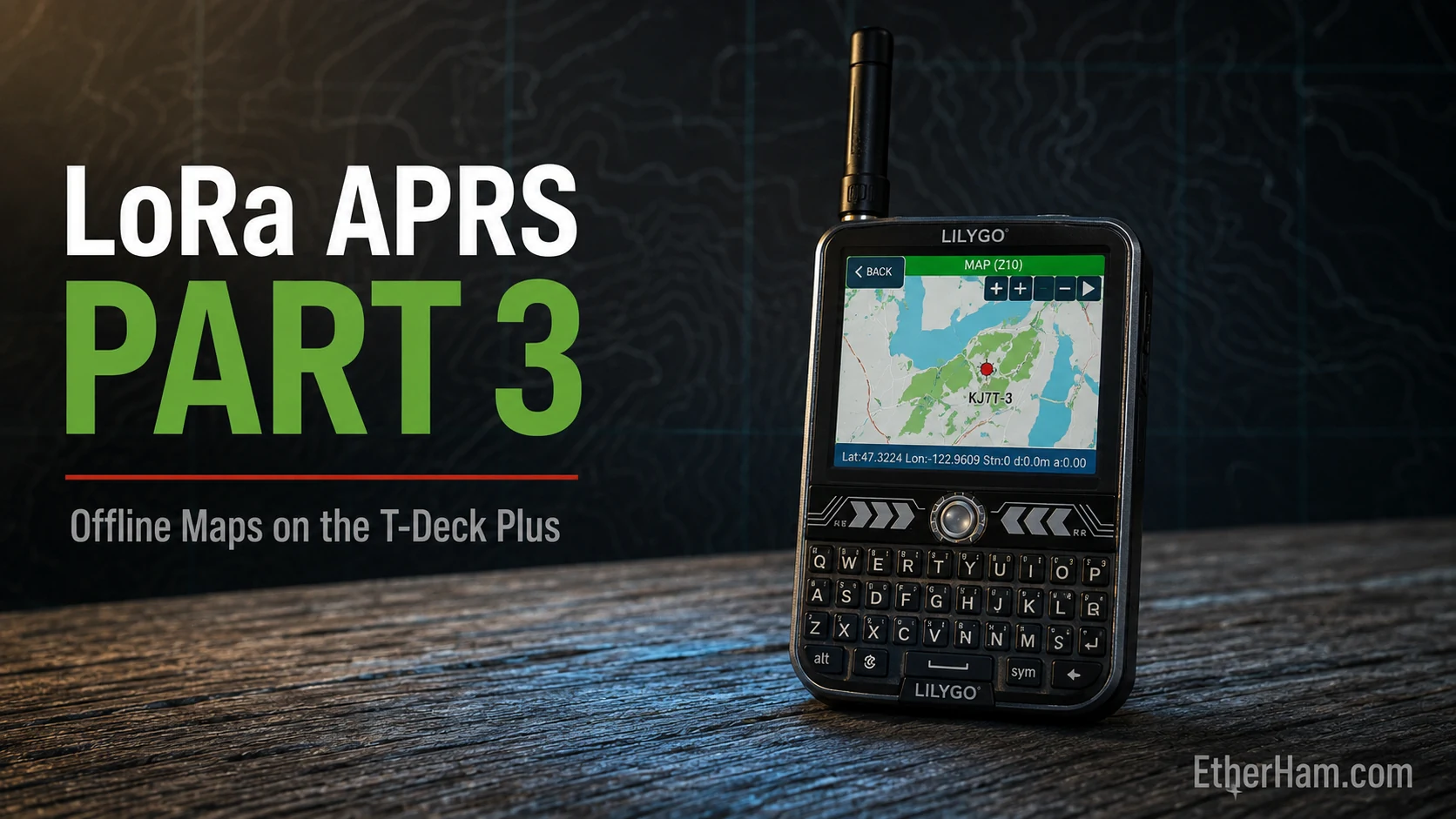
LoRa APRS: Part 3 — A T-Deck Plus Tracker, Offline Maps, and a Long Detour Through OpenStreetMap’s Terms of Service — A LilyGo T-Deck Plus running LoRa APRS will render an offline vector map of the terrain you’re standing in, hold threaded APRS conversations, and pass Winlink email — none of which a plain tracker does. Getting there took most of a day and five stacked failures, each one hiding the next: a wiki that contradicts the firmware it documents; an SD card in the wrong filesystem; 1,793 downloaded map tiles that turned out to be OpenStreetMap’s “Access blocked” graphic saved 1,793 times; a tile generator that had to be compiled from source inside Linux; and — after all of that — a map that had been working the whole time but wouldn’t render until I pressed the zoom button three more times. Somewhere in the middle, the tracker started reporting itself in the Southern Ocean while its own screen showed the correct coordinates. If you just want something that beacons your position, buy a T-Echo and enjoy long battery life. If you want the map and the messaging, here’s the whole path with the wrong turns left in, because the wrong turns are the part worth reading.
-
Weekly Report: August 13, 2026 — Catch up on band conditions, digital radio news, and the Groups.io digest.
3. New: EtherHam Community Space
Over the years, the conversations around the intersection of amateur radio and technology have grown incredibly rich. While the newsletter is a great way to share these concepts, I want to give us a dedicated space to hold deeper, multi-sided discussions.
Today, I am excited to officially launch the EtherHam Groups.io Community.
This is our new clubhouse on the web—a text-based space where you can ask technical questions, share project updates, discuss technology integration, shape future Random Wire and EtherHam topics, and connect directly with other subscribers.
⚠️ A Note on Capacity (First-Come, First-Served)
Because we are launching on a lean, independent infrastructure, space is strictly limited to the first 100 members.
To protect our space from automated bots, spam, and bad actors, membership requires manual approval. We are prioritizing licensed radio amateurs, though tech-minded enthusiasts are welcome too.
How to Secure Your Spot:
-
Click here to visit the group homepage: groups.io
-
Click the Apply For Membership button.
-
You will receive an automated email asking for your amateur radio callsign (or an explanation of why you want to participate).
-
Reply to that email immediately to lock in your application for review.
Once we hit our 100-member cap, the doors will close while we settle into this new space. If you want to help shape the foundation of the EtherHam community from day one, please submit your application today.
See you in the ether,
Tom KJ7T
Editor, Random Wire
www.randomwire.us
4. IP400: The Story Behind This Important Project
I’m sure you’ve noticed the changes over time on VHF/UHF repeaters: coordinated frequencies sitting quiet, hardware from the 1990s doing the same voice relay job it’s always done, and a shrinking pool of operators who show up to keep it maintained. For years, my friend Steve Stroh N8GNJ has been touting a project called IP400, and for good reason. A recent section of his Zero Retries newsletter will likely convince you that IP400 really is an exciting initiative in our amateur radio hobby. Why? Because he’s right.
But where did IP400 come from? It traces back to a longtime radio amateur, Martin Alcock VE6VH — who spent years designing commercial broadband wireless systems before focusing that experience toward amateur radio. Alcock looked at what already existed — AREDN, HamWAN, New Packet Radio — and noticed they all shared the same limitation: they either ran on license-exempt spectrum with real power restrictions, or they came with enough administrative overhead that they never spread much beyond a dedicated core of builders. What amateur radio didn’t have, in his view, was a data and mesh networking system built from scratch for the hobby, on ham bands, without those constraints. That observation became IP400, developed under the Alberta Digital Radio Communications Society (ADRCS), the group Alcock helped found in 2022 and where he’s been able to line up grant funding — including a 2025 ARDC grant — to keep development moving.
As the project has developed, it became clear that IP400 is not trying to replace DMR, D-STAR, C4FM, or your local FM repeater. Instead, it sits next to them. IP400 is additive to our hobby, not subtractive. The hardware — a controller board called the AMNC — talks to a radio you already own and adds a data layer compatible with AX.25 KISS framing, with an eye toward working alongside Winlink, AllStarLink-linked repeaters, and eventually AREDN’s mesh network. The goal is to give existing infrastructure a reason to be upgraded rather than replaced.
What’s running today rides on ordinary FM audio, but that’s really just the first step. Alcock’s longer-term plan involves dedicated software-defined radios with a direct I/Q interface, aimed at speeds well beyond what’s possible when squeezing data through a mic jack. Where that lands, and how fast, is exactly the kind of thing Steve is covering well.
I think there’s another reason for this, one that’s a little harder to say out loud: a lot of newer hams just aren’t as focused on voice communications as the hams who came before them. These new hams grew up in a data-driven, IP-enabled world, and IP400 speaks that language. I’d bet this brings a fair number of tech-fluent people into the hobby who might not have bothered otherwise.
In my view, IP400 is one of the most exciting and fundamental developments in amateur radio today. I’ve not covered it in the Random Wire newsletter because Steve does such an outstanding job of keeping his subscribers updated on IP400. This project is worth digging into, getting excited about, and supporting. IP400 may well be one of the most important technology improvements we’ll see in amateur radio.
For more, I suggest following this topic in the Zero Retries newsletter where it is sure to be very well covered by the ZR team.
5. Curious About 44Net?
Here is your chance to learn about 44Net and about John Burwell KI5QKX, on Eric Guth’s great podcast series, QSO Today, in Episode 539.
John Burwell, KI5QKX, found his way into amateur radio through 44Net, the Class A public IP address space set aside for amateur radio almost 50 years ago, now managed by ARDC. John’s interest in connecting devices over the Internet led him to this remarkable ham radio resource. In this interview, we go deep into IP addressing and networking, opening the door to new ways licensed amateurs can learn, experiment, and build Internet-connected projects. KI5QKX is my QSO Today.
6. QSO One 3.8.5 — Your Update Has Arrived
3.8.5 is live for beta testers, and this one is almost entirely about audio. From the announcement:
The mic gain scale actually works now, a real 0 to 100 instead of everything living in the bottom sliver. There is a new audio test for every network, you talk, it meters you, and it grades you hot, good, or quiet while you adjust. And the clever part, once the app has heard enough stations on a network, it grades you against how that network actually sounds, not against a number from a lab. Every network also gets transmit protection now so you cannot blow anyones ears off, Windows choppy audio got a real fix, and Bluetooth PTT buttons finally respect your PTT mode setting.
Socials:
-
Discord: https://discord.gg/4N6Wc3fsEv
-
Reddit- https://www.reddit.com/r/QSOone/
It’s good to see this project moving forward.
7. POTA Heil Headset
I’ll just say this here: this new headset from Heil isn’t just for Parks On The Air, but it’s a great choice for POTA. From Michael Martens KB9VBR:
8. Waiting on Two Radios: DMR & M17
Retevis RT3S DMR Radio
I ordered this a few weeks ago:
RT3S Dual Band DMR Radio Non-GPS/Built-in GPS
Why? Because I want to try OpenGD77 as the codeplug editor, and OpenGD77 says the RT3S is compatible. In fact, there are plenty of blog posts and reviews available on this exact pairing. (I’m not hyperlinking this radio here because I’ve not received or reviewed it yet.)
I got interested in this after a subscriber asked me how to get into DMR at a reasonable cost. Of course, I do like my AnyTone 878 radio very much, but that’s a more premium option than a $100 radio and free CPS software.
I promised a part two on DMR that I’ve been picturing as a how-to on developing your own codeplug. The RT3S with OpenGD77 is going to fit right into that slot. I’m looking forward getting this working and sharing the journey with you.
A few days ago, the RT3S radio was in Chicago. Wednesday, I received the extra bits: a speaker-microphone, antenna, and spare battery. Maybe the RT3S will arrive in time for initial impressions…but probably not.
Retevis C62 Dual-band Radio…for M17
And then I ordered another radio from Retevis:
Retevis C62 UV Dual Band AI Noise Reduction 5W Long Range Durable Business Two Way Radio
What comes up on that page is a 6-pack of radios. I ordered the single radio for $55.
Then I got an email: “We noticed that you purchased the (EU version) radios. To avoid any issues, would you like us to change your order to the US version[gmrs] instead?”
I paused and thought for a few minutes about this, then replied: no. The experimental work being done by the M17 Project with the C62 is happening — I believe — in Europe, so perhaps I should stick with that version. We’ll see, of course, if it works once it gets here and I load OpenRTX on it. If it works I’ll have an M17 handheld for $55! If it doesn’t work, I’ll have another radio for the unused radio bin.
9. APRS OTA
I’ve not tried this yet, but APRS OTA does sound interesting:
APRS OTA combines the vibe of a POTA activation with a native APRS messaging bot and a website to show what’s happening. Find an operator on the air, send one message and a position report to work them, and your contact is logged, mapped, and scored here as it happens.
A bot serves as a relay and automatically logs contacts:
APRS OTA is an activity and a bot…the OTA bot relays the exchange and logs every contact as it happens. There is nothing to install and no account to create: if you can send an APRS message, you are already in.
It’s a three-part system, with a host, a bot, and chasers.
Intrigued? Visit https://aprsota.org/ for more. If you try it, let me know what it’s like!
10. And Then I Had an APRS Messaging Moment
I was driving to get my morning coffee, watching carefully for deer. Sure enough, I had to hit the brakes so a young buck with velvet antlers could bound across the road. I’ve learned to look where the deer came from, too, and saw a doe and fawn turn back into the bushes. It was at that moment that I saw my APRS radio and a thought completely unrelated to wildlife popped into my mind.
I’ll write this up in long form and post it to EtherHam.com, but my EtherHam website is offline at the moment due to a major power loss at the web host’s Phoenix data center. No word on when services will be restored (and I hope “power loss” is not code talk for “fire in the data center” because that would be very bad).
What was that APRS thought? I wondered if I could send an APRS message from APRSdroid (I’m running the 9M2PJU Mod version) to my LoRa APRS tracker. Surely that could not work, because one system flows over cellular data and the other is LoRa radio. But the aha moment for me was realizing that both probably pass messages via APRS-IS. So I tested this by sending a message from my phone (KJ7T-5) to my tracker (KJ7T-3).
I was surprised and delighted to find this worked perfectly. Replying from the tracker to the phone also worked, so APRS messaging works in both directions.
Let me just pause and sit with that for a moment, because it was a revelation to me. We get pretty locked in about whether we’re working over RF or cell or satellite or wifi or whatever. Hung up on this, even. Lost in those details is the realization that APRS shares a common backbone: APRS-IS.
APRS-IS stands for the APRS Internet System, and it’s the quiet piece of infrastructure that ties every flavor of APRS together. Stations riding RF — my LoRa tracker included — reach it through something called an IGate: a small relay station, often nothing more than a radio and a cheap computer in someone’s attic (or in my case, the garage), that listens to local radio traffic and forwards it onto the internet. Apps like APRSdroid skip the radio step entirely and log straight into APRS-IS over cellular data.
Once a packet lands on APRS-IS, its origin stops mattering. It’s all just APRS-IS traffic from that point on — it can get relayed back out over RF somewhere else, or handed off to a site like aprs.fi to show up on a map. That’s what clicked for me on the drive: my phone and my tracker aren’t two separate systems that happen to talk to each other. They’re two different doors into the same room.
And this is the secret sauce that makes APRS such a powerful tool: different radios, different frequencies, different modes, different mechanisms can all communicate cleanly because they all use the same pipeline behind the scenes.
There is more to this test, because I also tried Winlink between my laptop and my APRSdroid app. That test yielded a surprising-but-educational result I’ll share once EtherHam.com comes back up.
Finally, in a “why not?” moment, I tried checking in to #APRSThursday from the tracker (LoRa APRS as KJ7T-3) and from APRSdroid (KJ7T-5). Unfortunately, both ANSRVR and APRSPH did not respond to messages or commands. I hope the #APRSThursday folks get that fixed.
11. Short Stack from the Interwebs
Well, with EtherHam.com offline, I had to resort to a special mega feed URL which fortunately worked. The following Short Stack items were harvested from this week’s aggregated ham radio feed, covering items from August 5–13, 2026.
SDR & Signal Hacking
-
Product Spotlight: A Look at the KiwiSDR2 Receiver (Video) — OnAllBands — A walkthrough of the standalone KiwiSDR2, covering 10 kHz to 30 MHz with nothing more required than a computer and internet connection to get going.
-
Demod: A New iOS/iPadOS App for Exploring Remote Receivers — The SWLing Post — A new app connecting to KiwiSDR, SpyServer, and rtl_tcp servers with a built-in directory of public receivers baked in.
-
MagicSDR – IOS interface to RTLSDR version 26.04 released — Mac Ham Radio — A plug-in-architecture panadapter/waterfall app for RTL-SDR dongles, covering AM/SSB/CW/NFM/WFM demodulation from an iPhone or iPad.
-
Using a 5 inch Naval Gun Mount as a Rotor and Being Asked by NASA to Listen for Artemis — SolderSmoke Daily News — Pete N0OY’s station includes a repurposed naval gun mount as an antenna rotor and a 10 GHz rainscatter contact spanning 91 miles — genuinely one of the wilder homebrew station tours out there.
-
Checking your Own Signal on FlexRadio — With Varying Frequency – Amateur Radio Ponderings — A quick how-to on using FlexRadio’s built-in features to self-monitor your transmitted signal.
Digital Modes & Mesh
-
Digital Voice over HF with FreeDV Information from Kirk KN6UMV — MichiganOne DMR Tech Net — Follow-up notes from a net discussion on FreeDV, with pointers on where Maidenhead grid squares fit into the picture beyond just contesting.
-
DX Explorer and the Thinknode Meshcore M1 transceiver — Roger G3XBM’s (Mainly) Amateur Radio Blog — A rundown of a new video on the Thinknode M1 LoRa transceiver, with a reminder that Meshcore vs. Meshtastic popularity varies a lot by region.
-
QSO One 3.8.5 – Getting closer! Your update has arrived — MichiganOne DMR Tech Net — A beta release focused almost entirely on audio fixes, including a mic gain scale that finally behaves like a real 0–10 range.
-
SliceLogger — With Varying Frequency – Amateur Radio Ponderings — W4TME’s logging tool gets a rebrand and a fresh v1.0.0.0 general release on GitHub.
-
Digital Mobile Radio Market Size to Hit USD 16.90 Billion by 2032 — MichiganOne DMR Tech Net — An industry market report pegs U.S. DMR growth at a 12.81% CAGR through 2032, largely driven by public-safety adoption rather than the hobby side.
-
Travel Internet CW — With Varying Frequency – Amateur Radio Ponderings — A cautionary field report: internet CW over shipboard wifi via a vBand adapter proved unusably laggy, and a backup Vail Adapter hit its own snag mid-trip.
Gear, Builds & Reviews
-
Pebble HF ordered — With Varying Frequency – Amateur Radio Ponderings — The Pebble HF kit opened for purchase this week, and K9ZW put in his order.
-
New Product Spotlight: Hamplus AS-603WL Black Automatic Remote HF + VHF 6 x 3 Antenna Switch — OnAllBands — A look at the Brazilian-made Hamplus remote antenna switch from Celso PP5CFS and Marcus PP5MS.
-
Mark’s First Impressions of the PK MW Loop — The SWLing Post — A Scotland-based listener’s first impressions of Paul Karlstrand’s PK Loop magnetic loop antenna, ordered after a chance conversation while traveling in Greece.
-
QMX (not QMX+) is becoming a firm favourite — Roger G3XBM’s (Mainly) Amateur Radio Blog — A nod to QRP Labs’ tiny QMX rig, which keeps showing up as a favorite in the field despite its small footprint.
-
Ford F-150 Radio Install – VGC N7600 — Above Average Terrain — Bob K0NR traded in his 2013 F-150 for a 2025 model and walks through installing a mobile rig in the new truck.
-
Rob spots a rare Hygain Galaxy R-1530 on eBay — The SWLing Post — A vintage-radio spotting: a Hygain Galaxy R-1530 listed “for parts or not working” at $749.95 — buyer beware, no returns accepted.
-
Book Review: VHF, Summits, and More – Having Fun with Ham Radio by Bob Witte K0NR — Q R P e r — A guest review from Jock Elliott (KB2GOM), reflecting on nearly 40 years in the hobby since his Novice days.
-
Margaret – A New SOTA Machine — N1CLC — An extensive build log on outfitting a new Subaru Outback Wilderness for SOTA work: mobile radio install, dedicated power distribution, a Starlink Mini, and a full house battery/solar system.
-
Silly me, did not take inventory on order arrival woes — With Varying Frequency – Amateur Radio Ponderings — A DigiKey order for a touch-paddle project turned up short a hundred MOSFETs, discovered only after months of sitting unopened.
POTA & SOTA Field Reports
-
The Battle of the Bands: Activation of Saint Stanislaus Conservation Area US-10954 — Q R P e r — Mark (KB2PIZ) turns an 8-minute detour near the St. Louis airport into a quick POTA activation between flight legs.
-
Meeting Friends on the Summit: A Special SOTA Activation at North Berwick Law — Q R P e r — Thomas K4SWL meets up with several UK-based ham friends for a SOTA activation during a trip to southeastern Scotland.
-
Hunting Fossils and POTA Contacts on Cocklawburn Beach in Beautiful Northumberland — Q R P e r — A coastal POTA outing combining fossil hunting with contacts from a KX2 and a Packtenna random wire antenna.
-
KK6IK: Summer Mornings, Iced Coffee & QRP — Q R P e r — Scott Nacey weighs the Elecraft KH1 against the KX2 for travel-friendly POTA operating during a Rhode Island visit.
-
Parks on the Air (POTA) — Lincoln County Amateur Radio Club — The club has set up a POTA activation account under its call sign, aiming to give newer members an easy way to get started.
Shortwave & Listening
-
A Glimpse of Korean War Clandestine Radio in Operation Chromite — The SWLing Post — A reader spots radio gear featured in a Korean production about the Incheon landings, starring Liam Neeson as General MacArthur.
-
Radio Bonaire 1530: A Mediumwave Station Built for Emergencies — The SWLing Post — A new off-grid, continuously broadcasting AM station on Bonaire, purpose-built to keep residents and visitors informed during emergencies.
-
Texas Radio Shortwave: Schedule for September & October 2026 — The SWLing Post — Updated broadcast schedules for the fall season on Texas Radio Shortwave via WRMI.
-
Carlos’ Illustrated Radio Listening Report and Recordings (August 1 – 8, 2026) — The SWLing Post — Political cartoonist Carlos Latuff’s latest illustrated shortwave report explores Javier Milei’s Argentina through the airwaves.
-
The Voice of Independent Myanmar: A new shortwave broadcast providing news to Myanmar — The SWLing Post — A weekly independent news broadcast to Myanmar, launched as a joint effort between Mizzima and Reporters Without Borders.
-
Alan Roe’s A-26 Season Guide to Music on Shortwave (version 4.0) — The SWLing Post — A free, downloadable PDF guide to music programming across the shortwave dial, plus companion single-page schedule grids for major broadcasters.
-
Radio Waves: Georgia LPFM Wants More Power, Radio Bulgaria QSL #8, Preserving Radio Mogadishu, Shortwave HQ Updates, and Joining the CIDX — The SWLing Post — This week’s grab-bag of reader-submitted radio news, spanning LPFM power requests to archival efforts for Radio Mogadishu.
-
“Holocaust” 1978 TV Mini Series Underground Radios – Warsaw Ghetto — The SWLing Post — Screenshots of an underground receiver as depicted in the 1978 miniseries “Holocaust,” starring Meryl Streep and James Woods.
-
The Very Last New Commercial AM Radio Station in the USA: Here’s What We Should Do Next — Off Grid Ham — A commentary piece on the twilight of commercial AM broadcasting and where the band goes from here.
-
Sunshine and shortwave — The SWLing Post — This week’s Imaginary Stations schedule, including WHFM – Herman’s Radio and Record Room airing on WRMI.
DX, Contests, Satellites & Awards
-
Happy 50th Anniversary to the Araucaria DX Group! — OnAllBands — A congratulatory nod to one of amateur radio’s most accomplished DXing and contesting organizations on its 50th year.
-
DX Engineering Supports the September/October 2026 9T0MD DXpedition from the Democratic Republic of the Congo — OnAllBands — The Mediterraneo DX Club heads to Africa’s second-largest nation for a multi-operator DXpedition running Sept. 30–Oct. 11.
-
Radio New Zealand Features the November DXpedition to Fakaofo — The SWLing Post — RNZ’s Dateline program covers an upcoming DXpedition to Fakaofo in the Tokelau atoll.
-
Contesting 101: The Art of the Possible—Gaining Perspective — OnAllBands — Kirk Pickering K4RO continues his contesting series with a piece on setting realistic goals and perspective.
-
ANS-221 AMSAT News Service Weekly Bulletins — AMSAT — This week’s bulletin covers registration for the 44th AMSAT Space Symposium, ongoing board elections, and a new ARISS associate director appointment.
-
Perseid MS shower — Roger G3XBM’s (Mainly) Amateur Radio Blog — A reminder that the Perseid meteor shower peak is prime time for meteor-scatter VHF contacts, with longer-than-usual returns.
Podcasts, Community & Events
-
Paul Taylor VK3HN Talks about Homebrew and SOTA — SolderSmoke Daily News — Charlie NJ7V of Red Summit RF interviews longtime SolderSmoke friend and Melbourne homebrewer Paul Taylor, VK3HN.
-
A German Builder Makes a 2 Meter Receiver – Warts and All! — SolderSmoke Daily News — A refreshingly honest “blow by blow” homebrew video showing every failed attempt on the way to a working dead-bug-style 2m FM receiver.
-
Chappy Happy Builds a 25 meter Direct Conversion Receiver using a PAL VFO — SolderSmoke Daily News — A repurposed CB PAL VFO becomes a direct-conversion SW broadcast receiver, with some discussion of the AM/DSB distortion inherent to the design.
-
Will N5OLA (the HW-101 Guy) Interviewed by Eric 4Z1UG — SolderSmoke Daily News — A QSO Today podcast interview with Will N5OLA, known for his soap-and-water restoration approach to old Heathkit HW-101 rigs.
-
Open Sauce 2026 in San Francisco — SolderSmoke Daily News — Early reports trickling in from Open Sauce, including sightings of WSPR circumnavigating balloons and homebrew CubeSats.
-
Morse Code Skills Maintenance — With Varying Frequency – Amateur Radio Ponderings — Scheduling conflicts push K9ZW toward Long Island CW Club sessions in the interim before the next CWOps course opens.
-
Zero Retries 0259 — Zero Retries — This issue covers OFDM-AB and a refactored IP400, new hardware and modulation aimed at making high-speed VHF/UHF mesh networking genuinely practical.
-
Berryville Hamfest 2026: Wet but wonderful — News – Shenandoah Valley Amateur Radio Club — Record rainfall didn’t keep hundreds of visitors away from this year’s hamfest.
-
Mods on the Air – GB64MOD Event — With Varying Frequency – Amateur Radio Ponderings — A special-event call active through all of August for fans of the Mod scene and modern hams alike.
-
International Lighthouse Lightship Weekend! — MichiganOne DMR Tech Net — This year’s ILLW (Aug 15–16) will see the group operating as K8L from Michigan’s Eagle Harbor Lighthouse.
-
Lighthouse Activation — Lincoln County Amateur Radio Club — The club activates the Yaquina Head Lighthouse for ILLW on Saturday, August 15, from 10am to 2pm.
Advocacy, Licensing & Growing the Hobby
-
Tell Your Lawmakers to Back the Amateur Radio Preparedness Act — OnAllBands — The proposed federal bill would bar HOAs from enacting restrictive antenna rules; non-hams can now easily lend support too via a linked letter tool.
-
Question pools should make teaching classes easier — KB6NU’s Ham Radio Blog — Dan KB6NU reflects on teaching a Tech class at DEFCON’s Ham Radio Village with 66 students and a freshly updated question pool.
-
Ways Amateur Radio Fosters Independence in Young Hams — OnAllBands — Katie Campbell KE8LQR, licensed at age ten, on how the hobby helped a shy kid find confidence.
-
Free On-line Technician Class Course starting Sept 3 — MichiganOne DMR Tech Net — A free seven-session Zoom Technician course, sponsored by the National Electronics Museum, kicks off September 3.
-
Amateur Radio Has Never Been More Affordable — So Why Do Some Things Seem So Expensive? — Q R P e r — Thomas K4SWL makes the case that the hobby is more accessible than ever, even as certain gear prices climb.
-
Why we had Radio Free Europe and how Ham Radio might fit in — With Varying Frequency – Amateur Radio Ponderings — A look at the winding-down of Radio Free Europe’s cross-border broadcasts and where amateur radio might step into that gap.
Software & Apps Roundup
-
A Wave of Mac Ham Radio App Updates — Mac Ham Radio — Marcus, DL8MRE, pushed a coordinated round of releases this week: K4-Control for Elecraft (iOS 1.139), FT-Control for Yaesu (macOS 1.139), TS-Control for Kenwood (macOS 1.139), and SDR-Control for Icom (macOS 2.9.140), alongside SmartSDR for macOS 2.9.139. Also new: HamClock Launcher 4.28, KLog 2.5.3, QRV for iOS 1.26, and WSPR Watch for iOS 4.38.
12. QRT: End Transmission
Booking it
I finally finished editing the 17 chapters in my book on conservation district management and governance. The first draft of the content happened swiftly back in May. Then I invited some experts to review the draft chapters. Now that the review phase is over, I’ve been trying to make final edits. Editing of chapters 1 through 9 went smoothly. Then life got very busy and I set it aside for a week…then two weeks…then two months. This past weekend, I pulled it up and got through editing the remain chapters, and then sent the manuscript to the publisher. I’m sure I will have another round (or two) of edits coming up, but the core content is complete and good.
“Writing a book” is far more complicated than I thought it would be. I thought writing would be the hardest part, but what I discovered is that when you care deeply about a topic and have solid life experience in it, the book almost writes itself. I spent months crafting a very detailed outline and that proved to be the turning point for the manuscript, allowing me to get started and stay on track. So what was difficult? All the other steps that come with it, like finding a publisher, selecting graphics, choosing a format, hiring a service to convert it for e-book publication, and more. As I travel this road, I’m learning a lot.
Along the way, I realized that a good purpose-built tool for managers to keep regular short notes on employee performance just wasn’t available. A diary-like approach can be very helpful for capturing such notes, and reviewing that history is invaluable when it comes time for performance reviews and implementing other employment-related actions. But finding nothing like that, I made one. It’s simple and rather austere, but it does the job. With a few Python commands, you can turn it into an EXE file to run on Windows or an APP file for macOS. Find it on GitHub.
I could have made a template for something like this in Notion, but then if someone used the template, their data wouldn’t be held locally. I prefer to be in 100% control of employee information at all times.
Coding
I also had some WordPress coding fun, creating a plugin that converts a text-based schedule of meetings to an online display. Some of the text descriptions are rather complicated, e.g.:
The [fill in the blank] Board meetings are on the second Wednesday of October thru May. Meetings in September, October, March, April, and May are at 7 p.m. Meetings in November, December, January, and February are at 6:00 p.m. Meetings are in the US Post Office Building Conference Room.
I built a parser to extract the key pieces and convert the data into a CSV file, then rendered the CSV in a monthly calendar format, with a list-based schedule below the calendar. When meeting dates or locations change, I simply download the CSV, update it, and upload it back to the server. I also added the ability to temporarily mark a meeting “canceled” without going through the whole CSV download-and-upload sequence.
All that is built into a custom WordPress plugin that produces a shortcode for use on any page on the website. It’s working great.
And then, since I was on a roll writing plugins, I wrote one to convert my 518-row spreadsheet of high school classmates into a database maintained on the class website. It has two roles: data admins and data reviewers/approvers. I included a real change log that allows changes to be rolled back. It renders output with shortcodes to display a full class list, our missing classmates, and classmates who have walked on before us. Fun little project.
That should do it for me for a week or two with WordPress plugins!
Home
I’m not really a big fan of tomatoes, but I make an exception for home grown tomatoes harvested on a sunny day at the peak of ripeness. Since I’m the only one who eats them, I have one plant growing in a pot on the deck. Unfortunately, a chipmunk (we named it Chippie) has decided it likes my tomatoes, and it is much faster to harvest them than I am! To try to protect them, I’ve covered the plant — ripening tomatoes and all — with a net. I left the net loose on the bottom the first day and the chipmunk got in and decimated a few almost-ripe tomatoes. The net is now tied tight, and I’m hoping it keeps Chippie out so I’ll get to enjoy the fruits of my own labor soon!
And speaking of home, my childhood home may, or may not, have been affected by the wildfires that have destroyed parts of Spokane, Washington. I wish I knew the status of the old neighborhood as I have many great memories of growing up there. I’m sure I’ll try to make a road trip this fall just to reassure myself that all is well with the old house in northwest Spokane.
Wildfire has been an active force on Pacific Northwest landscapes, particularly east of the north-south Cascade Mountain range:
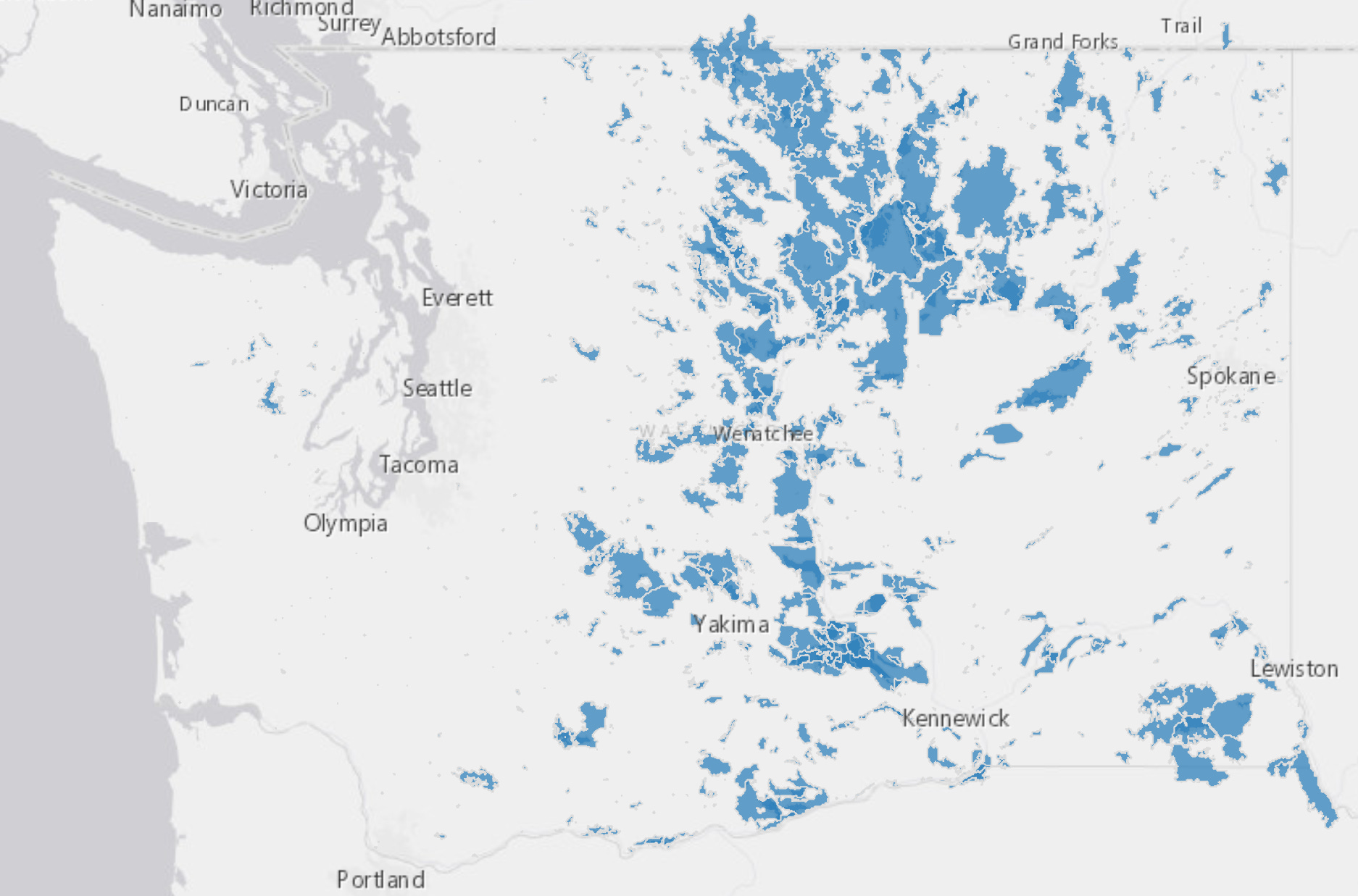
Source: Washington Large Fires 1973-2025
EtherHam website down (but back up late Thursday)
Thursday morning dawned with a different kind of tech problem: a message from the EtherHam web hosting company!
We’re currently responding to an emergency caused by a power outage at our Phoenix datacenter…undergoing emergency maintenance…experiencing network issues. Websites may be slow, unavailable, or return 503 errors. Hosting panel access may also be affected.
Starting my day with a web outage is always a bit unsettling. At least it wasn’t something I caused (and yes, that has happened before, more than once).
As Thursday draws to a close, resolution is in sight, but it still hasn’t happened. By Friday morning, the EtherHam.com website should be is back online.
73, and remember to touch a radio every day!