In previous articles, I’ve looked at necessary software to be used for EmComm. But really, what equipment do we need to have at the ready for when that “bad day” happens? Many operators are of the mindset that they will use their POTA setup as their EmComm setup. In some cases that will work, but EmComm requires a little different flair.
With POTA, we are looking to easily set up and get on the air. In most cases we will only be in a park for a couple of hours. We want to quickly get on the air, make as many good contacts as possible, load our gear in the car, and head out.
With EmComm, depending on the event, we could be there for an extended period. I was set up after Hurricane Katrina for nearly six months. I realize that is the extreme, but isn’t that what we train for? Most disaster scenarios would probably not extend past a few days in our current climate, but those few days could be crucial.
Assuming you have your radio, antenna, and power, let’s walk through an EmComm setup focusing on the not-so-obvious items.
First, you will need shelter. It doesn’t matter whether the sun is shining or the snow is blowing, you will need protection from the elements to be effective. You cannot assume you will be able to operate from your local EOC or other building, as it may be just as affected as the rest of the community you are serving.
I have seen some elaborate mobile communications vehicles and trailers for this very purpose. Everything necessary to deploy is set up inside the vehicle and ready at a moment’s notice. Desks, chairs, radios and antennas—even food and water—are usually part of these setups.
However, most of us are not quite that fortunate. I keep these things handy in a corner of our home. These are staged to quickly throw into the Jeep. Also, just as important as having the supplies is practicing with them. At a minimum, I use this setup at NVIS Day, Field Day, and International Lighthouse and Lightship Weekend. In the heat of battle is not the time to make sure you have everything and know how to use it proficiently.
I use a pop-up style tent for my portable shack. Measuring 10-foot x 10-foot x 8-foot, it has a front porch canopy, 360-degree windows, and a top vent that can all be covered during bad weather. All of the poles are internal. It is erected by simply pulling a tab on each wall and the roof. It has an integral floor to keep water and critters from entering, plus a weatherproof cable pass-through for coax and power cables.
I have a ¼-inch floor covering that folds up nicely for transport and storage. This protects the tent floor and insulates from the elements. A compact folding table serves as the desk and is accompanied by a pair of folding “director’s chairs.” I have a few battery-operated lights and a battery-operated fan that I have tested to make sure they are RF quiet. A Buddy heater makes operating in cold weather more bearable, and I also have a folding cot that fits along one side for extended operations.
Now we have a well-thought-out, well-executed space to deploy our radio equipment and operate for as long as needed. I will now go through what I use for EmComm. It’s my POTA setup with a couple of enhancements. The enhancements are a computer and digital interface, as I do not attach a computer to my rig for POTA.
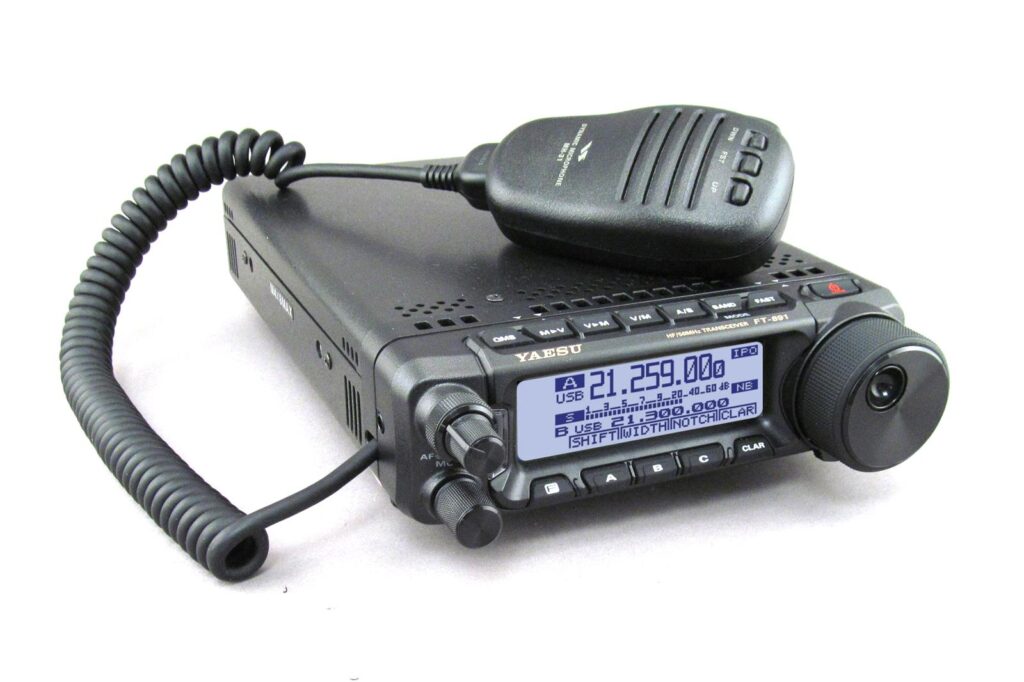
I use the Yaesu FT-891 as the center of the shack. It is rich in features given how small and lightweight it is. I know there is a lot of talk about the menu system, but like anything else, if you use it enough, it is a non-issue. I protect the rig with the Armoloq Tactical Protective Armor for the 891. This protects the radio, knobs, and connections at home, on the scene, or anywhere in between.


I also have a Yaesu FT-2980 for 2M operations. My 2M antenna is the Comet SBB- 7 atop a DX Engineering Nomad Mast connected with the DX Engineering Portable VHF/UHF Antenna Mount.
I use the Carlson Drive-On Mast Mount if no other suitable mast mount is available. If I need 2M/70cm operations, I can always use an HT and crossband repeat through the Yaesu FTM-300 in my Jeep.


The operating station is powered by a homebrew power box. The box contains a Samlex 1235P-M Power Supply and a Bioenno 1220A LiFePO4 Battery.
These two power sources are brought together with a West Mountain Radio Epic PWRgate and a West Mountain Radio RIGRunner DC Outlet Panel. A Bioenno Solar Panel is attached. I have operated for days on this setup. It allows for use of commercial power if available or solar/battery power if not available.


My go-to EmComm antenna is the Alpha Antenna Portable MIL EmComm Enhanced Antenna. This antenna has a vertical element for distant communications, but more importantly, it has four NVIS wire elements for near-field communications. This antenna provides some resonance from 80-6M without a tuner. However, depending on frequency used and environmental influences, you may want a tuner to clean things up a bit.

I use the mAT-TUNER MAT-Y200. It provides a wide tuning range with ample memories and low power consumption. As a bonus, it attaches nicely to the top of the 891 with some Velcro straps.

Finally, I connect a Microsoft Surface to the rig via a Digirig Digital Mode Interface Kit. This provides for seamless soundcard and CAT control integration. It is vital that you have the rig and the computer working together along with WinLink and NBEMS before you are needed to perform in the field. Trying to download drivers and software updates with poor or no internet service is a formula for failure.

Please do not look at this list and think you must get it all at once. This article and list are the result of years of failures both in training and real-world events. Take your time, consult with others in your area, and don’t be afraid to call DX Engineering just to get advice on what might work in your situation.
As stated earlier, I practice with this several times a year and have a system in place for mob and demob. Also, I have used it enough to know where I like everything on the desk and how it all fits in the space provided. Remember, people are counting on you to professionally meet their needs. Trial and error should not be done during a real-world event.
Until next time, 73 de AC8OW
The post Amateur Radio EmComm Prep—A Look at What Equipment You’ll Need When the Worst Happens appeared first on OnAllBands.
OnAllBands