[UPDATE] – Full details now available here – PDF file – download safe – credit EC7R. [MARCH 12] – Francisco, CT7AKS recently added S9R to the QRZ.com database. This is going to be a DXpedition to Sao Tome & Principe scheduled for October 17-31, 2026. Full details to follow in due course.
Author: NA4DA
-
JI3DST/6 & JA4GXS/6 – Danjo Islands, AS-056
[INFO] by Ken, JA4GXS & Take, JI3DST. The Danjo Islands are uninhabited islands with no regular ferry service (approximately 4 hours by boat from mainland Kyushu). JI3DST/Take and I will be going to these islands with the following plan in order to communicate with as many IOTA chasers as possible. The IOTA credit rate is […]
-
How Do You Become a Good Ham Radio Operator? Listening is a Great Start.
For many years, I was an instructor for fire, EMS and law enforcement academies. More often than not, sessions would start out something like this: “Today I am going to teach you what you need to know to pass the test. Later, when you have passed the test, we will discuss how things really work.”
Whether it is public safety, parenting or anything in between, there is the “book” way and the “real-world” way. Life doesn’t always follow the book or the rules. Our job is to figure out how to be the most effective communicator while adhering to the spirit of our hobby and not violating any rules or regulations.
So where do you learn how it really works? Here are a few sources of real-world wisdom to learn from. Remember, you need to take your exposure in each of these areas, measure it against “the book,” and take the best of everything to make it your own. Also keep in mind that every time you go key down, you are an advocate for the hobby.
First You Should Listen
I tell everyone to begin listening to the local repeaters as soon as you can, even before getting your license. This will give you a taste of how things flow on the repeaters in your area. There are commonalities across the hobby, but there may be some local flavor that occurs where you live. By listening early, you will be more confident to make that first repeater contact as soon as you receive your call sign.
When it comes to HF, it is a little more universal and generic. With HF there is truly no local flavor because the world is your neighborhood. Listening is still a great idea. You will learn the nuances that occur between VHF/UHF and HF. A lot of HF is about just making contacts and making a simple exchange. However, there are some interesting nets to get involved with and a lot of preparedness activities to dive into.
When looking for nets to listen to I recommend netfinder.radio. It allows you to see what is happening right now or search by various criteria. A good source for contest information is the WA7BNM Contest Calendar, and for special events check out the ARRL Special Event Listing. Aside from that, just spin the dial and see what you can find. Always keep in mind the FCC Band Plan and your operating privileges before transmitting.
Another source of street knowledge is your local club. I know, I have beat this drum a lot. But clubs are where the hobby, for the most part, lives and grows. This is where you can see that you’re not alone on a deserted island.
There are other operators who are deeply entrenched in the hobby and would love to impart their years of experience to you either one-on-one or via group presentations. You may also find club and community events to be involved in. Club listings can be found at the ARRL Find-A-Club Tool or the QRZ Radio Club Database.
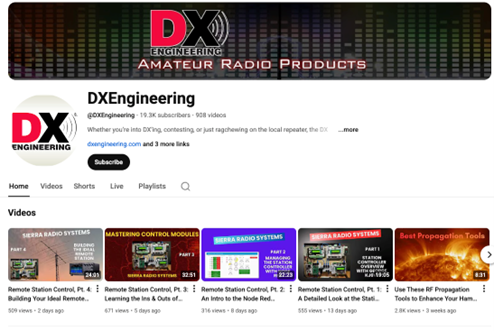
The final source we will discuss today is YouTube. Again, just like any other resource, you will need to vet the information you receive. You can find a vast array of information on many popular ham radio topics, either as detailed explorations or high-level generic overviews. There are also a wide range of content creators, so you should be able to find one that has a style you like. I recommend that you find a good selection of sources who you can trust to provide accurate information. The DX Engineering YouTube Channel, for example, offers hundreds of videos covering just about every amateur radio topic under the sun, including the sun.

DX Engineering YouTube Channel. (Image/DX Engineering) Please study diligently for your test so that you can answer whatever question is given to you, but remember, the book is the foundation on which you build your collection of knowledge and wisdom to become a solid ham radio operator.
Until next time, 73 de AC8OW
The post How Do You Become a Good Ham Radio Operator? Listening is a Great Start. appeared first on OnAllBands.
-
T88RR – Palau
Yas, JA6UBY will be active from Palau as T88RR during June 10-18, 2026. QRV on 160-6m; SSB, FT8, FT4. QSL via LoTW, eQSL or homecall. * T88RR was previously active (along with T88HV) in 2023.
-
PA/OR5R – DXpedition to Ameland, EU-038
From May 18 to May 22, 2026, a team of Belgian radio amateurs will be active from the Dutch Wadden island of Ameland (EU-038) under the callsign PA/OR5R. The operation will take place from locator JO23TK and promises to be an interesting opportunity for DX hunters as well as Belgian and Dutch stations. The DXpedition […]
-
DX-World Weekly Bulletin
[#661] The latest FREE NON-SUBSCRIPTION DX-World Weekly Bulletin written by Bjorn ON9CFG is available to download. Click below to get the newest jam-packed edition which this week runs to 18 pages. Previous bulletins can all be found here. Please contact Bjorn with any updates or errors. DOWNLOAD THE LATEST BULLETIN =====
-
Youth Insights: Tips on Explaining Amateur Radio to Your Non-Ham Friends
Most of us are aware of the challenges when trying to explain our hobby to non-ham friends and acquaintances. Should we call it a public service hobby? An electronics hobby? A social hobby?
Explaining that amateur radio is “all of the above” options plus a few more can also be a challenge. At some point, the best choice seems to be just brushing off ham radio as a “nerd” hobby and seeing the confused stares from your audience quickly subside.
This option, however, doesn’t help solve the problem of the ham community getting smaller and the mean age getting older, especially when those opting not to explain it represent the younger segment of the hobby.
How we explain and talk about amateur radio matters if we want the hobby to continue to thrive.
Like many hams, I have been guilty of brushing off questions regarding what amateur radio is or providing an incomplete answer. But after a few years of practice (attending a small public high school as an involved amateur radio operator has provided this opportunity), I’ve been able to improve how I answer the question, “What is it that you post about on Instagram all the time?” without saying, “Oh…just one of my hobbies.”
An effective tactic for answering this question is stripping down the hobby to its most basic activity: talking to people. You can also put this into specific contexts. For example, “Talking to people by using satellites” or “Talking to people around the world,” which can help provide a good transition into what exactly you do with the hobby as well.
It can also be helpful to tailor your description to topics in which your friend is knowledgeable and has an interest. Since an explanation of amateur radio may be hard to comprehend for someone who isn’t involved in technical activities or doesn’t know much (if any) amateur radio jargon, explaining it in terms of what they’re already familiar with can be useful.
Another approach—when possible—is to simply let them experience amateur radio rather than trying to explain it. The concept of talking to a bunch of strangers using very technical-looking equipment can seem completely absurd to many, particularly the younger generations (despite the fact that is essentially what we do with our phones). Having the opportunity to show people exactly what it means when we say we’re “talking to people on the air” can make it a little less intimidating and seem a lot less crazy. This is also helpful for explaining aspects of the hobby that may not be as obvious or well understood by the public (e.g., satellites, digital modes, and fox hunting).

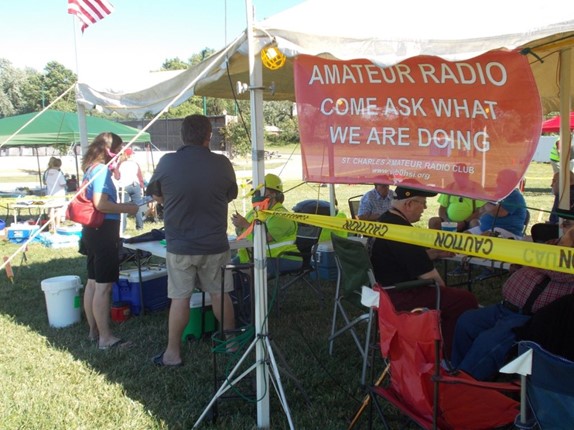
Avoiding jargon when talking to non-hams friends, similar to how you might explain amateur radio to visitors on Field Day (above), is a good approach. (Image/Sean, KX9X) If you’ve gotten past the point of simply explaining to a friend what the hobby is but still aren’t sure how to actually discuss it with them, this can also be a challenge. We naturally want to share our hobbies and things we enjoy with our friends, family, and acquaintances, but it’s not always enjoyable to talk about these things when you need to explain every other word you use.
For the majority of my time in high school, my friends’ reactions to my amateur radio stories were either, “Oh, your nerd hobby again” or telling me afterward they hadn’t understood any of it, but it sounded great. So, I’m familiar with the challenges of trying to share your enjoyment of ham radio with people who don’t understand it. I’ve found the best solution to this problem is telling the story without any amateur-radio-specific vocabulary and relating it to topics your audience is already familiar with. While it can sometimes be nice to share parts of our hobby with our non-ham friends, it can be more fulfilling to expand our circle of ham acquaintances and share there instead.
That’s not to say we should avoid talking about the hobby with non-amateur radio operators. We should, in fact, do the opposite. Talking about ham radio is one of the most common ways for non-operators to become interested in it, and while it can be frustrating sometimes, it’s well worth the effort.
My high school recently hosted an exam session, and a significant portion of my classmates earned their Technician license. As a result of hams talking about the hobby, 14% of my graduating class are now licensed amateur radio operators. Talking to non-hams about amateur radio can have a huge impact and may even inspire your friends and acquaintances to get their licenses as well.
The post Youth Insights: Tips on Explaining Amateur Radio to Your Non-Ham Friends appeared first on OnAllBands.
-
XT2AW – Burkina Faso
[UPDATE] – Harald, DF2WO will again be active from Ouagadougou, Burkina Faso as XT2AW during May 6-19, 2026. Plans are to QRV on 80-10m; SSB & FT4 and QO-100 SAT (10489666.) LoTW will be uploaded after the DXpedition ends. More info including new pictures here. (Recording below from 2022). [OCTOBER 18] – Equipment now back […]
-
NCVEC Question Pool Committee Issues Revision to 2026 – 2030 Technician Pool
This announcement was originally published in the ARRL Letter on February 19, 2026. ARRL members can subscribe to the weekly ARRL Letter at www.arrl.org/opt-in-out.
—
The National Conference of Volunteer Examiner Coordinators (NCVEC) Question Pool Committee (QPC) released a February 19, 2026, revision to the new 2026 – 2030 Technician Class question pool. Questions drawn from that pool are vali…
-
New Technician Class Question Pool Released — Effective July 1, 2026
This announcement was originally published in the ARRL Letter on December 18, 2025. ARRL members can subscribe to the weekly ARRL Letter at www.arrl.org/opt-in-out.
—
On December 18, 2025, the National Conference of Volunteer Examiner Coordinators (NCVEC) Question Pool Committee (QPC) released the revised 2026-2030 Technician Class (Element 2) question pool. It will be required for all Amateur …