Pertti, OG2M announces he will be active from Garowe, Puntland, northeastern Somalia as 6O2M during October 5-25, 2026. QRV on 40-10m; CW & SSB. Spare time activity. QSL via LoTW. This post appeared first on: DX-World Want to know more about it? Read More
Author: Source Author
-
Get on the Air to Celebrate 100 Years of Route 66
Plus, check out Route 66 collectibles you can add to your garage or shack!
***
Kerchow!
This year marks the 100th anniversary of Route 66, the legendary 2,400-mile highway connecting Chicago and Santa Monica, California. To commemorate this milestone, the Citrus Belt Amateur Radio Club (W6JBT) in San Bernardino is hosting an operating event to celebrate a century of burned rubber since the road was established.
Route 66 On The Air, now in its 27th year, runs from Sept. 12-20 and will feature more than 20 amateur radio clubs situated along the historic route using 1×1 call signs. Visit the W6JBT website for more details as they become available for the 2026 event.
Last year, the event featured a unique aeronautical rover station (using the W6Y call sign). Bill Hartsell, N3WSH, flew his Cessna from Chicago to Santa Monica, allowing ground-based ham radio operators the opportunity to make contact with the plane mid-flight.
Because of high traffic on the airwaves, operators are asked to keep transmissions short and avoid prolonged rag-chewing so everyone gets a chance to make a clean sweep of all available stations.
A Look Back
The event serves as a way for ham radio operators to “relive the ride” and celebrate the 100-year journey. With such a storied past, we figured it’d be interesting to once again take a trip down memory road.
Established in 1926, Route 66 was the first major project to link the West Coast with the nation’s heartland. It was known as the “Mother Road” or “America’s Main Street.” While images of old drum up picturesque views of a paved road through the desert, it was actually a mix of dirt, gravel, and paved segments until 1938 when it was completely paved thanks to funds through Great Depression relief programs. Route 66 was the first highway in America to be fully paved.
Route 66’s development was famously documented in John Steinbeck’s “The Grapes of Wrath,” which centered on the Dust Bowl and its impacts on the people living during that time. Many people traveled Route 66 to the West Coast looking for new jobs in the growing industries in California, according to History.com.
When World War II rolled around, Route 66 turned into an industrial and military corridor, moving troops and supplies. This meant motels and merchants saw an uptick in business from servicemen and their families. Route 66 also helped facilitate one of the largest wartime mobilizations ever as the masses used it to flock to Oregon, California, and Washington to join the war effort and get jobs in defense plants, according to the National Parks Service.
Once rationing restrictions were lifted after the war, more people joined in on traveling the historic road. Car ownership grew dramatically with more than 52 million cars registered in 1955, almost 30 million more than what was registered at the end of the war. Hey, people wanted to hit the road—especially since Disneyland had opened in California in July 1955. Back then it offered five themed lands with 20 different attractions.
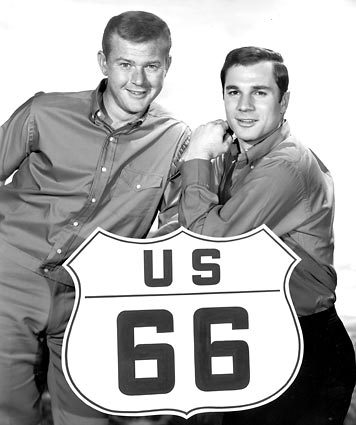
Of course, the route was immortalized in Bobby Troupe’s “Route 66” song and the TV show of the same name. The show was about two down on their luck men working odd jobs as they looked for adventure on the road. But this success and popularity would be short lived because the same powers that made it into a popular road trip destination were the same that sent it into decline. President Eisenhower signed the Federal-Aid Highway Act of 1956—a new network of five interstate highways (I-55, I-44, I-40, I-15, and I-10)—that would be built over the next three decades.

Martin Milner (left) and George Maharis (right) from the TV show “Route 66,” which ran from October 1960 to March 1964. (Image/Public Domain) By 1984, the new interstates were completed, and Route 66 was officially decommissioned. While the route led through several smaller towns, connected using backroads, the interstates were designed to let people travel far distances in a short amount of time. There was no real need for it anymore, despite its connection to several important eras in American history.
That connection is what led advocates to fight to keep it alive, and six years later, Congress passed the Route 66 Study Act of 1990. This law recognized Route 66 as a symbol of American heritage—a physical representation of those who traveled it to find better lives for themselves. A special resource study was conducted by the National Park Service and eventually led to the creation of the National Park Service Route 66 Corridor Preservation Program, which helped local individuals, agencies, nonprofits, and others preserve the route, according to the National Park Service.
Route 66 was thrust back into the spotlight in 2006 when Pixar released its mega-hit movie “Cars.” It centered around professional race car Lightning McQueen and his struggles to make the final race of the season while being stuck in a small town on Route 66. Voiced by Owen Wilson, McQueen’s most notable line is his catch phrase, “Kerchow!” The movie unexpectedly gave an adrenaline shot to the many small towns seemingly abandoned along Route 66. Many of them embraced the movie, painting murals and heavily featuring the characters in their towns. A new wave of tourism from fans of the movie came in as well, helping to keep the towns afloat.
In 2008, Route 66 was listed on the World Monuments Watchlist, which marks monuments that are endangered. And work continues to this day to preserve the magic that the road once brought to millions of people either looking for a new life in the west, working to ensure the protection of our country, or vacationing with loved ones.
Celebrate the 100th Anniversary with Summit Racing
Summit Racing, DX Engineering’s parent company, has cool Route 66 collectibles you can enjoy while you’re busy contacting stations along the route:

Historic Centennial Route 66 Aluminum License Plate. (Image/Summit Racing) 
Route 66 100th Anniversary Sign. (Image/Summit Racing) 
Route 66 Gas Pump with Tire Stack Pen Holder. (Image/Summit Racing) 
Route 66 Neon Clock. (Image/Summit Racing) 
Route 66 Steel Thermometer. (Image/Summit Racing) 
Route 66 Jigsaw Puzzle. (Image/Summit Racing) Enter “Route 66” at SummitRacing.com for more blasts from the past!
The post Get on the Air to Celebrate 100 Years of Route 66 appeared first on OnAllBands.
OnAllBands
-
DX-World Weekly Bulletin
[#678] The latest FREE NON-SUBSCRIPTION DX-World Weekly Bulletin written by Bjorn ON9CFG is available to download. Click below to get the newest edition which this week runs to 19 pages. Previous bulletins can all be found here. Please contact Bjorn with any updates or errors. DOWNLOAD THE LATEST BULLETIN ===== This post appeared first on: DX-World Want to know more about it? Read More
-

Software Fix Keeps Veritium HFClock Running
Users of the Veritium HFClock now have a fix available to keep their HamClock based device functional. N2TBN and AI4Y have teamed up to provide detailed, step-by-step directions aimed at getting Veritium HFClocks working again. The procedure requires removing the rear panel and flashing the device’s firmware.
Once the new firmware is applied, users will run through a few brief setup steps and HFClock will continue to operate.
HFClock owners can download PDF instructions that describe how to fix their device.
Source: AI4Y
Amateur Radio Daily
-
Legendary DXer Bob Locher, W9KNI, Presents Tales from a Serial Sniper Part 3: “Yemen on 40 Meters”
OnAllBands is thrilled to feature articles from noted author and amateur radio DXing legend Bob Locher, W9KNI. Bob will be sharing his favorite DXing memories along with insights on what it took to capture the rarest of the rare. OnAllBands’ readers have been equally excited to enjoy these stories and recall how Bob’s writing inspired them to become armchair travelers as well:
“The “Complete DX’er” and all his articles back in the ‘70s hooked me on CW Dxing,” wrote NG3Q. “Also expanded a love of geography and having my National Geographic atlas close by.”
Be sure to read parts 1 and 2 of this series:

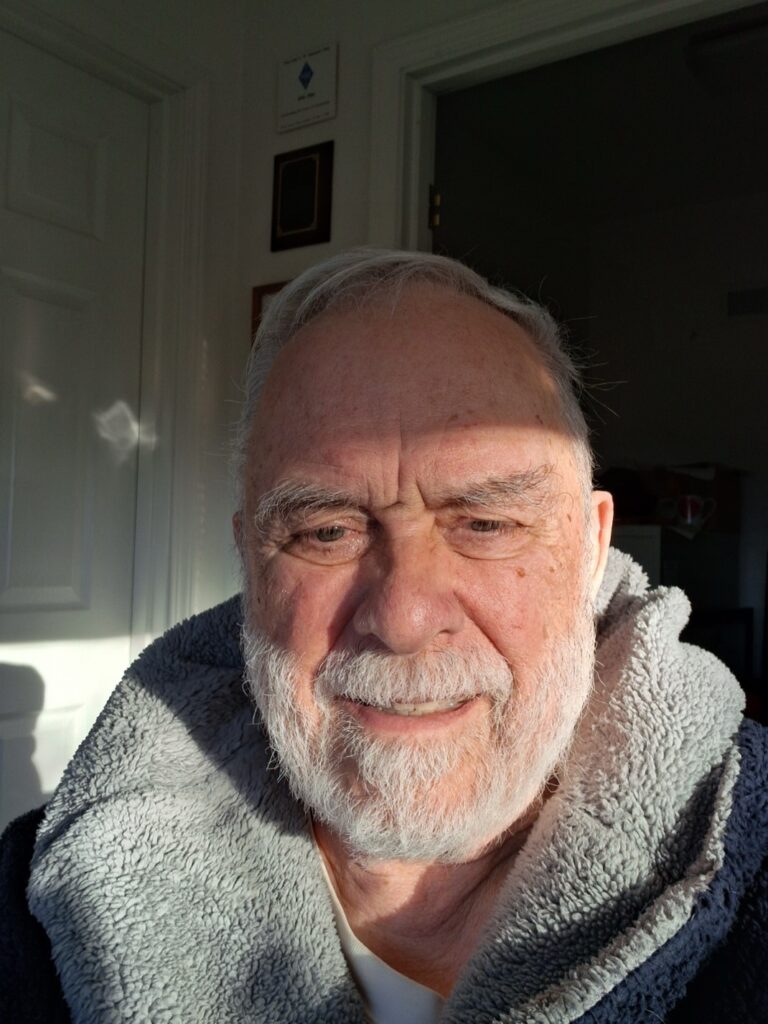
Bob Locher, W9KNI, in his Dawn Patrol uniform. (Image/W9KNI) ***
40 Meter Aficionado
The different high frequency bands (160 to 10 meters) plus the VHF band (6 meters) offer different challenges for DXing. Year round and throughout the sunspot cycle, 20 meters is the queen of the DX bands. If you want to work DX reliably, you need to have 20 meter capability. But the other bands have their attractions as well—and their own challenges—and many DXers favor one band or another.
My band of choice is 40 meters. For 40 meter afficionados, the band has its special charm. It is a band that under normal circumstances is a twilight and darkness band, and of limited DX value around the summer solar solstice. But the rest of the year the band is capable of good DX—and occasional real and very pleasant surprises—for those who know how to use it.
A well-sited Yagi offers a revelation to newcomers to the band who are used to using dipoles or verticals. Still, real DX can be worked using simple antennas. Your scribe managed to work all 40 CQ zones in one year on 40 meters, running 100 watts and a Butternut vertical. But with a Yagi, several more layers of DX become available, and the openings last significantly longer.
I love the challenge of the band. At the same time, I am an armchair traveler and a serious DXer. As far as I am concerned, the two go together hand in hand. I am a person who can look at a map and let my imagination soar, imagining the strange and wonderful places hinted at by the map. At the same time, I love competitive DXing in the institution of the DX Marathon. One of the real beauties of the DX Marathon is that it renews annually, so every year I get the thrill of working new ones for the year AND still feed my armchair travel addiction. A marriage made in heaven for me.
In Pursuit of Yemen on 40 Meters
It would be difficult to find a place more exotic than Yemen—a country lying at the bottom of the Arabian Peninsula, a home of ancient civilizations dating back 7,000 years! While the country has a huge history, in modern times it has become politically unsettled with a significant civil war. Post World War II, Yemen was occasionally on the air, mostly by European operators living in the country. None of them were terribly active, making it always a rare catch.

Yemen (Image/Public Domain) Around the year 2000, DXpeditioners tried to get permission from the country to mount a major operation, but all were denied because of the unstable political situation. But finally, in 2012, someone broke the code. The country was willing to issue a license, but only specifically for operation from Socotra Island, a Yemeni island about 200 miles from the mainland.
Socotra was— and is—totally removed from the problems of mainland Yemen. A sizeable team of experienced operators organized a DXpedition, using the call sign 7O6T. Operation was from late April into May. Equipment included amplifiers and Yagis for the higher bands. I was able to work them on 20 and 17 meters without too much difficulty, but for me the real prize would be to work them on 40 meters.

(Image/DX Engineering) 
Here’s the QSL card from 7O6T posted on OnAllBands in honor of a Socotra activation in 2024. One panel of the card shows Yemen’s flag—equal horizontal bands of red, white, and black. (Image/DX Engineering) For one thing, I was working for an entry in the DX Marathon for 40 meter monoband, and in any case, 40 meters has always had a special place in my heart. It would be an all-time new one (ATNO) for me on the band. Working into that area of the world has always been one of the two toughest areas for me from my West Coast location, the other being inland central East Africa. And this operation was quite late in the season for optimum 40 meter propagation. Had it been in February or March it would have been much easier.
They were certainly on 40 meters and making an active effort on the band. But from my QTH, there was really only one opening—very late afternoon my time. And it was not a very good one. On top of that, they were not on 40 meters CW every day at that opening. Some days yes, some days no. And when they were on, it seemed like all of Europe was calling them—stations who would obviously have far stronger signals into Yemen than I would. Still, that is part of DXing. Some are easy, some are not. And this one was emphatically not!
The operation was winding down—their departure date fixed. I had heard them three or four days on the opening, always weak. If I had had a one-on-one shot with them we could have had a QSO. That was not going to happen. Their signal was at best a 449. As their last days wound down I was getting more and more anxious. At least for the last few days of their stay they were on 40 meter CW during my minimal opening. Of course, I was waiting on them late every afternoon, hoping somehow for a chance.
I tried calling them with the few tricks I had, but to no avail. The only good news was that they finally seemed to have Europe pretty well worked out, with much smaller pileups of European stations calling them. And I was pretty sure all the big guns in Europe on 40 meters had already worked them—now I was more likely competing with the “100 watts to a dipole” crowd.
Finally, it came down to their last day of operation. Was I nervous? Let’s just say the thought passed through my mind that I really ought to consider getting a life, but then it passed and I adjusted my headphones… Ahhh. There they were. 449 maybe…honestly, probably 339, working split, up one. I could hear European stations calling them. There didn’t seem to be very many of them. Maybe I did have a chance?
I checked their sunrise and sunset times. Pretty ugly, really. Their sunrise was an hour before my sunset. 40 meters much prefers late twilight to pre-sundown, and the same for sunrise, though at sunrise the band will hang open a bit longer. But they did have advantages—a beach with a saltwater takeoff and, presumably, a dead quiet location.
Anyhow, I was hearing them with pretty good copy, except their signals were starting a slow fade as they were being bathed more and more in sunlight. I was thinking how their situation was not that different from my morning openings. Then a thought flashed through my head: morning openings sometimes include unusual long path and crooked path openings. Naaaahhhh. But wait. They were starting to fade anyhow, closing the door on any chance I had of a contact. What did I have to lose?
I turned the antenna to long path, skeptically listening to their frequency. And after nulling out as the antenna swung round to the new bearing, their signal started coming up! When the antenna reached the long path bearing, they were 569!!! My heart in my mouth, I called. He came back to a German station. I called again and he responded to a French station. I called again. And then I heard the most beautiful music ever—the music of the spheres: “W9KNI W9KNI 5NN 5NNK.” Wow! Wow! I sent him a “5NN TU” and got a very clean “R 73.” I sat back, stunned. I had just worked Yemen! It was clearly him, and five minutes later he was gone, totally faded out. The next morning, I logged into Clublog and checked the log submissions. There I was—in the log! (And it is still there to this day.) Finding my call was almost as exciting as working him. Validation!
The log online showed that the operator I had worked was WD5COV. At the time, I knew nothing about him. I found out that on DXpeditions he is considered an especially valuable operator for the low bands, thanks to his ability to copy and work weaker signals in noisy conditions.
I had the good fortune to meet him in person a few years later at a West Coast DX Convention in Visalia, CA. I told him the circumstances around the contact and how exciting it had been for me. To my considerable pleasure and surprise, he remembered that QSO as well, being as it was very much out of the ordinary and a surprise to him as well at the time.
The post Legendary DXer Bob Locher, W9KNI, Presents Tales from a Serial Sniper Part 3: “Yemen on 40 Meters” appeared first on OnAllBands.
OnAllBands
-
KH0N – Saipan
Tony, JA6CNL will again be active from Saipan, Northern Mariana islands as KH0N during September 10-15, 2026. QRV on HF bands, mainly FT8, FT4 & FT2 using a vertical antenna. QSL via H/c. This post appeared first on: DX-World Want to know more about it? Read More
-
5H1RK – Tanzania
Rafal SP3RK will be operating from Zanzibar (AF-032), Tanzania as 5H1RK during December 23, 2026 to January 6, 2027. QRV on 20-10m; mainly FT8, FT4, FT2 and some CW; QRP operation. More info here. This post appeared first on: DX-World Want to know more about it? Read More
-
J75A, J79A, J79H, J79BH & J79FJ – Dominica
Laurent, FM5BH reports that a team consisting of him, F5VHJ, FM5FJ and FM1HN will be in Dominica from October 17th to 27th. Prior to the CQWW SSB contest, they will sign with individual callsigns, namely J79BH, J79A, J79FJ and J79H. The contest call will be J75A. This post appeared first on: DX-World Want to know more about it? Read More
-
FS/DL1MGB, PJ7WW & VP2E activity
Chris DL1MGB informs that he will be active holiday-style from Anguilla, Sint Maarten and St Martin during the following dates: VP2E (callsign t.b.a) from Nov 20-23. PJ7WW from Nov 23-30. FS/DL1MGB from Nov 30 to Dec 9. He will be running low power into some wire antennas near the sea. Bands: 160-10m while on PJ7. […] This post appeared first on: DX-World Want to know more about it? Read More
-

Guide to September 2026 Ham Radio Contests—State QSO Party Edition
September is one of the busiest months for State QSO Parties. You’ll have plenty of chances to get on the air to make contacts during events happening from Maine to Washington and lots of states in between. Check out the full list at the bottom of this article.
If you’ve never participated in a State QSO Party, we suggest reading these OnAllBands articles for the basics of these fun events that challenge you to reach as many counties as possible (often rare ones) within a state.
- Ward, N0AX: “State QSO Parties—Great HF Practice”
- Sean, KX9X: “State QSO Parties—Low-Pressure Contesting”
Outdoor operating enthusiasts will want to read this excellent article by John, WG8X, on “Combining Parks on the Air with Contesting,” including State QSO Parties.
Whether you’ll be activating a county or chasing across the state to achieve a clean sweep, you’ll find everything you need at DXEngineering.com to get maximum excitement out of State QSO Parties. Choose from transceivers, antennas, CW keys and paddles, the DX Engineering GO Portable Polo Shirt, and much more.
Here are a few more contests to make it a September to remember:
IARU Region 1 Field Day, SSB: Sept. 5, 1300Z to Sept. 6, 1259Z. This annual event presents an excellent opportunity for clubs to test their low-power portable operating capabilities; experiment with design, construction, and deployment of antennas; and use alternate means of power.
All Asian DX Contest, Phone: Sept. 5, 0000Z to Sept. 6, 2400Z. Sponsored by the Japan Amateur Radio League, this annual event is for both Asian and non-Asian stations making SSB QSOs on 160, 80, 40, 20, 15, and 10 meters.
ARRL EME Contest: Sept. 5, 0000Z to Sept. 6, 2359Z. The object of this annual event is to work as many amateur stations as possible via the earth-moon-earth path on any authorized amateur frequency above 50 MHz. September 5-6 is designated for 2.3 GHz and up. Oct. 31-Nov. 1 and Nov. 28-29 are for 50 to 1296 MHz.
WAE DX Contest, SSB: Sept. 12, 0000Z to Sept. 13, 2359Z. The German Amateur Radio Club (DARC) invites amateur operators worldwide to participate in this Worked All Europe contest. The RTTY portion of the contest is scheduled for Nov. 14-15. Read complete rules here.
Ohio State Parks On The Air: Sept. 12, 1400Z to 2200Z (10 a.m. to 6 p.m. ET). Before the POTA program grew to the size of your average sequoia, an active amateur radio club in the Buckeye State planted the seed for bigger things to come by initiating the first Ohio State Parks On The Air (OSPOTA) special operating event in 2008. Flash forward 18 years and the event—along with portable operating in general—continues to blossom like autumn ragweed in a Ravenna field.
The Portage County Amateur Radio Service (PCARS, K8BF) developed and still sponsors the event, which encourages hams to activate state parks in Ohio the first Saturday after Labor Day. There are 76 parks that can be put on the air for the 2026 edition.
Learn much more about Ohio State Parks On The Air from its longtime chairman and DX Engineering technical writer, Tom, KB8UUZ, in his OnAllBands post later this month.
Also, don’t miss the flora, fauna, frequencies, and fun of Wisconsin Parks on the Air, Sept. 19, 1600Z to 2300Z, sponsored by the Fox Cities Amateur Radio Club, W9ZL.
ARRL September VHF Contest: Sept. 12, 1800Z to Sept. 14, 0300Z. Amateurs in the U.S. and Canada will be trying to work stations in as many 2 degree x 1 degree Maidenhead grid squares as possible using authorized frequencies above 50 MHz. Stations outside the U.S. and Canada may only work stations in the U.S. and Canada. All legal modes are permitted, including CW, SSB, FT8, MSK144, FM-Only, PSK31, FSK441, and JT65.
QRP Afield: Sept. 19, 1500Z to 2100Z: Hosted by the QRP Club of New England, this low-power event rewards operators based on power levels and location.
ARRL 10 GHz and Up Contest: Sept. 19, 0900Z to Sept. 21, 0759Z. North American amateurs will attempt to contact as many stations in as many different locations as possible in North America on bands from 10 GHz (3-centimeter) through Light. Amateurs are encouraged to operate from more than one location during this event. Contesters may enter in either “10 GHz Only” or “10 GHz and Up” categories.
For those interested in 10 GHz operation, you’ll find the Icom IC-905 VHF/UHF/SHF All Mode Base/Portable Transceiver at DXEngineering.com. The rig boasts operating capability up to 10 GHz with the optional CX-10G Transverter (sold separately).
CQ World Wide DX Contest, RTTY: Sept. 26, 0000Z to Sept. 27, 2359Z. This annual event attracts more than 15,000 RTTY enthusiasts from around the world.
Masonic Lodges on the Air: Sept. 26, 1400Z to 2200Z. “The idea for the Masonic Lodges on the Air Contest grew out of the realization that many Freemasons have a love for Amateur Radio,” according to the event’s official website. The idea is to see how many Masonic Lodges you can contact in a day on 80, 40, 20, 15, and 10 meters SSB. You do not need to be a Mason to participate, but organizers ask that you get permission from your local lodge to contest from their property.
AWA Amplitude Modulation QSO Party: Sept. 26, 2000Z to Sept. 27, 2400Z. Sponsored by the Antique Wireless Association, this event is designed to “promote and encourage the use of amplitude modulation on the amateur radio bands” and to “enjoy the friendly atmosphere and pleasant audio quality of AM communication,” per the AWA website. Participants will try to make contacts using the amplitude modulation mode on 160, 75, 40, 20, and 10 meters. From its website, the vision of the AWA is to “preserve and share the history of technology used to communicate and entertain from the first telegram to today’s wireless text messaging.”
State QSO Parties
- Tennessee: Sept. 6, 1700Z to Sept. 7, 0300Z
- Colorado: Sept. 12, 1400Z to Sept. 13, 0359Z
- New Jersey, Sept. 12, 1400Z to Sept. 13, 0200Z
- Texas: Sept. 19, 1400Z to Sept. 20, 0200Z, and Sept. 20, 1400Z to 2000Z
- Iowa: Sept. 19, 1400Z to Sept. 20, 0200Z
- New Hampshire: Sept. 19, 1600Z to Sept. 20, 0400Z and Sept. 20, 1200Z to 2200Z
- Washington State Salmon Run: Sept. 19, 1600Z to Sept. 20, 0700Z, and September 20, 1600Z to 2400Z (find more details on the Salmon Run official website)
- Maine: Sept. 26, 1200Z to Sept. 27, 1200Z
The post Guide to September 2026 Ham Radio Contests—State QSO Party Edition appeared first on OnAllBands.
OnAllBands