George, T30GI located in Tarawa, Western Kiribati quite often appears on the 7163 DX net run by Stan, KE5EE. He operates low power (approx 30w) into a dipole antenna. Today, he also appeared on the 14209 DX net – again run by KE5EE. QSL info is unknown. — Recording below by DX-World from September 18, […] This post appeared first on: DX-World Want to know more about it? Read More
Author: Source Author
-

August 2026 Guide to Ham Radio Contests—Special Events Edition, from Micro-Cars to Lighthouses
OnAllBands is devoting part of our contest guide to some of the special event stations on the air this August. You’ll find a nice selection of special events to keep you busy every month at the ARRL website.
We love the low-key fun and educational component of making QSOs with stations that bring attention to local and regional history, important landmarks, and people who have shaped our world. Here are a few to mark on your calendar:
King Midget Micro-Car 80th Anniversary
The Athens County, Ohio, Amateur Radio Association is celebrating the smallest street-legal car ever made in America—the King Midget. More than 5,000 King Midgets were manufactured in Athens, Ohio, by the Midget Motors Corporation from 1946-70, with the first kit models costing $270 and the 1970 “commuter” model marked at a still minuscule $1,295. At one point, the car was marketed as “the 500-pound car at $500.”
Depending on model speed and engine size, the small but mighty King reached top speeds of 30 to 50 mph. It is estimated that about 20% of the cars produced have survived. Even today, local and state regulations generally permit them for use on city streets and roads, but it’s best to steer clear of the highway.
From Aug. 6-9, dozens of these cars will visit Athens for the 80th Anniversary King Midget Jamboree.
For those who are wondering, the road-legal Peel P50, a three-wheeled micro-car (legally classified as a three-wheeled motorcycle) produced on the Isle of Man from 1962-65 and then from 2010 to present in England, was listed in the 2010 “Guinness World Records” as the smallest production car ever made.
Now back to the King Midget and ham radio: You can reach special event station K8M Aug. 5-9, 0000Z-2359Z, on 7.245 and 14.245.

King Midgets on display at a Summit Racing car show. Summit Racing has been DX Engineering’s parent company since 2000. (Image/Summit Racing) 
(Image/OnAllCylinders) National Navajo Code Talkers Day
In celebration of National Navajo Code Talkers Day (August 14, 2026), contact Herb Goodluck, N7HG, Aug. 8-14, 0024Z-0004Z, on 14.265 and 7.265.
For many years, hams around the world have contacted special event stations to honor the bilingual Navajo speakers who played a vital communications role while serving with the U.S. Marine Corps in the Pacific theater during World War II. Translating English code words into their native language, the “code talkers” sent confidential messages from battle lines to air bases and other locations, saving countless lives yet going unnoticed for their bravery until much later after the war. President Ronald Reagan declared August 14 as National Navajo Code Talkers Day in 1982.

Dave, N8NB, DX Engineering customer/technical support specialist, received this card from the N7C special event station. (Image/DX Engineering) International Lighthouse Lightship Weekend
Taking place the third weekend in August, this annual 48-hour event is one of the most popular of all international amateur radio activities, attracting around 500 participants who operate from lighthouses in over 40 countries. The event runs this year from Aug. 15-16. View the list of registered lighthouses here, from the Punta Mogotes Lighthouse in Argentina to the Mumbles Lighthouse in Wales (below).

(Image/MumblesLighthouse2 by Lilo Lil | CC BY 2.0) Read this OnAllBands article from Troy, AC8OW, DX Engineering customer/technical support specialist, about his club’s activation of the Marblehead Lighthouse, about two hours away from DX Engineering headquarters.

(Image/AC8OW) Steamboat Nannie Byers Disaster
The Clifty Amateur Radio Society (W9EFU) of Jefferson County, Indiana, will be operating special event station N9B in remembrance of the 15 lives lost after the collision of the steamboat “Nannie Byers” with the steamer “E.C. Hillman.” The collision occurred on February 24, 1866, at 2:30 a.m. on a windy night on the Ohio River near Madison, Indiana, causing the “Nannie Byers” to sink in four minutes.
Reach special event station N9B Aug. 15, 1400Z-2200Z on 28.328, 14.325, 7.250, and 20 and 10 meters FT8.
In addition to these special events, hone your skills before the year’s major blockbusters with these contests:
***
YB Bekasi Merdeka Contest: Aug. 8, 1200Z to Aug. 9, 1159Z. This SSB-only, single-operator 80/40/10M contest commemorates the anniversary of Indonesian independence from Japan (Aug. 17, 1945). The event is sponsored by the Indonesian Amateur Radio Organization.
***
Kentucky State Parks on the Air: Aug. 8, 1400Z to 2200Z. The Murray State University Amateur Radio Club (MSUARC) is sponsoring its annual Kentucky State Parks on the Air event. Activators will have an opportunity to operate from the Bluegrass State’s 50 parks and nine national sites, while chasers can make CW, SSB, and Digital QSOs with hams enjoying the diversity of the state’s outdoor areas.
***
ARRL EME Contest: Aug. 8, 0000Z to Aug. 9, 2359Z. The object of this annual event is to work as many amateur stations as possible via the earth-moon-earth path on any authorized amateur frequency above 50 MHz. Aug. 8-9 and Sept. 5-6 are designated for 2.3 GHz and up. Oct. 31-Nov. 1 and Nov. 28-29 are for 50 to 1296 MHz.
***
MMMonVHF/DUBUS 144 MHz Meteorscatter Sprint Contest: Aug. 12, 0700Z to Aug. 14, 0700Z. MMMonVHF, in cooperation with the magazines DUBUS and Funk-Telegramm, invites you to take part in the 2026 edition of the “144 MHz Meteorscatter Sprint Contest.” Per the contest website, the Perseid meteor shower will be active until Aug. 24. Its maximum is estimated to occur on Aug. 13 between 0200 UTC and 0400 UTC.
Last year during the Perseid meteor shower, HamSCI hosted a Meteor Scatter QSO Party, an on-the-air experiment to study meteor scatter propagation on HF bands below 30 MHz. Open-source data gathered from the event is being used to further our understanding of 6- and 10-meter propagation, along with gaining new insights into meteoric behavior. Read the results of the event in this report from Gary Mikitin, AF8A.
In June of 2026, HamSCI held a Meteor Scatter Party during the daytime Arietids shower.
***
Keymen’s Club of Japan Contest: Aug. 15, 1200Z to Aug. 16, 1200Z. Formed in 1976, the Keymen’s Club of Japan is devoted to promoting CW operation on the amateur bands. Find club history and contest rules at the KCJ website.
***
SARTG WW RTTY Contest: Aug. 15, 0000Z to 0800Z and 1600Z to 2400Z; Aug. 16, 0800Z to 1600Z. This annual RTTY-only event is sponsored by the Scandinavian Amateur Radio Teleprinter Group.
***
ARRL 10 GHz and Up Contest: Aug. 15, 0900Z to Aug. 17, 0759Z. If you’re a fan of operating on the Super High Frequency (microwave) spectrum, this is your chance to shine. North American amateurs will attempt to contact as many stations in as many different locations as possible in North America on bands from 10 GHz (3-centimeter) through Light. Amateurs are encouraged to operate from more than one location during this event. Contesters may enter in either “10 GHz only” or “10 GHz and Up” categories. The second weekend of the contest will be Sept. 19-21.
For those interested in 10 GHz operation, you’ll find the Icom IC-905 VHF/UHF/SHF All Mode Base/Portable Transceiver at DXEngineering.com. The rig boasts operating capability up to 10 GHz with the optional CX-10G Transverter (sold separately).
***
North American QSO Party, SSB: Aug. 15, 1800Z to Aug. 16, 0559Z. All amateur licensees are eligible to work as many North American stations as possible during the 12-hour contest period.
***
ARRL Rookie Roundup, RTTY: Aug. 16, 1800Z to 2359Z. From the ARRL, the Rookie Roundups “encourage newly licensed operators (“Rookies”) in North America (including territories and possessions) to operate on the HF bands and experience competitive Amateur Radio operating. Experienced operators (“Non-Rookies”) are strongly encouraged to participate and help new operators—either on the air or in person.”
***
ALARA Contest: Aug. 30, 0600Z to Aug. 31, 0559Z. The Australian Ladies Amateur Radio Association will be hosting the ALARA Contest, an SSB/CW event in which YLs may contact anyone while OMs may only contact YLs on all HF bands except 160M and WARC bands. Formed in 1975, ALARA boasts a membership of more than 200 operators, with many members sponsoring operators overseas. ALARA’s mission is to “encourage women’s interest and active participation in amateur radio.”
***
The U.S. Islands QSO Party: Aug. 29, 1200Z to Aug. 30, 0300Z. The U.S. Islands QSO Party “promotes verifiable amateur radio contacts with stations located on islands in the United States and its Territories and Protectorates.” This 15-hour SSB/CW/Digital event offers two classes (QRP, five watts or less) or QRO (greater than five watts), and several categories: Island Fixed, Island Rover, and Non-Island.
The U.S. Islands Awards Program centers around activating and chasing U.S. river, lake, and shore islands. Thinking about activating an island? Here’s a state-by-state U.S. island directory.
***
Also check out these state QSO parties:
- Maryland-DC: Aug. 8, 1400Z to Aug. 9, 0400Z
- Hawaii: Aug. 22, 1600Z to Aug. 24, 0200Z
- Ohio: Aug. 22, 1600Z to Aug. 23, 0400Z
- Kansas: Aug. 29, 1400Z to Aug. 30, 0200Z; Aug. 30, 1400Z to 2000Z
The post August 2026 Guide to Ham Radio Contests—Special Events Edition, from Micro-Cars to Lighthouses appeared first on OnAllBands.
OnAllBands
-
Ham Radio Youth Insights—How to Enjoy Amateur Radio While Traveling
After countless run-ins with security because I decided to travel with a CW key (or any other piece of equipment that looks “sketchy” on the TSA’s X-ray machines), it’s safe to say that I’m pretty familiar with how traveling and amateur radio collide with each other—or more fittingly, how they complement each other.
At first glance, it can seem like trying to incorporate amateur radio into traveling would just complicate it, but with good planning it can make your trip even better than it would have been without ham radio.

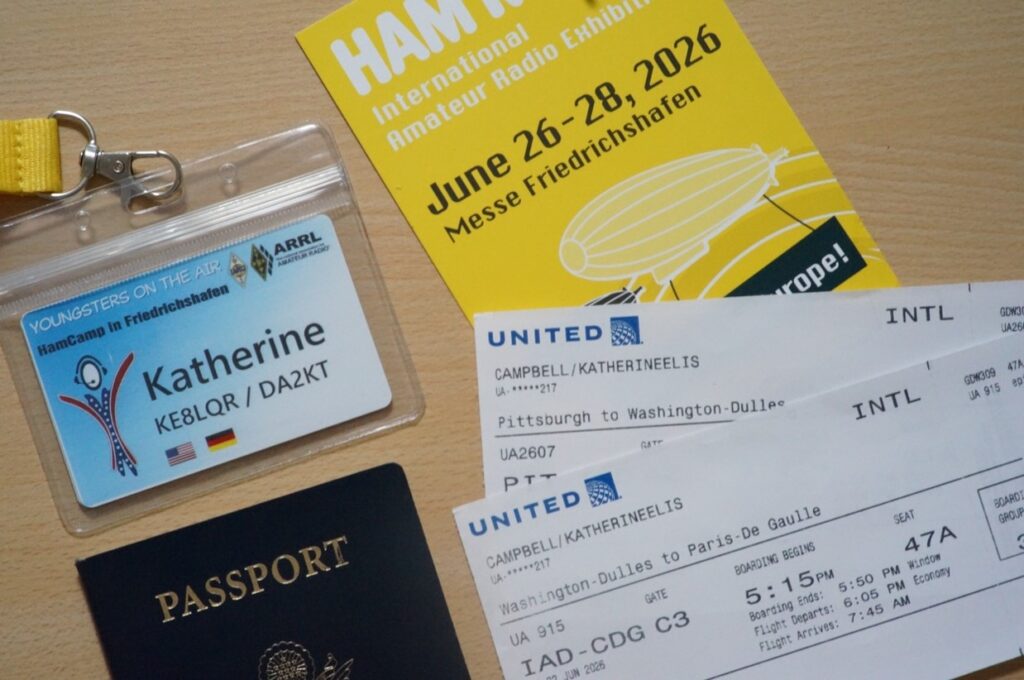
(Image/KE8LQR) The first and probably most obvious way that amateur radio could be enjoyed while traveling would be bringing a portable station with you and getting on the air from a new place. While being relatively simple, there are a few things to pay attention to:
- If you’re traveling to a foreign country, make sure you educate yourself on the rules and laws regarding operating in that country with the license you have from your home country. Many countries have reciprocal agreements with each other so that if you’re simply going on holiday, you can add a prefix or suffix to your personal callsign and operate easily, but this is not always the case.
- Carefully think through what you will bring to complete your station and how you will take it with you. If flying, I strongly recommend taking the components of your station in a carry-on bag rather than checking them, but both options are possible. Just remember to check your airline’s policy on transporting such equipment.
- Taking your own equipment while traveling also opens doors to interesting experiences like SOTA or POTA activations. You will want to consider opportunities like these when deciding whether or not to bring your own equipment.
Operating portably can be a lot of fun, but if bringing your own equipment isn’t possible, there is almost always a local amateur radio club you could visit. Some of my favorite travel experiences have been visiting an amateur radio club and operating a bit from there. For example, while in France this summer I had the opportunity to operate from both the F6KOP and F4KTR stations. This let me operate from France without having to pack my own equipment, while also visiting two stations that I hear on the air all the time.
Clubs aren’t the only way to operate without bringing your own equipment. Hams are almost always happy to meet other hams, and meeting new hams in a new place can be incredibly fun. The amateur radio community spans the entire world. You’ll find that anywhere you go, there are hams to meet. For example, while my host family and I were on holiday in Italy last year, Bruna Begali invited us to have coffee with her and tour the Begali factory. When I wanted to attend Ham Radio Friedrichshafen for the first time, Carsten, DM9EE, hosted us at his hotel for a few nights before the conference.
Looking back, it was amateur radio that gave me a reason to start traveling and showed me that I loved traveling so much. After a few trips to various conventions around the U.S., I realized I wanted to travel as much as possible, which was one factor in my decision to embark on an exchange this past school year. The development of the relationship between amateur radio and travel for me has been immensely interesting—when I first started traveling for amateur radio, it was specifically to attend amateur radio conferences for the conference. Now, I travel for the opportunity to see the friends I’ve made at the conferences and contests, or just to visit and see their country. I encourage you to leave some room in your suitcase for a radio on your next trip. Amateur radio really is a worldwide hobby. It’s flexible, so you can make it exactly what you want it to be both at home and when you travel. The hobby doesn’t have to be confined to your shack, and you may even find that it’s more enjoyable when experienced everywhere you go!
The post Ham Radio Youth Insights—How to Enjoy Amateur Radio While Traveling appeared first on OnAllBands.
OnAllBands
-
XU7X – Cambodia
[PRESS RELEASE] 20 International Operators Set to Deliver Unprecedented Amateur Radio Activity from Southeast Asia’s Premier Tropical Destination Koh Rong Island, Cambodia. The amateur radio community is invited to participate in one of 2027’s most anticipated DXpeditions: XU7X Cambodia. Operating from November 13-23, 2027 from the pristine Koh Rong Island off Cambodia’s coast. This landmark […] This post appeared first on: DX-World Want to know more about it? Read More
-
W9HT/VP9 – Bermuda
Josh, W9HT will again be active from Bermuda as W9HT/VP9 during October 17-20, 2026. QRV on HF + 6m; SSB, CW & FT8. QSL via home call direct. Josh was previously active from Bermuda (QTH: VP9GE) in 2019 & 2024. This post appeared first on: DX-World Want to know more about it? Read More
-
NEW ARRL 10-Band DXCC Award
The NEW ARRL 10-Band DXCC Award Plaque recognizes amateur radio operators who have confirmed two-way radio contacts (QSLs) with 100 or more DXCC countries on all major HF bands from 1.8 – 50 MHz. Like the 5-Band DXCC plaque, the 10-Band DXCC plaque comes as a handsome wooden frame with a ceramic, blue-embellished tile inlay. […] This post appeared first on: DX-World Want to know more about it? Read More
-
Ham Radio Contesting 101: Basic Propagation for Contesting
Editor’s Note: OnAllBands is pleased to post a series of articles written by accomplished amateur radio contester and DX Engineering customer/technical support specialist Kirk Pickering, K4RO. The articles, originally published in the National Contest Journal from 2008-2011 and updated with current information, offer valuable insights for both contesters new and old.
***
Welcome back to Contesting 101. In the last installment, we covered basic antennas for contesting. We discussed the importance of target areas and how we might use the patterns of simple antennas to work to our advantage. Knowing where to orient our antennas is important, but we also must know when we are most likely to have propagation to a target area on a given band.
One of the things that makes contesting interesting is the challenge of maximizing the use of available propagation. Not every band is open to every direction at every time, and the successful contester must learn which bands at what times can produce the best results. There are hundreds of books and thousands of articles devoted to the study of propagation, as well as propagation prediction tools. The reader is encouraged to explore the many resources available. In this brief article, I will attempt to cover very basic HF propagation as it relates to contest operating.
Follow the Sun
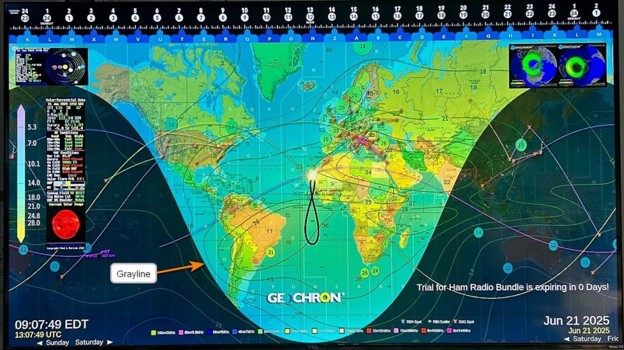
One of the best indicators we have for understanding propagation is the position of the sun relative to our location on earth. As the earth rotates along its axis, the sun illuminates one half, while the other half remains in darkness. Every rotation, of course, takes 24 hours and is how we define a calendar day. Different tools have been created over the years to help us understand the position of the sun, starting with the sun dial. As contesters, we are interested in seeing how the earth, as a whole, is illuminated. There are paper graphical tools to help such as the “DX Edge,” which was sold decades ago. Today, the Geochron Digital Atlas 3 4K World Clock with special Ham Radio Bundle includes real-time propagation layers for operators that allow tracking of the gray line and other benefits.

The gray line displayed on the Geochron Digital Atlas using Mercator projection. (Image/K8MSH) There are also three-dimensional globes which show the sun’s illumination on the earth. With the advent of the computer age, we now have programs such as Geoclock and various websites to help “show us the light” across the planet. Of particular use are programs capable of presenting maps in an azimuthal equidistant projection, centered on our location.
Editor’s Note: Some current propagation tools and resources are discussed in these OnAllBands articles, “Propagation Paths—The Long and Short of It” and “HF Propagation at the Equinox.”
The Ionosphere
The reason that we are so interested in the position of the sun is because of its effect on the ionosphere, a belt of charged particles surrounding the earth in the upper atmosphere. The ionosphere has a different composition when lit by the sun, compared to when it is not lit. The sun-lit area might typically have four layers, with the D-layer closest to earth, the E layer above that, and the F1 and F2 layers above that. In the areas of darkness, the D and E layers essentially disappear, and the F1 and F2 layers combine into a single F layer at night.
The density of these layers changes not only with the position of the sun, but also with the number of sunspots and the resulting solar radiation on any given day. Knowing that the layers exist is certainly interesting, but what really matters to contesters is the effect that the ionosphere has on radio propagation. In general, the more highly ionized the layers, the more they support the refraction (bending) of higher frequencies. More ionization also means more absorption (attenuation) on lower frequencies. The refraction of HF radio waves in the ionosphere is responsible for the “skip” phenomenon, allowing the magic of worldwide propagation to occur.
Follow the Maximum Usable Frequency (MUF)
One feature of the ionospheric refraction phenomenon is that different frequencies bend at different angles. Some angles are so slight that the radio wave does not return to earth. Generally, the higher the angle (more toward the zenith, or straight up) the shorter the skip. Likewise, the lower the angle (toward the horizon) the longer the skip. For a given target direction, there is an upper frequency limit at which communication can occur. This limit is called the Maximum Usable Frequency, or MUF. Propagation tends to be best at the MUF, so it is important for the successful contester to be aware of the MUF at any given time. (Editor’s Note: The Geochron bundle mentioned above provides MUF visualization.)
Learn by Operating
It simply can’t be said enough. The best way to learn about propagation is to be in front of the radio as much as possible during contests and any other time that you can operate. Each hour will present different conditions as the earth rotates along its axis. Some contesters describe DX contests as “watching the earth turn.” We will go through an example of a typical DX contest effort from middle Tennessee. The exact times and band openings will be different for each location, but hopefully this will give an example of the kinds of patterns to look for. For the purposes of demonstration, we will assume some decent conditions for our example contest, with enough solar flux to support reliable openings on 10 meters to Europe. We will only describe one solar day. Note that in a 48-hour DX contest, conditions often will vary considerably between the two days, but the same general patterns apply.
Typical DX Contest Openings
0000-0200z—Contest Start Time
The sun has set in middle TN, but because of the decent solar flux, western paths are still open on the high bands. There is plenty of sunlight illuminating the path between TN and JA, and JA signals are loud on 15 meters. The only signals heard on 10 meters are from South America, an indication that the MUF toward JA is somewhere above 21 MHz but below 28 MHz today. No signals from Europe are heard on 10 or 15 meters. The path of complete darkness between TN and EU means that the denser layers of the ionosphere have dissipated, and the MUF to EU is well below 20 MHz. We are hearing some EU on 20 meters and hearing EU quite well on 40 meters. As a single operator, we must make a choice: work JA on the high bands or work EU on the low bands. I would probably milk the 15M opening to JA first and then switch to 40M for EU after the high bands close to Asia. The openings to Asia are rarer and less reliable from middle TN. The same opening might not exist on day two, so we will choose to “make hay while the sun is shining.”
0200-0400z
The high bands have closed to Asia, and the only target population center open is Europe on 40 meters. Eighty meters is also starting to open to Europe—especially eastern Europe. Our sunlight map program shows us where the terminator or gray line is located. The gray line is the area between sunlight and darkness—either dawn or dusk—which constantly turns across the globe as the earth spins. Stations located along the gray line often experience enhanced propagation as the terminator crosses over. The astute contester will keep their eye on the gray line and pick up some nice multipliers on the low bands. ‘
0400-0600z
As the sun comes up across the European continent, signals on 80 and 160 meters reach their peak signal strength. With a careful eye on the gray line, it should be possible to work several European countries on 80 and 160 meters.
0600-0800z
With the sun completely up in Europe, the 80 and 160 meter bands are no longer open. The D and E layers have reappeared over EU in the presence of sunlight, and these layers act like a sponge, absorbing signals below 5 MHz. There is still good propagation to EU on 40 meters, so we work what we can on that band.
0800-1000z
Some propagation to Europe is still available on 40 meters, but it is dying out. The D and E layers have become denser with more sunlight over Europe, and absorption begins to attenuate 7 MHz signals. We are still in complete darkness in middle TN, and the high bands are essentially closed in all directions. This is a good time for some aggressive search and pounce on the low bands for the many Caribbean and South American multipliers.
1000-1200z
The sun has now set in Asia, so the D and E layers are disappearing between TN and Asia. We are beginning to hear signals from Japan on 40 meters. As our local sunrise approaches in middle TN, we prepare for our own gray line opening. The period immediately surrounding sunrise is our best (and only) chance to work any Asian stations on 160 meters. We spend a lot of effort on 80 and 160 meters while our brief gray line opening lasts, looking for the rare multipliers which only are heard during this window.
1200-1400z
The sun is up now in TN, and the high bands are open to Europe. Often if conditions are good, there will be a strong opening on 20 meters first. Sometimes the morning opening comes on so fast that it can be disorienting. One minute there are hardly any signals at all, and the very next minute, the band is jam-packed wall-to-wall with signals. Sometimes the biggest opening from TN is on 15 meters. This is the time I want to be established on a good run frequency, “shoveling” European QSOs into the log as fast as possible.
1400-1600z
The high bands are still open to Europe. The name of the game is run, run, run Europe. It is the primary population center, and the majority of our QSOs will come from EU. We also might see stations appearing on 10 meters. The path between TN and EU has been illuminated by the sun long enough for the ionosphere to support an MUF as high as 30 MHz. If there is ANY opening on 10 meters, we take advantage of it to the fullest extent.
1600-1800z
It turns out we were lucky this year. Ten meters is wide open and remains that way up until the sun begins to set in Europe. Signals are unbelievably loud because we are operating right near the MUF. There is very little local QRM because most U.S. stations are skipping over us, and we can’t hear them at all. When the band is open, there’s no meter like 10 meters.
1800-2000z
With the sun setting in Europe, the MUF starts to fall, and 10 and 15 meters begin to close down in that direction. Twenty meters is still well open to Europe and beyond. We will also start to hear more African and Caribbean stations, as the sunset terminator line moves westward across the Atlantic Ocean. South American stations are plentiful and loud on 10 and 15 meters. There is still plenty of sunlight on those paths, plus North-South (also called trans-equatorial) propagation is very reliable, regardless of solar conditions. This is one of the reasons that stations near the equator can be so competitive.
2000-2200z
Twenty meters is still the band for working Europe. Because of the relatively high solar flux, the MUF has stayed at or above 15 MHz, and we enjoy great conditions on 20 meters toward Europe. 10 and 15 meters remain well open to the southern directions.
2200-2400z
As we approach the end of the first day, we start to hear Asia coming in on the high bands. The sun has been ionizing the directions to our west, and high bands are supporting a good run to JA on 15 meters. 20 meters is still open to EU, but we will concentrate again on the Asian opening since it tends to be much shorter in duration. We make sure to check 10 meters frequently (including calling some CQs) for any openings to the rare Asian multiplier areas. If the MUF creeps high enough, we might be able to have a short run to Japan. Europe will be pounding in again on 40 meters soon, so we will milk the high band Asian opening for all we can until that path is closed.
Day two may follow a similar pattern, or it may not. Depending on our QSO and multiplier totals, we may need to spend more time on a particular band to fill in some gaps. If we are a smaller station, we will have more luck calling CQ the second day. The big gun stations have likely all worked each other by then and will be looking for anyone new to work on day two.
That’s all for this installment. See you on the bands, and don’t forget to submit your log to the sponsor, no matter how many QSOs you made. It helps you, helps the sponsor, and helps the sport of contesting.
The post Ham Radio Contesting 101: Basic Propagation for Contesting appeared first on OnAllBands.
OnAllBands
-
PS1A – Algodao Island, SA-029
Fabio PY4YY and Marcelo PY2AE will be active from Algodao Island, SA-029 (Rio de Janeiro State West group) as PS1A during September 24-26, 2026. QRV on 80-10m; CW, SSB & FT8. QSL via Club Log / LoTW. More info here. This post appeared first on: DX-World Want to know more about it? Read More
-
C6AYM – Bahamas
Eric, K9GY will be active from Eleuthera Island (IOTA NA-001), Bahamas as C6AYM during August 5-10, 2026. QRV on 80-6m; CW. Participation in the WAE CW contest (Aug 8-9). QSL via LoTW. NOTE: Eric plans future C6 activity from NA-048 (Bimini Islands), NA-054 (Berry Islands) and South Bahamas (NA-113). This post appeared first on: DX-World Want to know more about it? Read More
-
DX-World Weekly Bulletin
[#673] The latest FREE NON-SUBSCRIPTION DX-World Weekly Bulletin written by Bjorn ON9CFG is available to download. Click below to get the newest edition which this week runs to 17 pages. Previous bulletins can all be found here. Please contact Bjorn with any updates or errors. DOWNLOAD THE LATEST BULLETIN ===== This post appeared first on: DX-World Want to know more about it? Read More