Hello again, everyone. This week let’s talk about combining our Parks on the Air® (POTA) activations with our favorite contests. Not every contest will align perfectly with POTA, but many can work quite well together. Personally, I find contesting from a park more enjoyable and relaxing than operating from home. It’s a great way to step away from everyday responsibilities and enjoy radio in a different environment.
So, how do we combine contesting with POTA? Let’s start by looking at a few contest types that naturally lend themselves to portable operation—primarily State QSO Parties and State Parks on the Air events.
First, a quick reminder: POTA itself is not a contest.
You can activate a POTA park on any band your license allows. However, contesting on WARC bands is generally prohibited by a long-standing “gentlemen’s agreement” in the amateur radio community. Most State QSO Parties explicitly exclude the WARC bands (30, 17, and 12 meters) and 60 meters in their official rules. Always review the rules for the specific event to ensure you’re operating within its guidelines.
State Parks on the Air Contests
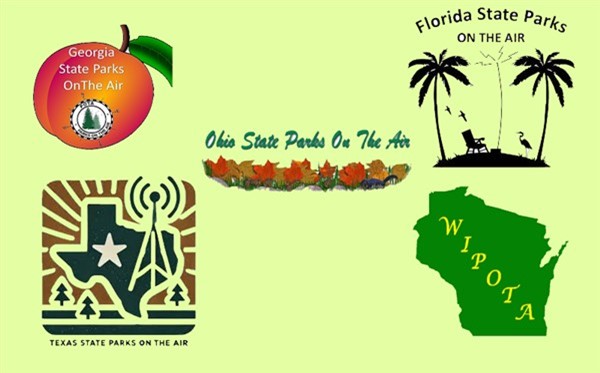
One of the oldest examples of State Parks on the Air Contests is Ohio State Parks on the Air (OSPOTA), which began in 2008 as a way to promote amateur radio fun. It’s held each year on the first Saturday after Labor Day. Because it predates POTA by several years, it uses its own unique set of park abbreviations. Also, only Ohio State Parks count as multipliers.
My advice for OSPOTA is simple: Log what you hear during the contest and sort out any issues with the park designator afterward. Since POTA park numbers are not part of the required exchange, this won’t cause problems, but I do recommend keeping a notepad handy to jot down any out-of-state park numbers for later reference.
Other states—including Georgia, Texas, Florida, and Wisconsin—also host similar events. Unlike OSPOTA, most use the standard POTA park numbering system.

State QSO Parties
State QSO Parties are another excellent way to combine contesting with POTA. They tend to be more relaxed and beginner-friendly, often with a casual atmosphere where brief rag-chews can even pop up during the event.
In these contests, multipliers are typically counties within the host state. As a result, portable operators often set up in less common counties—frequently from within POTA parks. While they usually don’t advertise the POTA activation during the contest, they don’t need to.
Here’s an example:
WG8X is operating in the Virginia QSO Party from Smyth (SMY) County, Virginia, at a location within a POTA park. The exchange includes a serial number and county:
- WG8X: “N8DXE, thanks, copy 001 SMY”
- N8DXE: “Thanks, copy 015 OH, 73”
That’s it; no POTA number is exchanged. However, when WG8X uploads logs to the POTA system, N8DXE receives hunter credit for the park contact.
One important tip: Always submit your logs to both the contest sponsor and the POTA website. You may earn a certificate for your efforts.
Most contest logging software can export an ADI file, which can be uploaded to POTA or similar programs like World Wide Flora & Fauna (WWFF).

Tips for Success
If you plan to operate from a park during a contest, consider registering your activation on the POTA website. You can do this by going to the “Scheduled Activations” page. This is one of the few times I regularly use the scheduled activations tool, assuming the contest rules allow self-spotting.
If you’re operating CW or digital modes, scheduling your activation becomes even more valuable. When the Reverse Beacon Network detects your signal, it automatically matches your activation with the signal it detected and spots you on the POTA site. You’ll know it’s working when you start receiving calls from stations that aren’t participating in the contest. Be patient with them. These operators may not understand the contest exchange, so take a moment to guide them through what you need.

Final Thoughts
I like to return to the same location each year for certain contests. It gives me a chance to refine my setup and improve my results. In the end, I’m never really competing against other stations, just against my own past performance.
Are these the only contests that work with POTA? Not at all. While I prefer QSO Parties and State Parks events, nearly any contest can be operated portable with a bit of planning.
A great resource for finding upcoming contests is contestcalendar.com. With a little preparation, the opportunities to combine POTA and contesting are nearly endless.
If you are camping as part of your activation, be aware of and respect quiet hours. Most campgrounds have these posted. Here in Ohio, it’s usually 10 pm to 7 am, but this can vary by location.
Speaking of power levels, it’s best to leave the amplifiers at home. I typically operate at low power—around 30 watts on CW and 100 watts on SSB —and have no trouble making contacts.
I hope I’ll hear you on the air from a park during an upcoming contest. Until then, let’s get out there and activate something!
73, WG8X
The post Portable Ham Radio Insights: Combining Parks on the Air with Contesting appeared first on OnAllBands.