
Wow, what a week! Not much time for radio, but the coding bug dug in deep this week.
The Random Wire newsletter is the journal of what I’m doing during the week, and serves as a companion to EtherHam.com where more detailed, technical content gets published. I hope you enjoy both the newsletter and the website.
I enjoy hearing from readers and hope you’ll share what is on your workbench!
KJ7T Tom

1. QRV: Are You Ready?
Coding
Not a lot of radio play this week, as I got caught up in “the zone” while coding for my day job. Two days in a row, I started in on a project and when I looked up, the clock said ten hours had elapsed. It’s been a while since I entered a flow state like this. I kind of miss it. Time flies and the work can be very satisfying. (If you code, you know.)
What did I do? First, I rebuilt an issues-and-actions tracker for work that covers a five-year rolling time period. Then I converted a +800-person directory from a PDF document to an online database embedded in a WordPress site, to help my work team keep our member information updated. This was honestly much more complicated than it sounds.
For the online directory, I also added some protection against scrapers (bots that grab everyone’s email from a website). Emails in the directory are never displayed in the public HTML page, instead being protected by signed tokens and a rate limit with a lockout if exceeded. Clicking the email link opens a “reveal page” that shows the email address as visible text (with an app-launch attempt on top). The reveal links are rate-limited per visitor, so a bot trying to harvest hundreds of addresses in bulk gets throttled and locked out — a real visitor clicking a few links will likely never notice.
And then one of my work teammates cranked up our annual conference web pages and asked for help, resulting in another day two days of revisions and coding. Along the way, I found several plugins that were weighing down every page. Click click, poof — they are gone, and what they were doing has been replaced with some custom fields, Cascading Style Sheet magic, and a few custom-built plugins. I saved a lot of memory overhead and the pages load faster. Yes, satisfying.
Ultimately, we ended up with a group of custom plugins, all nested together under “Conference” in our Dashboard menu. This will help us manage most of the content for our annual conference and business meeting. It will also greatly reduce the repetitive entries we would normally make in the actual HTML pages. That will mean fewer errors and less time spent figuring out all the little gotchas that can be so hard to find in hundreds and hundreds of lines of content.
Radio
I was able to hang out on the M17 net last Saturday, using my Talk2Me PoC radio and, out of curiosity, simultaneously listening with BlueDV on my laptop. The M17 net is always educational, and it’s fun to hear about the continued evolution of M17 as a protocol, in hardware, and in apps like MSeven.
If you click this Talk2Me PoC radio link, you’ll discover a new feature I’m just starting to build out at EtherHam.com: a compendium of the gear I’ve used, reviewed, or recommended. I’m just getting a start on this so content is light. Translation: more to do!
I also finished up my series on push-to-talk over cellular radios and started a new series on MeshCore. Still in process are some articles on DMR.
APRS continues to be on my mind. I run it in my pickup truck on my Yaesu FTM-300D mobile radio…and on my phone with APRSdroid. But I also have the LightAPRS Gateway (a VHF 1-watt fill-in digi and igate) in the garage, and now a LoRa APRS igate/digi (UHF) running about 100 milliwatts. I’m waiting on another T-Deck Plus built around 433MHz so I can play with APRS messaging over the LoRa APRS station.
In summary, it was a week of coding with some radio and writing, too. As Julie Andrews sang:
♫ These are a few of my favorite things ♫
2. New on EtherHam
-
Push-to-Talk Over Cellular: The Buyer’s Checklist — Part 4 of 4. Part 1 was the lot walk. Part 2 was my own radio purchase, start to finish. Part 3 was the radio itself, on the bench and on the road. Part 4 is the short version — everything worth checking, without the weeks it took me to learn it. Three articles, several weeks, and my own money all contributed to this list. If you only read one piece in this series, spend your time with this one.
-
Building a MeshCore Node — Part 1: Why, What, and How — CascadiaMesh, the MeshCore community covering the Pacific Northwest, promises you can get on the mesh in three easy steps: pick a device, flash it, pair it to your phone. I wanted to test that claim the honest way — buy the hardware, do exactly what the guide says, and see where it actually breaks. Spoiler for Part 1: it worked fine. Flashing a LilyGo T-Echo Plus turned up one genuine hardware-vs-host-computer mystery (solved), and getting a companion radio talking to a repeater took about as long as promised. Part 2, where I will cover building and configuring a MeshCore repeater, is where things promise to get more interesting.
-
Expanding Technician Privileges: The Fix Needs a Push — There’s a real, already-written fix for one of Technician licensees’ most common complaints — and it’s been sitting in an FCC docket since 2018. The petition would open modern digital modes like FT8 to Technicians on 75, 40, and 15 meters, plus some phone privileges, with almost no opposition on record. Seven years later, it’s still stuck — not from pushback, but from plain bureaucratic inertia. I dig into why it hasn’t moved, what it still wouldn’t fix (including a telling admission buried in ARRL’s own petition language), and why right now — with the FCC’s current deregulatory docket wide open — is the moment to actually push it through.
-
Weekly Report: July 30, 2026 — The usual: Band Conditions, Digital Radio News, Groups.io Digest.
A New “EtherHam Gear” Page
I added a gear page on the EtherHam.com website. As my content catalog grows, I am finding it harder to come back later and find the equipment I’ve reviewed or recommended. Going forward, I’ll populate the gear page with those devices, and then link to the gear listing in my articles.
This methodology should make it easier for visitors to find the items I talk about. It will also make it easier for me to maintain links to items, because those links do change at vendor sites.
The Gear page is produced by a custom WordPress plugin, which was a lot of fun to build.

Frankly, there are already plugins that will add short, custom links to an item, but as I researched them, I found them bloated and complicated. Some require a connection to a third-party service. I also don’t like using anything that says it features “link cloaking.” Even though this is actually a common practice, it just sounds and feels wrong. My plugin is trim, does only what I want, and lives entirely on EtherHam.com. If you run a WordPress site and want the code, drop me a line. It is one PHP file, 419 lines long.
3. On The Bench
Last week, I included this item in the Short Stack:
APRSdroid 9M2PJU Mod: The Enhanced APRS Companion for Android, Built by Hams, for Hams — Hamradio.my — A ham-built mod to APRSdroid. Given the LoRa APRS iGate work on EtherHam right now, this is a natural companion piece.
Well, I installed it. If you go down this road, there are a few wrinkles to be aware of. First, you must uninstall APRSdroid if that is already on your Android device. Second, the app requires granting several permissions, but fortunately, granting permissions is as easy as pushing one button, then tapping “allow” on the ensuing popups.
Enter your call sign and your APRS passcode (just search online for “APRS passcode”) and you’re ready to go.
I’ve been using it in the pickup truck as KJ7T-5 and it is working fine.
I installed this version because it offers the ability to connect with LoRa devices if they have Bluetooth low-energy (BLE) and use a KISS TNC protocol. This means that with the right LoRa tracker, I’ll be able to connect to the other APRS network most amateurs aren’t aware of that runs on LoRa radio at 433MHz. There is a clear, step-by-step guide for this at https://aprsdroid.hamradio.my/#lora.
My 433MHz LoRa device is on its way to me from across the Pacific. I’m just very curious how this will work. One surprise for me was learning that LoRa APRS stations that are igated hit APRS-IS, so they show up on sites like aprs.fi. (Click to see my LoRa APRS station on aprs.fi.)
4. M17 Net Notes
From Saturday’s M17 net on America’s Kansas City Wide network.
-
M17 is a digital voice and data protocol with hardware and software solutions.
-
The LinHT handheld transceiver continues to move forward. Uses GNU Radio software.
-
Other software that runs M17 includes DroidStar, the MSeven app, and QSO One.
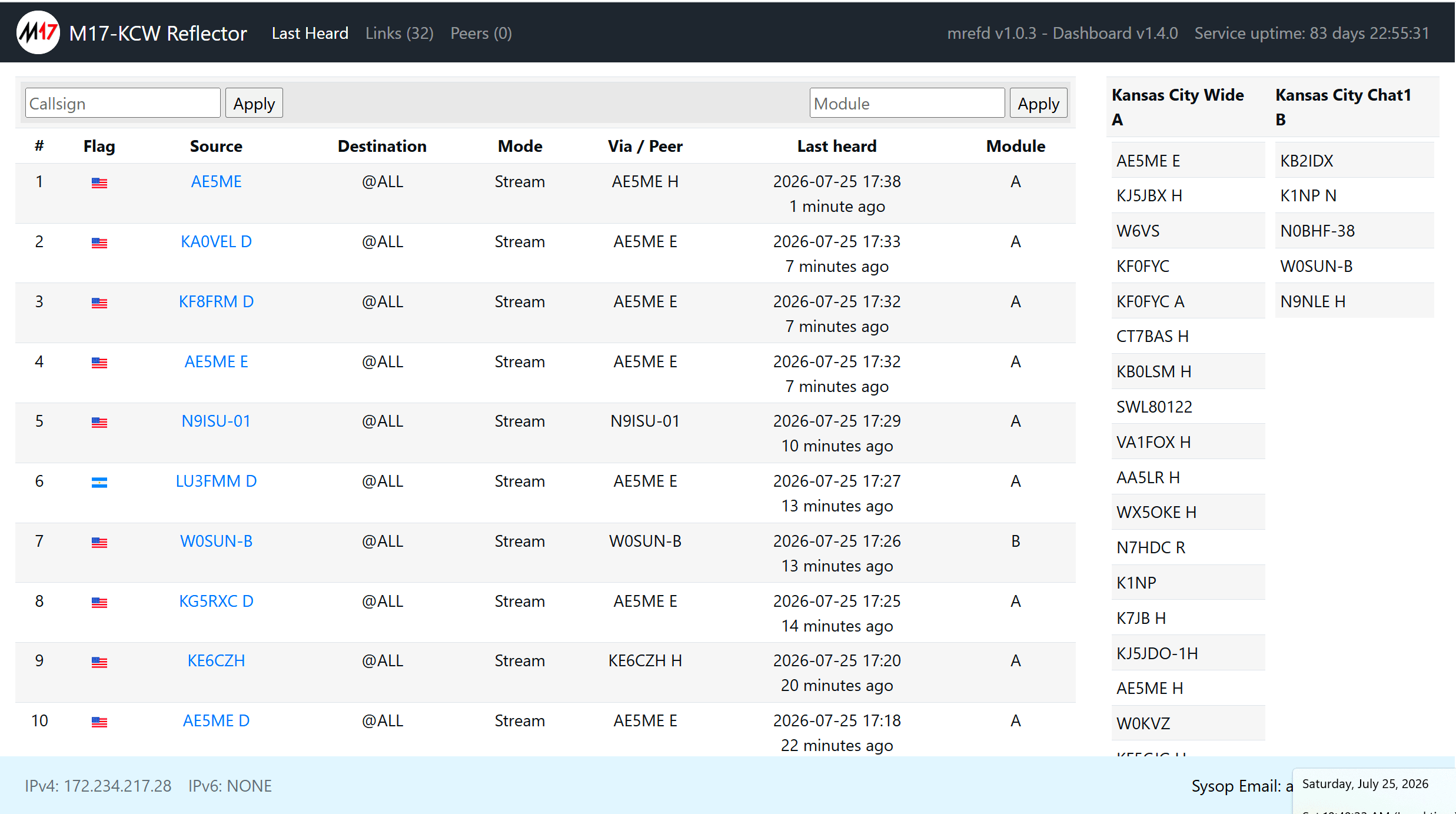
The M17-KCW reflector carries primary KC Wide network traffic on module A (M17-KCW A). The B module on M17-KCW (also called “the B side”) is for M17 only; it is not connected to the A side. In the screenshot below, you can see some stations on module A and on B in the right-hand side of the reflector dashboard.
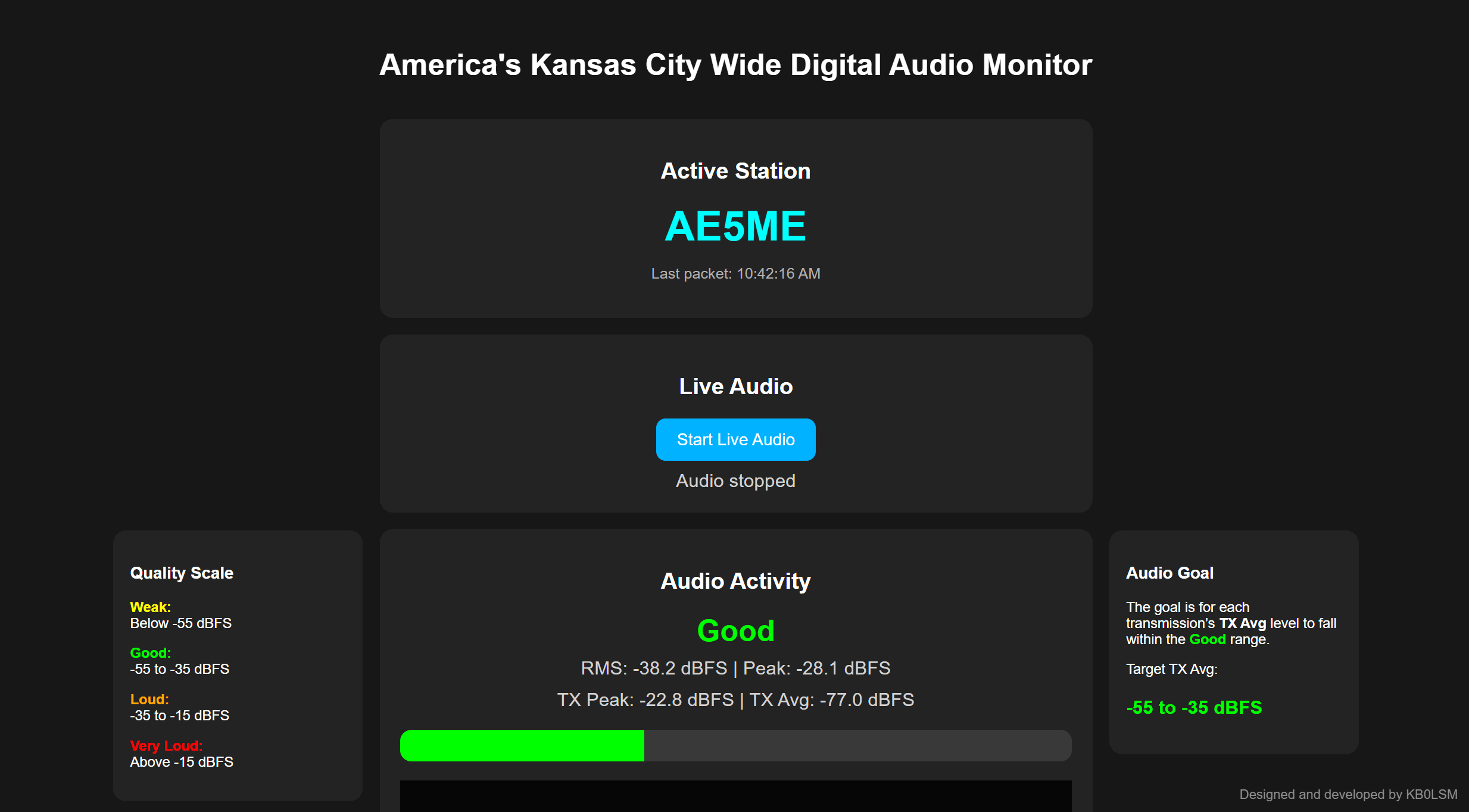
There is also a great service offered through KC Wide: seeing your live audio level. Find this at https://level.kansascitywide.com/. The interface looks like this:
There was very interesting commentary about FreeDV on HF and 2-meter sideband. Exploring FreeDV is on my list of things to dig into.
The net closed with some conversation in the net chat about radiograms. Some of the helpful links that were shared in the chat are:
5. Short Stack from the Interwebs
Pulled from the aggregated feeds on EtherHam (etherham.com/feeds/), items from July 28–30.
SDR
-
Testing Airspy’s New WebSpy Web SDR Interface with an RTL-SDR — RTL-SDR Blog — A look at Airspy’s new browser-based SDR interface.
-
Building a $50 BOM Software Defined Radio with a HT9201 20 MHz ADC and an FX2LP USB Controller Clone — RTL-SDR Blog — Budget homebrew SDR build, bill-of-materials and all.
-
Radio Silence: A Native iOS App for Listening to Public KiwiSDRs — RTL-SDR Blog — A dedicated iOS client for the public KiwiSDR network.
-
TunerScope: A Browser App to Help Optimize HDTV Antenna Positioning with an RTL-SDR — RTL-SDR Blog — Clever repurposing of an RTL-SDR as an antenna-aiming tool.
-
DeepSDR Updates: Live Public Safety Incident Map with an RTL-SDR, Whisper and an LLM — RTL-SDR Blog — RTL-SDR plus Whisper transcription plus an LLM, mapped live. The standout item this week.
Digital Modes & RTTY
-
H-Mode: An Open HF Digital Mode That Turns Errors Into Ionospheric Measurements — Hamradio.my — A new open digital mode that uses decode errors themselves as ionospheric data.
-
Someone Turned a Sony PSP Into an RTTY Encoder — Hamradio.my — Exactly what it sounds like, and a fun homebrew read.
-
5D Web Programmer: A Free, In-Browser Codeplug Editor for the Yaesu FT-5D — Hamradio.my — Open-source, browser-based codeplug editing — no vendor software required.
Shortwave & Listening
-
RTI French Service Announces August 2026 Shortwave Broadcasts to Europe and North Africa — The SWLing Post — Fresh broadcast schedule for shortwave listeners.
-
Japan Times: The Uncertain Future of Shiokaze’s Shortwave Broadcasts — The SWLing Post — A look at the funding and future of the Shiokaze shortwave service.
-
Carlos’ Illustrated Radio Listening Report and Recording of Multiple Stations (July 21–28, 2026) — The SWLing Post — A week’s worth of DX catches with recordings.
Podcasts & Community
-
HRWB 268 – Diversity Reception with Dave AB7E — Ham Radio Workbench — Podcast episode on diversity reception techniques.
-
Ham Radio and the Possibility of Internet Over Ham Radio — Amateur Radio Today — A think piece on running internet traffic over ham bands.
-
Two Big Store Updates: Ship with DHL or UPS, and Taking PayPal Payments — TAPR — Practical update from the Tucson Amateur Packet Radio store.
Also Noted (Tech)
-
Amazon Accidentally Spent $1.8 Million Using Claude for Menial Coding Task, Went 860% Over Budget — Tom’s Hardware — A cautionary tale on agentic AI cost management.
-
These 3 Raspberry Pi Projects Solve Real Problems — and One Brings Back Cassette Nostalgia — How-To Geek — Relevant to anyone running Pi-based nodes or hotspots.
-
PSA: Your Watch Band May Be Messing With Your Laptop — Tom’s Hardware — Magnetic clasps triggering laptop lid sensors — a weird, easy-to-miss gotcha.
6. QRT: End Transmission
Plumbing, part 3. Get a dehumidifier, the plumber said, so I did. And I went low cost:
Dehumidifiers for Home, 1000 Sq.Ft Dehumidifier with 95oz Water Tank, Quiet Dehumidifier for Basement Bathroom Bedroom with 7-Color Ambient Light & Auto Shut Off, Sliver (this is an affiliate link)
The device has been pulling about a cup-and-a-half of water out of the air daily. It’s not silent — the fan noise is like white noise in the background, not really unpleasant at all. It remains on during my Zoom calls without disturbing me or the people on the call. The good-sized water tank and the automatic shutoff were key factors in my choice.
And the new moisture meter did arrive:
Klein Tools ET140 Pinless Moisture Meter for Non-Destructive Moisture Detection in Drywall, Wood, and Masonry; Detects up to 3/4-Inch Below Surface (this is an affiliate link)
Since I’m trying to sense moisture underneath the old linoleum flooring, I’m using the drywall setting. I don’t get exact/true measurements this way, but I do get relative measurements by comparing a known dry area against a suspected damp area. A week ago, the areas affected by the leak were about 10% higher moisture than the dry areas. As of today, measurements in the damp spots show about 6% more moisture. Meanwhile, the dehumidifier continues to pull moisture out. I’m guessing I’ll be ready to try the heat gun in about a week. I’m hoping this will let me flatten the tiles, and if I’m really lucky, the existing mastic will re-adhere to those lifted edges.
And with that, it’s time to say 73 and send my best wishes to you for a great radio-focused week ahead!
Remember to touch a radio every day!