
1. QRV: Are You Ready?
I went a bit DMR crazy this week. Hit the DMR category on EtherHam and you’ll see what I mean. Here’s the elevator version: I used OpenGD77 on a $100 Retevis RT3S radio to install the PNWDigital codeplug. What I learned along the way is shared in my new DMR articles.
I also took a dive into Winlink, APRS, and EmComm. I wonder how this essay will land, especially with folks deeply experienced in search-and-rescue, incident command, and related activities. I suspect that my take on incident command may go against the grain for some folks. But maybe not.
A scripting error corrupted my work database, and that took a day to unravel the cause and another day to clean the data. Paraphrasing a database guru I learned from many years ago: there is no such thing as a perfect database, only those with an acceptable number of errors. The number of errors I had this week was unacceptable so I dove in and fixed the problem.
And that pretty much sums up my radio and technology week: a lot of digital radio and little bit of coding and cleanup.
I saw good uptake of the new EtherHam Groups.io space. Remember: in this first phase rollout, it is limited to 100 subscribers. We’re almost halfway there so sign up now if you are interested!

2. New on EtherHam
Winlink Tells You What Happened. APRS Tells You What’s Happening. — I’m afraid I went a bit overboard on this essay, simply because of my background in emergency services/management. I’ve been an EMT on a rural ambulance service, a hospital commissioner, an underground mine rescue EMT, a search-and-rescue member. I was part of an ARES group for a while and also served as a state agency representative to the state’s emergency management department. Those roles gave me deep appreciation for how incidents actually unfold and get managed in real time…and I think that biases my point of view toward those working at the forward edge rather than those in the command center. It’s a long read so I included a table of contents to help you. One of the best moments for me while I wrote this was learning more about how LoRa radio actually works to pick out signals buried in the noise.
This was “DMR week” at EtherHam, with parts 2, 3, and 4 published. Part 5 will cover on-air etiquette and troubleshooting — including PTT habits, why they matter more on digital than on FM, and the answer to: if you can’t scan the band to find people, how do you actually find someone to talk to?
Introduction to DMR, Part 2: The ID, the Radio, and the Hotspot — Part 1 promised the ID, the radio, and the hotspot before ever touching a codeplug — this is that piece, delivered after the fact. It walks through registering a free DMR ID at RadioID.net, then lays out the actual fork in the road on radio choice: the AnyTone AT-D878UVII Plus for anyone who wants a download-and-personalize codeplug the same afternoon, versus the Retevis RT3S and OpenGD77 path this series has been running on, for readers who want the talkgroup/frequency separation badly enough to tolerate a rougher first hour. From there it’s a full step-by-step Raspberry Pi hotspot build — parts, assembly, and WPSD configuration — reused and adapted from an earlier hands-on build, plus a hard look at how much hotspot hardware costs today versus when that build first went up. Read this one before Part 3, even though it was written after it.
Introduction to DMR: Part 3 — Building Your First Codeplug — I flashed a new Retevis RT3S with OpenGD77, built a codeplug from scratch pointed at my hotspot, keyed up — and got silence. Then got silence again, for an entirely different reason. This is the unvarnished version of that afternoon: what a codeplug actually becomes once the four concepts from Part 1 turn into specific numbers that have to match specific other numbers somewhere else, why DMR answers a single wrong value with total silence instead of a useful clue, and what it does to your troubleshooting when fixing a genuine problem changes nothing you can see. If you’ve been putting off building your first codeplug, or you’ve built one and can’t work out why it won’t talk to anything, this one’s for you.
I added an addendum at the end of this article, titled: The settings, field by field. The addendum gives you a screen-by-screen accounting of the settings I used in the OpenGD77 CPS.
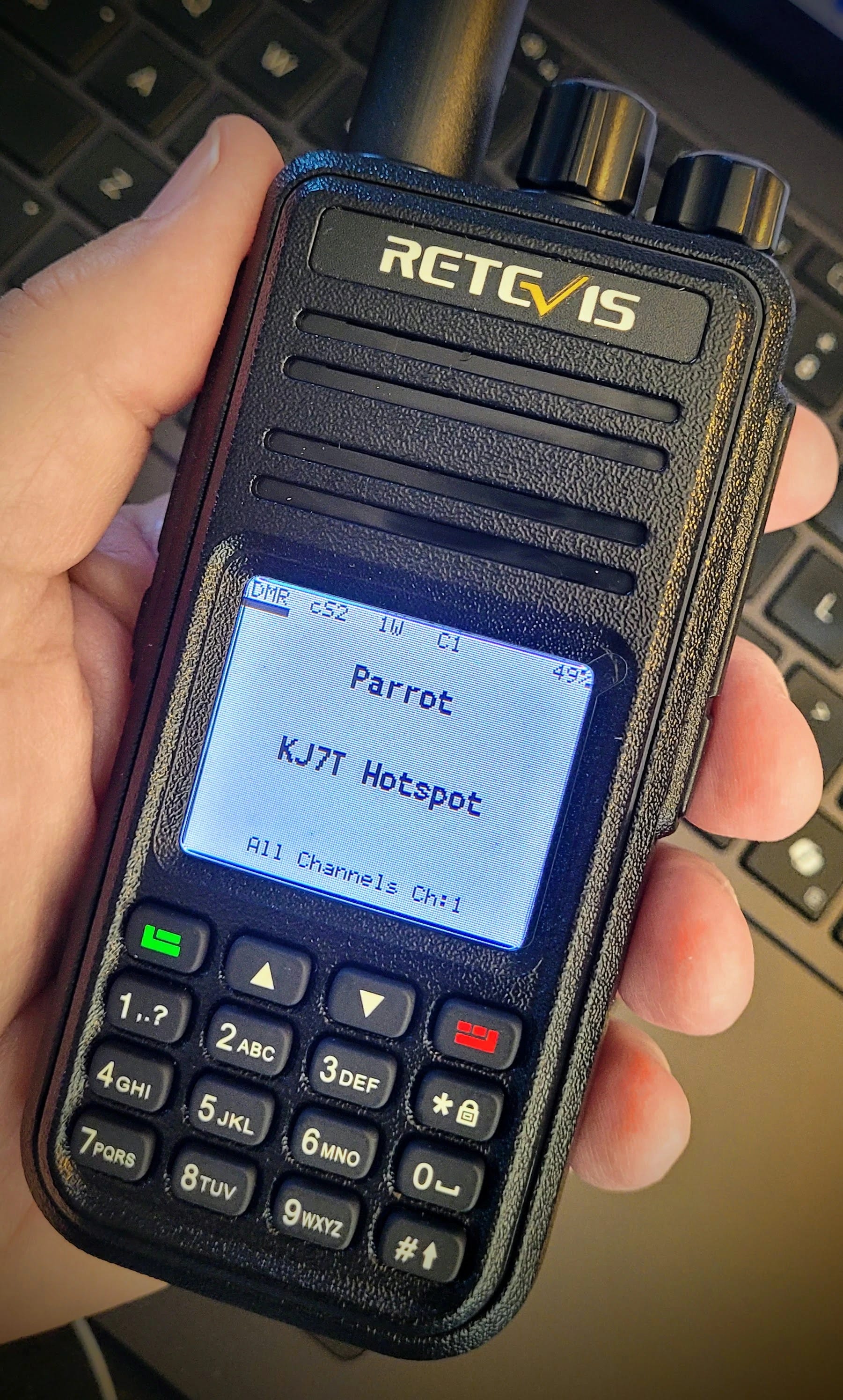
It’s a long article, so if you want the answer to the question “does the Retevis RT3S DMR radio work when programmed with OpenGD77,” the answer is yes:
Introduction to DMR, Part 4: Loading Somebody Else’s Codeplug — Part 4 of the Introduction to DMR series takes the opposite approach from Part 3: instead of building a codeplug from scratch, I downloaded PNWDigital’s ready-made OpenGD77 codeplug — 125 channels, seven zones, someone else’s careful work — and it took longer than building one by hand. Not because the codeplug was wrong. Because a community codeplug is built for that community’s network, and my hotspot was pointed at BrandMeister. That single unasked question sent me chasing filters, timeslots, and call types for hours while the actual problem sat one layer up.
Along the way: the CPS button that’s invisible at the wrong browser zoom, why the codeplug arrives wearing another operator’s callsign, the difference between a repeater talkgroup list and a hotspot one, and talkgroups that stay asleep until you kerchunk them awake. The piece also includes something I felt would help you picture how DMR is structured — a single diagram of how zone, channel, contact, talkgroup list, and network actually chain together, and why you should build that chain backward from the network rather than forward from the CPS.
Retevis RT3S + OpenGD77 Cheat Sheet: Every Control, Remapped from the Radioddity GD-77 — OpenGD77 was written for the Radioddity GD-77, and it runs beautifully on the Retevis RT3S — but the two radios don’t share a control layout. The GD-77 has four arrow keys; the RT3S has two buttons and a rotary knob, so the firmware reassigns them, and it reassigns them differently depending on whether you’re sitting on a main screen or inside a menu. The result is that a documented shortcut doesn’t fail cleanly, it does something else: the key combination the manual gives for changing zones will quietly change your transmit power instead. This sheet is every control translated for the RT3S, with the ones I’ve confirmed on my own radio marked as such and the rest flagged as untested.
Weekly Report: August 20, 2026 — Band Conditions This Week / Digital Radio News / Groups.io Digest. Summary:
-
The predicted A-index of 11 suggests we’re not entirely out of the woods yet, so keep an eye on the numbers before investing an evening in a long-haul DX session.
-
The MMDVM firmware for DMR received a merge (PR #362) that adds a configurable audio‑fidelity link option.
-
AllStarLink’s app_rpt was updated to version 3.10.4; the patch series (PR #1205‑#1207) adds a client‑disconnect helper, removes duplicated sanity checks, disables autoservice during safe‑sleep, and fixes thread‑creation leak bugs.
-
The LoRa APRS iGate repository received three commits on 2026‑08‑16 that update the T‑Deck hardware requirements, refresh the README, and add new image assets.
-
Community posts on the AllStarLink forum report connection refusals from keyed nodes, intermittent telephone‑portal operation, and general remote‑node connectivity failures.
-
Groups.io: 31 groups checked, 15 active, 493 total messages, 11 quiet. The most active groups in the set were Repeater Builder, APRS, and TinySA.
3. QSO One, the CGNAT Killer?
QSO One was built so hams could get on AllStarLink, EchoLink, IAX Direct, DMR, System Fusion, and M17 from a single app, without a Raspberry Pi, a radio interface, or a weekend of Linux. It’s free. Sign up with your callsign, download it for Windows or Android, and you’re on the air in about five minutes. More platforms are coming.
But one of the magical aspects of QSO One that we’re not hearing much about is that it works with CGNAT: “node mode and WT mode for AllStarLink are solid, with cellular and CGNAT handling that actually deals with carrier networks instead of just failing.”
As IPV4 addresses continue to become less available and CGNAT networks become more common, I suspect that QSO One’s secret sauce will be its ability to carry traffic through CGNAT networks.
4. APRS
#APRSThursday follow-up: the check-ins actually worked
In the previous issue, I mentioned that my #APRSThursday check-in attempts — from the LoRa tracker as KJ7T-3 and from APRSdroid as KJ7T-5 — went unanswered by ANSRVR and APRSPH. Turns out that wasn’t quite right. Digging through Sergei KJ5LOX’s APRS Observer dashboard, both check-ins are right there in the log, addressed to ANSRVR and timestamped clean. The messages went out fine; I just never got a reply back.
The reason surfaced in Michael Diturno’s weekly #APRSThursday recap: ANSRVR itself had been down, and Jeff W4JEW and the APRS Foundation rebooted it to get the net back on track for the 752 operators who checked in that week. So the silence wasn’t anything on my end — it was a server having a rough week, now fixed. Good reminder to double-check the infrastructure before assuming the bug is local.
One more thing that dashboard surfaced: KJ7T-5 (APRSdroid) is reporting altitude cleanly, but KJ7T-3 (the LoRa tracker) shows up as “Unknown” for altitude every time. Almost certainly a config setting I haven’t dug into yet — but to even get in there, I’ll need to break out the ToughBook. My regular laptop is ARM-based, and the T-Echo just won’t talk to it over USB. More on that once I sort it out.
This week? I got checked in no problem:
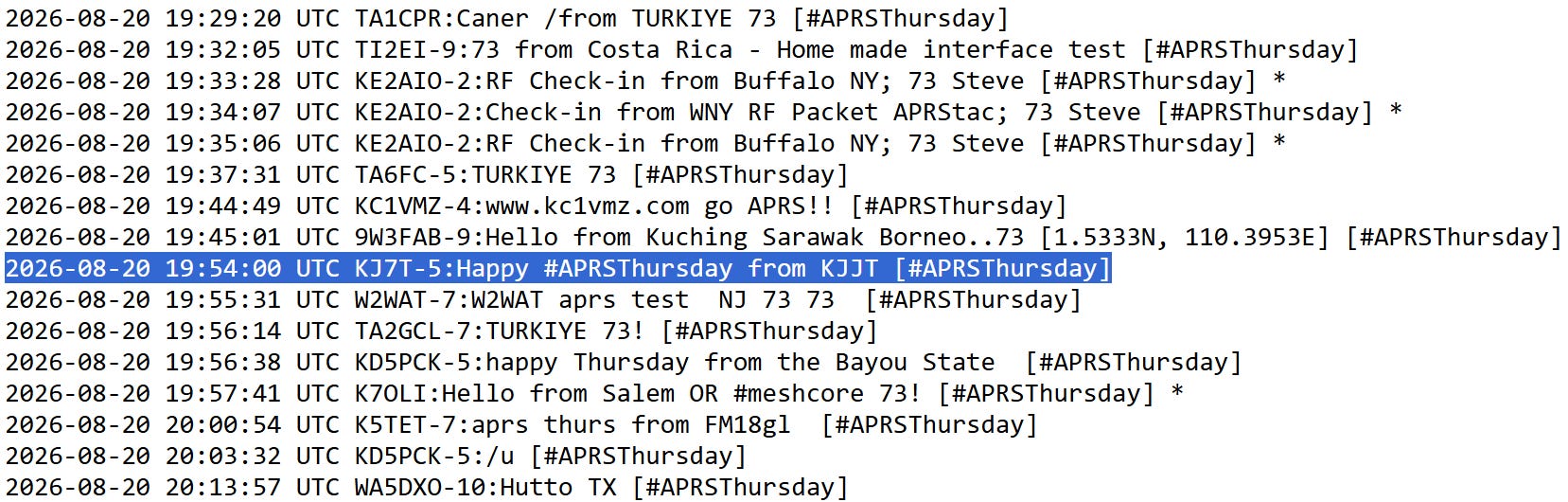
Did you happen to notice the MeshCore checking from K7OLI? That looks interesting!
APRS OTA
A few days ago, I received a very nice email from Jared K0TFU, the ham who built https://aprsota.org. He wrote:
It’s been fun to watch hams begin to use this. One highlight for me was this string of QSOS from OE7BOE in the Tyrolean Alps https://aprsota.org/OE7BOE/ops/2.
I’ve now got a stats page up and running at https://aprsota.org/stats so everyone can see the usage of the service. We should pass 500 QSOs made using APRS OTA sometime later today, and have hams in 14 countries who have participated.
When you read his radiograms you can see this is fresh work. I predict APRS OTA will become another popular way to use radio and technology. It looks like it is off to a great start.
5. The Surprising Family Tree of Yahoo! Groups
If you’re a ham who misses the old Yahoo! Groups, here’s a piece of trivia that might reframe things: the person who built the service you’re pining for is the same person who built the one a lot of us use now.
Groups.io’s founder, Mark Fletcher, didn’t start with Yahoo! Groups — he started with a service called ONElist back in 1998, a free mailing-list host built for exactly the kind of niche system hams have always relied on. ONElist soon merged with a competitor called eGroups, and in June 2000 Yahoo! bought the combined company and rebranded it as Yahoo! Groups.
For a while it thrived. But Yahoo! management largely stopped investing in it. Over the next fifteen-plus years, the platform calcified under their watch: clunky moderation tools, a dated interface, and eventually real spam and security problems that group owners had no good way to address. Fletcher, watching from the outside as the company let his creation rot, eventually decided to build the successor himself. Groups.io launched in beta on September 23, 2014 — six years before Yahoo! finally pulled the plug on Groups on December 15, 2020.
That timing turned out to matter a lot for amateur radio. When the Yahoo! Groups shutdown was announced, hundreds of ham-related mailing lists — build groups, DX nets, kit-support forums, digital mode communities — suddenly needed somewhere to go, fast, with their years of archived messages intact. Groups.io was ready and purpose-built to catch them, and hams migrated in numbers well out of proportion to the general population of orphaned Yahoo! Groups. Today, ham radio groups punch way above their weight on the platform. By one count, 10 of Groups.io’s top 40 largest groups (out of roughly 100,000 total) are amateur radio communities, with the Softrock40 group alone landing at #4 overall with over 8,000 members, trailing only a couple of non-radio giants and IBM’s internal list. YouTuber Callum, better known as DXCommander, is often credited with giving the migration wave an extra push by publicly encouraging hold-out groups to make the jump.
We are living with the legacy of Yahoo! Groups. It didn’t vanish when Yahoo! finally killed the service in 2020. Instead, it moved, largely intact, onto Groups.io, which is why the platform now provides such outsized support to the amateur radio community specifically. The free, low-friction, member-run model that made Yahoo! Groups worth missing in the first place is exactly what its original builder set out to preserve and protect from further neglect when he built its successor.
If you’re active in a ham radio group on Groups.io today, you are standing on infrastructure with a direct lineage back to a scrappy 1998 mailing-list startup — one that Yahoo! bought, neglected for two decades, and finally killed, only for its original builder to come back and keep it going for communities like ours.
6. Old IEEE Articles on Amateur Radio & Tech
It’s been far too long since I dove into the past offerings of IEEE Spectrum. I did that this week, harvesting a handful of interesting titles for you to consider. Maybe one will spark a project idea.
-
The Most Hackable Handheld Ham Radio Yet — March 27, 2024.
-
Detect Quakes With “Raspberry Shakes” — September 27, 2023.
-
Detect Solar Flares and Gamma-Ray Bursts for Less Than $100 — January 19, 2022.
-
Hacking Ham Radio for Texting — November 15, 2021. This is the one that piqued my interest, because instead of two chips, I could probably use a single Arduino Uno Q to run it. It would cut the two-chip serial bridge in the original design down to one board’s built-in RPC, gain Wi-Fi for APRS-IS gateway access, and get real Linux tooling for the UI/storage side. The tradeoffs would be battery life, needing to either port or replace MicroAPRS, and building a radio audio interface.
7. Gadgets
Yaesu VX-6R charging
I bought an $11 USB charging cable for my Yaesu VX-6R handheld radio. A side benefit: it also fits my Yaesu FT-70D handheld. I am finding that it works fine to charge the FT-70D battery but conversely, not with the VX-6R. I get a “NO BAT” message on the VX-6R’s screen when I try to charge with the USB cable. The radio operates as if it is on external power when I turn it on with the cable connected. When I disconnect the cable and try to turn on the radio: nothing.
USB Charger Cable for Yaesu Radio CD41 CD47 CD15A CD26 (this is an affiliate link)
So I’ve ordered a fresh battery and high-capacity charger, and neither are original Yaesu products. Fingers crossed on this purchase.
It may be that my original battery sat fully discharged too long and now the radio doesn’t even see it when it is connected. I’m guessing this might be the case. Perhaps fully charging it with the hi-cap charger will work. If not, I’ll still have a new battery.
Tri-Band Yaesu VX-6R Submersible Amateur Ham Radio Transceiver (144/222/440) (this is an affiliate link)
The VX-6R is a tri-band analog FM transceiver. The 220 MHz band operates at 1.5 watts out instead of the full 5 watts out on 70 cm and 2 meters. In the U.S. market, it comes with NOAA weather channels and maritime channels. But what I like most about the VX-6R is how it feels in my hand. It is a compact radio that fits my medium-sized hands just right. The case has enough texture to feel secure in my grip. And since I live in a place with a lot of winter rain, the IPX7 rating gives me some comfort when I carry this radio on my journeys.
8. Short Stack from the Interwebs
The Short Stack from the Interwebs, pulled from the aggregated feeds on EtherHam (etherham.com/feeds/), items from August 13–19.
SDR & Signal Hacking
-
KrakenSDR Tested as a GNSS Jammer and Spoofer Localizer — RTL-SDR Blog — Putting the 5-channel coherent SDR to work finding the source of GPS jamming and spoofing.
-
Carshepherd: An Android RTL-SDR App For the Early Awareness of Nearby Emergency-Service Vehicles — RTL-SDR Blog — A pre-release Android app that pairs an RTL-SDR dongle with your phone to flag nearby police/fire/EMS traffic.
-
Detecting Dark Matter’s Mark with an RTL-SDR Based DIY Radio Telescope — RTL-SDR Blog — An IEEE Spectrum writeup on using an RTL-SDR, LNA, and homebrew horn antenna to measure the galaxy’s hydrogen line.
-
VibeSDR Jr: Apple Watch RTL-SDR, KiwiSDR, UberSDR Client now Available — RTL-SDR Blog — The AI-vibecoded SDR client shrinks down to run on your wrist.
-
More Information about the FrameRF Technical Surveillance Counter-Measures Platform — RTL-SDR Blog — A deeper technical follow-up on the Italian-built TSCM platform for bug-sweeping.
-
AntSDR T510 Pre-launch: A 1 MHz to 6 GHz SDR with 2 GHz Bandwidth and a Built-In NVIDIA Jetson — RTL-SDR Blog — A high-end SDR platform pairing an AMD Zynq RFSoC with an onboard Jetson for AI-assisted signal work.
Digital Modes & Mesh
-
Building an Off-Grid Meshcore Network, One Node at a Time — QRPer — A QRP-flavored look at building out a Meshcore network on sub-1W, 900 MHz nodes.
-
LoRa APRS iGate V4.0.0: New WebUI, Live Stations Map, and Channel Activity Detection for ESP32 Digipeaters — Hamradio.my — A major update bringing a Bootstrap WebUI and live Leaflet station map to the ESP32 LoRa APRS iGate project.
-
qFT8 Review: Is This the Best FT8 Android App for Portable Ham Radio? — Radio Hobbyist — Running FT8 from a park or summit without hauling a laptop.
-
vBand USB Adapter vs CW Hotline as an Adapter vs Vail Adapter — With Varying Frequency — A hands-on comparison of internet-CW hardware adapters, including notes on latency while traveling.
-
Ham Radio and Digital Data Modes: How Low-Power Signals Can Communicate When Voice Cannot — Amateur Radio Today — A primer on why digital modes keep working when voice comms break down.
Gear, Builds & Reviews
-
AnyTone AT-779UV with UV-72 Antenna and Cable Review: A Compact 20-Watt VHF/UHF Mobile Radio — Amateur Radio Today — A mobile transceiver review aimed at operators who want more than a typical HT but don’t need a full base rig.
-
A Basic Elecraft KX2 Setup & Orientation Video — QRPer — A 22-minute, no-frills walkthrough for getting a new KX2 up and running.
-
CYD Ham Dashboard: Turn a $10 ESP32 Cheap Yellow Display into a Touchscreen Ham Radio Shack Monitor — Hamradio.my — A cheap ESP32 display turned standalone shack monitor with greyline, propagation, and DX spots.
-
QMX QRP – It works! — With Varying Frequency — Getting the feature-packed QRP Labs QMX up and running after a firmware update.
-
K9ZW 630m Station Build – a Few Steps Closer — With Varying Frequency — Sourcing the last cables, connectors, and adapters for a 630m station build.
-
Time for antenna work. — Amateur Radio Weekly — Notes from replacing a radial plate on a Hustler 4BTV vertical.
-
A Few Words from Momobeam about the Mechanical Design of Its HF Directional Antennas — On All Bands — A look at the mechanical engineering behind Momobeam’s HF beams, spotted at Hamvention.
-
Geeky Gift Building – Sweeping radar style ADS-B traffic display — With Varying Frequency — A 3D-printed, radar-sweep-style ADS-B display built as a gift.
POTA & SOTA Field Reports
-
Ham Radio Portable Operating Insights: Transitioning from a POTA Activator to Hunter — On All Bands — Lessons learned after years of activating parks, now applied to hunting instead.
-
W8TMI: QRP Along the North Shore of Lake Superior — QRPer — A Michigan Upper Peninsula activation report from a self-described “frequent flyer” of the Mackinac Bridge.
-
QRP Along the River: A POTA Activation along the Tweed Estuary — QRPer — An early-morning coffee-fueled activation on the Scottish coast.
-
KB2PIZ: A Rough Start Turns Into an Easy POTA Activation — QRPer — A shaky beginning that turned into a smooth three-hour activation before work.
-
GB1DOG Active in 26 — Ham Radio Operator M0YKS — A special-event station making noise across HF and satellite bands through the month.
Shortwave & Listening
-
C.Crane Interview: Radio During Hurricane Helene — The SWLing Post — A conversation with C. Crane about the role radio played in the aftermath of Hurricane Helene.
-
The New XHDATA D-226/D-228 DSP Shortwave/AM/FM/WX Portable — The SWLing Post — XHDATA is prepping two new portables, the D-228 and D-226, with NOAA weather radio built in.
-
A Glimpse of Korean War Clandestine Radio in Operation Chromite — The SWLing Post — A reader spots wartime clandestine radio work in a charity-shop movie find.
-
The Morrow CM-1 receiver – A relic of the cold war’s effect on amateur radio — KA7OEI — A deep dive on a CONELRAD monitor receiver born of Cold War civil defense requirements.
-
Why is Lahti on the Dial of the Receiver? Where is Lahti? — Solder Smoke — Bill Meara chases down an unfamiliar city name printed on an old receiver dial.
DX, Contests, Satellites & Awards
-
ANS-228 AMSAT News Service Weekly Bulletins — AmSat — This week’s bulletin covers the call for AMSAT Space Symposium presentations and a CubeSatSim feature in QST.
-
AMSAT Canada Begins Offering Membership Options — Amateur Radio Daily — AMSAT-CA opens up membership to help fund its support of amateur radio in space.
-
Happy 50th Anniversary to the Araucaria DX Group! — On All Bands — A tip of the hat to one of DXing’s most accomplished contesting organizations.
-
Kopernik Observatory Seeks Amateur Radio Operators to Track August 19 Balloon Flight — ARRL News — An APRS- and SSTV-equipped educational balloon needs trackers across the northeast.
-
ARISS Receives Challenger-7 Recognition — ARRL News — Amateur Radio on the International Space Station picks up a national honor.
-
The ARRL Solar Update — ARRL News — This week’s propagation and solar activity forecast from NOAA’s Space Weather Prediction Center.
-
Contesting 101: Building a Workbench & Basic Ham Radio Troubleshooting Techniques — On All Bands — A veteran contester’s series continues with workbench setup and troubleshooting basics.
-
CHOTA 2026: Churches and Chapels on the Air — Amateur Radio Daily — This year’s Churches and Chapels on the Air event is set for September 12.
Podcasts, Community & Events
-
AmateurLogic 220: It’s Going To Get Meshy — Amateur Radio Weekly — This episode covers mesh networking experiments, including a solar-powered mesh node build.
-
Amateur Radio Weekly – Issue 434 — Amateur Radio Weekly — This week’s roundup, including a PDF/CSV FCC “Call Book” for low-bandwidth QSO chasing.
-
LHS Episode #626: The Weekender CXLII — Amateur Radio Weekly — Linux in the Ham Shack’s latest weekend-project roundup.
-
SolderSmoke Podcast 266: TROUBLESHOOTING! Test Gear, LA6NCA, ZIA Rig, Australia, Nuvistors, 75 AM, MAILBAG — Solder Smoke — The latest episode digs into test gear and troubleshooting war stories.
-
Looking Back at Ham Radio Friedrichshafen 2026 — On All Bands — A recap from an exchange student’s visit to the biggest ham radio show in Europe.
-
Recent SKs: NU2J, K3SHD, K7AJM — KB6NU — Remembering three hams who shared a passion for the hobby.
Advocacy, Licensing & Growing the Hobby
-
10-Year-Old Receives Ham License and More — ARRL News — A brand-new young Technician-class ham in Arizona gets a warm welcome to the hobby.
-
Making hams of hackers — KB6NU — A retired ham’s ARDC-funded mission to turn hackers into licensed operators.
-
9/11 ‘We Do Remember’ Special Event Returns for 6th Year — Amateur Radio Daily — The Alabama Contest Group’s K4 America special event returns for its sixth year.
Software & Apps Roundup
-
9M2PJU HamClock Installer: Space Weather, VOACAP Propagation, and Shack Automation Dashboard — Hamradio.my — A modernized HamClock distribution with native OHB backend integration and multi-arch Docker support.
-
Open Hamclock Backend (OHB): Keeping Thousands of HamClocks Alive with Open Source Infrastructure — Hamradio.my — A community-run replacement for the sunsetting Clear Sky Institute backend that keeps HamClocks worldwide running.
-
Android SSTV Alarm: The Open-Source Ham Radio Alarm Clock That Forces You to Decode Slow-Scan Television to Wake Up — Hamradio.my — An alarm clock that won’t stop until you’ve decoded an SSTV image.
-
EmComm Tools OS Community Edition: The Ultimate Turnkey Linux Distribution for Off-Grid Ham Radio and Tactical Cyberdecks — Hamradio.my — A technical breakdown of the open-source Linux platform built for off-grid emcomm.
-
DXLens: An iOS App Combining Shortwave Schedules, Propagation Data and Public SDRs — RTL-SDR Blog — A new iPad/iPhone app for listening to remote SDR receivers alongside schedules and propagation data.
Linux, Homelab & Self-Hosting
-
The best way to run Docker on Proxmox depends entirely on your hardware and use-case, and it took me years to realize that — XDA Developers — Docker-on-Proxmox isn’t a one-size-fits-all decision, and this breaks down when to use which approach.
-
I wish I’d learned these 5 simple Proxmox skills sooner — How-To Geek — A little practice up front that could have saved much bigger headaches later.
-
Luckfox Lyra PLC – A Linux-based Rockchip RK3506B industrial controller with RS232, RS422, RS485, CAN bus, and relays — CNX Software — A Linux-based PLC with the kind of I/O that suits remote station and sensor automation.
-
Google Chrome is now available for Arm Linux. We tested it on a Raspberry Pi 5 — CNX Software — Chrome finally lands officially on 64-bit Arm Linux, tested on Pi OS.
-
Using the Khadas Mind Graphics 2 (NVIDIA RTX 5060 Ti USB4 eGPU) on Ubuntu 26.04 — CNX Software — Getting a USB4 eGPU dock working cleanly on Ubuntu.
-
Waveshare PiRack-M6F 6-node rack unit for Raspberry Pi 4/5 brings all ports to the front — CNX Software — A 2U rack-mount cluster kit for up to six Pi 4/5 boards.
-
I finally self-hosted my passwords, and it’s simpler than I expected — XDA Developers — Moving off a cloud password manager and onto Vaultwarden.
-
Why CachyOS is the better Arch-based distro if you’re not gaming 24/7 — How-To Geek — A case for CachyOS as a daily-driver Arch distro beyond its gaming-performance reputation.
-
Pine64 hits pause on Linux devices due to RAM and eMMC shortage/high prices — CNX Software — The ongoing memory crunch forces Pine64 to pause new Linux hardware.
-
Why Most Linux Users Avoid Flatpak: The Honest Technical Case Against Universal Packaging — Hamradio.my — A technically grounded look at Flatpak’s disk bloat, sandbox escapes, and stale dependencies.
-
USBridge-KVM 2.0 – An open-source IP-KVM with BIOS access over SSH, OCR, and AI support — CNX Software — A compact open-source IP-KVM for remote management of servers and PCs, including systems that won’t boot.
9. QRT: End Transmission
I’m very curious how the DMR radio will work. So far, I’ve been pleased with the Retevis RT3S DMR handheld. Discovering the differences between it and the Radioddity GD-77 radio was enlightening and helpful. I’m happy I was able to map important key combinations this week.
And if DMR traffic in my neck of the woods proves interesting, I might start looking for a mobile rig to carry in the pickup truck. The PNWDigital group has a good number of DMR repeaters in the region so I would have reasonable coverage most of the places I regularly travel to and from.
On the tech and software side of the house, I’m looking at notifier systems like Pushover and Pushbullet. It would be convenient to develop a stack of circumstances that trigger automatic notifications pushed to my smartphone. My tech stack is deep enough at the house that it’s actually hard to notice if something has gone offline or if the IP address changed because the upstream provider made changes. I have a notifier set up for some websites but those “down” notices come through as emails, meaning they get swamped by all the other emails I receive. For the sites I manage, getting those notices by SMS or pushed to an app would be helpful.
And that’s it from the great Pacific Northwe(s)t, where we are actually in a drought and experiencing a record number of wildfires. I hope all who have been affected get the help they need to recover from these disasters.
73, and remember to touch a radio every day!