Several months ago, I received an email through a regional DX group in Colorado from Ted, N7VZ. He, along with Mark, W7UM, were fascinated with DXpeditions and wanted to start planning operations of their own. They were looking for interest from other local hams to join them, and I responded immediately.
Through Zoom calls and in-person meetings, we started planning for the first trip. After discussing possible destinations, we decided on Roatan, an island off the coast of Honduras. The mainland of Honduras is currently in a Level 3 Travel Advisory (reconsider travel) with some areas in Level 4 (do not travel). However, the Bay Islands are generally safer than the mainland, and after researching Roatan, we decided it was a good location for accessibility and propagation.
We wanted to be active during a contest and chose the CQ WPX SSB contest in March. Ted and Mark had not operated outside the U.S. or entered a contest before, but the goal of the trip was to learn as many new things as possible.
We held many more Zoom calls to discuss equipment, getting through customs, lodging/operating location, and applying for a license. For the equipment, we made a list of everything we would need and started collecting the items we did not have.
Finding a location to operate proved to be tricky as most of the rental locations on the island ran off solar power instead of the main power grid. It was virtually impossible to tell if a location would have a high noise level. After consulting with a well experienced DXpedition planner who suggested operating from a pre-established station for our first trip, we changed our plans. Instead of packing our own gear, we decided to rent a station already established on the island—HQ9X. The benefit of using an existing station for the first trip is you can learn how to operate from a DX location and still get practice with applying for licenses and other paperwork with minimal risk in case anything does not go according to plan.
Although we could have operated with our own callsigns with /HR9 (KN2P/HR9, for example), we wanted to get a local Honduras callsign to make the contest operation as smooth as possible. Ted applied for a Honduras license, and three months later we received the paperwork granting us a temporary callsign of HQ9UM. Recent changes to the government had caused a delay in the licensing process, and we received the paperwork on March 14, a week before we left. David, with Radio Club de Honduras, was extremely helpful and went above and beyond to work with the new government to get us the local license.
We planned to be at the station for a week, from the Tuesday before the contest until the following Tuesday. We left Colorado on Monday afternoon, had an overnight layover in Houston, and a short flight to Roatan Tuesday morning. TSA in Houston was experiencing significant wait times up to four or five hours, and we arrived at the airport around 4 am for a 9:30 flight. We arrived at the station via taxi from the airport by mid-afternoon and immediately got to work hooking up the station.
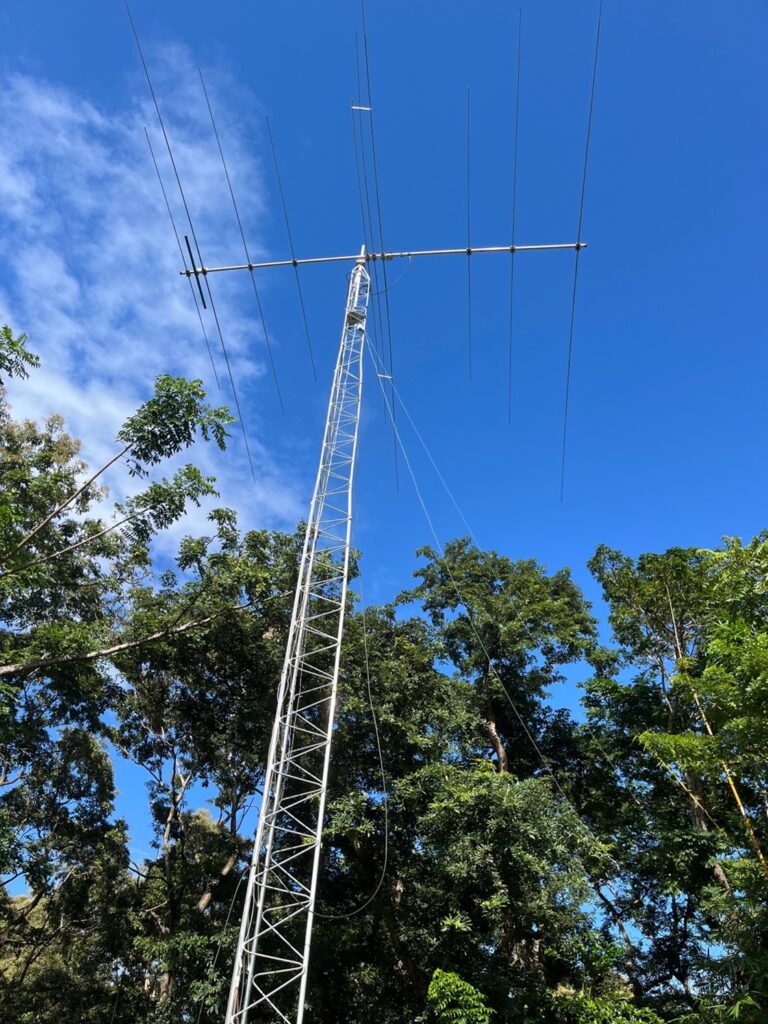
One station was an Icom IC-7610 and the second was an Icom IC-7300, both using Alpha 99 amplifiers. There was a tri-band Yagi for 20/15/10m, a vertical and dipole for 40m, and verticals for 160/80m.

After initial testing, everything seemed to be in working order, and we made the first contacts on SSB that evening! The second radio was set up for CW, and we also did some FT8 as well.

Wednesday and Thursday were spent practicing for the contest and filling the log. I enjoyed the openings during the night to Japan and Australia/New Zealand on 20m. We sat down together after dinner on Thursday and discussed logistics of the contest. We came up with a schedule and talked about which bands to focus on during which hours. Since we were entering the contest as Multi-Single (multi operators, single radio), only one person was operating at a time, which gave the other two time to rest in between shifts.

The contest began at 6 pm local time on Friday evening. I started off on 20m and had a solid first hour. We encountered a major setback with amplifier tuning issues on 10m and were limited to 100 watts on that band. I operated the overnight shift while Ted and Mark took turns alternating shifts during the day.


The 48 hours went by quickly. Although this was the first contest for Mark and Ted, they picked up on the operating style and did an excellent job running a frequency. By 6 pm on Sunday, we were all very tired and eager for a full night of sleep. We celebrated the end of the contest with dinner at a local restaurant on the beach.
We finished the contest with 3,622 QSOs with 8.6 million points. We were happy with the results and learned many lessons of things to change for the next contest. We ended the week’s operation with a total of nearly 6,000 QSOs, including the contest, and currently have 50 states and 87 countries confirmed through LOTW.
Lessons we learned during this trip included applying for the license early, and to also apply for a callsign certificate for that license through LOTW. A QRZ page with accurate information and contact info is important as well. Make sure to include how you will be confirming QSOs, whether through LOTW, QRZ, eQSL, or if you will have paper QSL cards available.
Many hams are happy to share experiences and lessons they have learned on their own trips, and there will always be someone else with more experience in planning and organizing DXpeditions, so ask questions!
The post Turning Dreams of a DXpedition into Reality—The of Story HQ9UM appeared first on OnAllBands.