Few antennas in amateur radio stir up as much debate as the end-fed antenna. Mention one at a club meeting, and you will immediately hear wildly different opinions. One ham will praise it as the greatest invention since coaxial cable. Another will claim it turns every appliance in the house into a touch lamp. A third will mutter, “common-mode current,” shake their head, and walk away.
The truth, as usual in ham radio, lies somewhere between engineering and sorcery.
End-fed antennas have become popular because they solve a problem nearly every amateur eventually faces: How do you get an HF antenna on the air when you do not have enough space, towers, trees, or cooperative neighbors? The appeal is obvious. One wire. One support point. Easy installation.
In other words, the end-fed antenna is the radio equivalent of duct tape. It may not be elegant, but it gets the job done.
The Good
The biggest advantage of an end-fed antenna is simplicity. A half-wave wire fed at one end can be installed in places where center-fed antennas become impractical. If you only have one tall tree instead of two, an end-fed may be your solution. Toss a wire into the air, connect a matching transformer, and suddenly you are working stations hundreds or thousands of miles away.
Portable operators love end-fed antennas. Hikers, Parks on the Air® enthusiasts, and emergency communicators appreciate that an end-fed antenna packs easily in a go-kit. A lightweight wire and transformer can be deployed quickly, without requiring much hardware or patience to assemble.
Another benefit is versatility. Many end-fed half-wave antennas can operate on multiple bands with relatively low SWR. A 40-meter end-fed half-wave, for example, may also work reasonably well on 20, 15, and 10 meters. That makes it attractive to operators who want multiband capability without having to build separate antennas for each band.
And despite endless Internet arguments, end-fed antennas often work surprisingly well. Sometimes very well. Hams love debating theory, but the station on the other side of the QSO only cares whether your signal arrives above the noise. Many operators have earned DXCC, worked contests, and broken pileups using nothing more than an end-fed hanging from a branch.
Stealth is another huge benefit. Thin antenna wire is nearly invisible. In neighborhoods controlled by homeowners’ associations, where a visible antenna may trigger emergency HOA meetings and dramatic Facebook posts, an end-fed can quietly disappear into the trees. Some operators hide their antennas so effectively that even they can’t find them.
The Bad
Unfortunately, the laws of physics eventually come into play. The biggest issue with end-fed antennas is that “end-fed” does not mean “magic.” The current still needs a return path. In a center-fed dipole, the currents balance naturally between the two halves of the antenna. In an end-fed system, the radio, feedline, ground, counterpoise, or random household wiring may become part of the antenna whether you intended it or not.
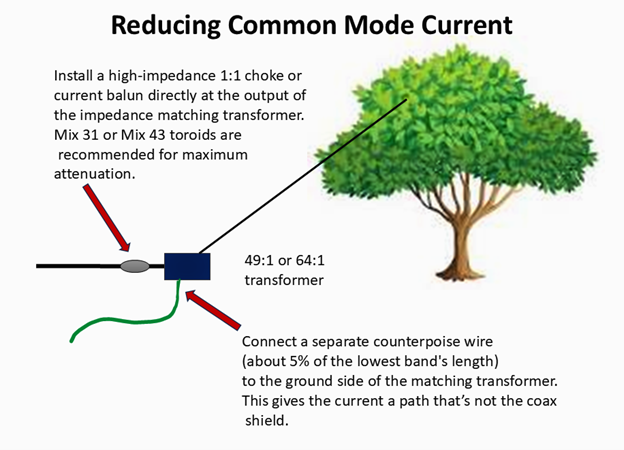
This is where common-mode current enters the story like an uninvited guest. Without proper choking or grounding, RF current can travel down the outside of the coax shield. The feedline radiates. Computer speakers begin reproducing conversations from stations in Djibouti. Motion sensors activate mysteriously at 2 a.m. Don’t blame the antenna—the problem is poor management of RF currents.

Matching can also be tricky. The feedpoint impedance of an end-fed half-wave antenna is very high, often several thousand ohms. That is why most systems require a transformer, commonly a 49:1 or 64:1 unun. If the transformer is poorly designed, losses increase and heat becomes a problem.
In ham radio, the phrase “the transformer gets a little warm” often translates to “you may want to keep a fire extinguisher nearby.”
Bandwidth can present another issue. Some end-fed antennas exhibit narrow operating ranges, especially on lower bands. Operators may find themselves adjusting tuners or compromising on performance.
Then there’s the matter of noise. End-fed antennas sometimes pick up more local electrical noise than balanced antennas. Because the feed system may interact with nearby wiring and structures, urban operators occasionally discover their antenna receives every switching power supply within three counties. If you have ever heard a mysterious buzzing sound every evening precisely at sunset, congratulations. Somewhere nearby, an LED fixture is preparing to light up the darkness.
The Ugly
The ugly side of end-fed antennas is the mythology surrounding them. Few antenna types inspire more exaggerated advertising claims. Reading some product descriptions, one might conclude that a 29-foot wire and a magic 9:1 unun can outperform a full-size beam on every band simultaneously, while also curing lower back pain and improving your memory.
Reality is less dramatic. No end-fed antenna can repeal the laws of antenna physics—a compromised antenna is still compromised. Efficiency, radiation pattern, and losses still matter. A short wire on 80 meters remains a short wire on 80 meters, no matter how convincing the marketing language becomes.
Another ugly truth is that many operators install end-fed antennas with absolutely no understanding of counterpoises, choking, or RF management. The results can be unsettling. Entire stations are accidentally included in the radiating system. At lower power, this may cause mild weirdness. At higher power, it becomes a science fiction event.
Stories abound of operators triggering touch lamps, rebooting computers, opening garage doors, and causing voice assistants to respond to random RF noise. Somewhere, at this very moment, an end-fed antenna is probably convincing a smart refrigerator to lower the temperature in the vegetable bin.
Portable operators sometimes discover another ugly reality: support trees are not always cooperative. The classic “throw a line over a branch” technique occasionally evolves into “throw a line over every branch except the correct one.” Entire afternoons have disappeared while hams attempt to rescue ropes, weights, and their dignity from trees.
And then there is the operator confidence effect. Once a ham successfully works DX with a wire installed at a ridiculous angle, they begin to believe antenna geometry no longer matters. Soon, the antenna resembles modern abstract art. The wire droops across fences, zigzags through trees, loops around gutters, and terminates somewhere suspiciously close to the barbecue grill.
The operator proudly declares, “Works great!” And somehow—annoyingly—it often does.
Final Thoughts
End-fed antennas are not miracle devices. They are practical tools with real strengths and real compromises. When properly designed and installed—with adequate choking, grounding, and realistic expectations—they can perform remarkably well. For many operators, especially those with limited space or portable operating needs, end-fed antennas open the door to HF operating that might otherwise be impossible.
These antennas are approachable, affordable, and effective. But they also reward understanding. The more you learn about feedlines, impedance transformation, common-mode current, and antenna placement, the better your end-fed antenna will behave.
In amateur radio, there is an old truth: Every antenna is a compromise. End-fed antennas compromise in particularly creative ways.
The post End-Fed Antennas for Amateur Radio: The Good, the Bad & the Ugly appeared first on OnAllBands.