[QSL NEWS / PREVIEW] – The S21WD – Bangladesh 2026 QSL cards are being printed right now. If you would like to receive your card in the first mailing batch, please make sure to submit your request via Club Log OQRS by Sunday, 7 June 2026. We have prepared a nice 4-sided QSL layout, which […] This post appeared first on: DX-World Want to know more about it? Read More
Author: Source Author
-
Ham Radio Tech: Do Nearby Metal & Trees Significantly Affect Antennas?
Antennas may look simple—just a piece of metal in the air—but they are surprisingly sensitive to their surroundings. Nearby metal objects and trees can dramatically affect how an antenna performs, sometimes improving it, sometimes hurting it, and occasionally turning a perfectly good antenna into an expensive yard ornament.
Radio waves don’t exist in isolation. Every antenna interacts with its environment. Houses, gutters, vehicles, power lines, aluminum siding, steel towers, wet leaves, and even your neighbor’s rusty trampoline all become part of the antenna’s “neighborhood.” Whether those neighbors are helpful or troublesome depends on distance, size, conductivity, frequency, and a bit of radio magic that sometimes seems suspiciously close to black magic.
Metal Objects: Friends, Enemies & Uninvited Participants
Metal is usually the most significant environmental influence on an antenna. Conductive materials interact strongly with radio frequency energy. In many cases, nearby metal effectively becomes part of the antenna system whether you intended it or not.
A metal object near an antenna can reflect, absorb, or reradiate RF energy. This can change the antenna’s radiation pattern, feedpoint impedance, and resonant frequency. Sometimes the effects are mild. Sometimes they are dramatic enough to make an antenna behave as if a committee designed it.
A classic example is the mobile HF antenna mounted on a car. The vehicle body actually serves as part of the antenna system, acting as a ground plane or counterpoise. Remove the metal car body and performance tanks. In this case, nearby metal is beneficial.
But metal can also create problems. Suppose a vertical antenna is mounted too close to a metal gutter or tower leg. The antenna may become detuned because the nearby conductor alters the electromagnetic field around it. The resonant frequency shifts, SWR changes, and the radiation pattern may be distorted. An antenna tuned perfectly in the driveway suddenly behaves differently when installed next to the house.
This is why antenna manufacturers often recommend a minimum spacing from metal objects. A few feet can matter, especially on higher frequencies like VHF and UHF where wavelengths are shorter. At 440 MHz, a quarter wavelength is only about 6.7 inches. A nearby metal pipe or railing can have a surprisingly large effect.
HF antennas are affected as well, although the suggested distances are greater because the wavelengths are longer. A 40-meter dipole near a metal roof may experience pattern distortion, increased losses, or strange directional behavior. You might think your antenna is omnidirectional until all stations from the west disappear into the ether.
Towers & Support Structures
Ironically, antennas are often mounted on metal towers, which themselves affect performance. Tower interaction is a well-known issue in antenna design.
For example, a Yagi antenna mounted too close to a tower may develop asymmetrical radiation patterns because the tower reradiates energy. The boom-to-tower spacing matters. This is why large contest stations carefully engineer antenna placement and sometimes use nonconductive mounting sections.
At VHF and UHF, small changes in geometry can significantly alter gain and front-to-back ratio. That beautiful computer-modeled radiation pattern may vanish once real-world metal is introduced.
Of course, hams have a traditional engineering solution for this problem: “Let’s put it up and see what happens.”
Trees: Nature’s RF Sponge
Trees are more complicated than metal. They are not highly conductive like aluminum or steel, but they contain water, sap, minerals, and organic material that interact with RF energy. The result depends heavily on frequency and moisture content.
At HF frequencies, trees often have modest effects unless the antenna is literally buried in dense foliage. Many wire antennas operate reasonably well in trees. In fact, trees have supported countless dipoles, end-fed wires, loops, and experimental contraptions since the dawn of amateur radio. Entire generations of hams have considered pine trees to be legitimate antenna accessories.
However, trees are not invisible to RF. Leaves and branches absorb some energy, especially when wet. Water is particularly lossy at higher frequencies. After rainfall, antennas in trees may show measurable changes in tuning and signal strength.
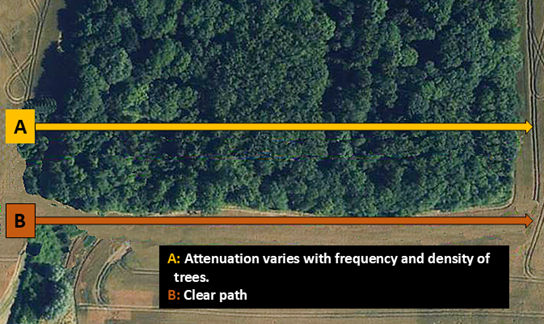
At VHF, UHF, and microwave frequencies, trees become much more problematic. Dense foliage can attenuate signals significantly. A line of wet trees between two 70-centimeter stations can significantly weaken signals. Microwave operators regard trees with roughly the same affection sailors have for icebergs.

Transmitting through a forest causes signal loss, known as attenuation, because foliage, branches, and tree trunks absorb, scatter, and reflect radio waves. This effect is heavily dependent on frequency and seasonal moisture. (Image/K8MSH) Seasonal Changes
An antenna system may behave differently throughout the year. Ever notice how UHF handheld radios work great in winter and mysteriously worse in summer? Leaves are often the culprit. A fully leafed-out forest can absorb and scatter RF energy surprisingly well.
In winter, bare branches contain less moisture and have less surface area, which can slightly improve signal propagation. In spring and summer, fresh leaves and increased sap content can increase RF absorption. This sometimes leads operators to believe their antenna has stopped working. In reality, nature redecorated the propagation path.
Rain adds another layer of complexity. Wet trees can detune nearby antennas and increase signal attenuation. If your SWR changes every time it rains, the antenna may be too close to foliage.
Multipath & Reflections
Both metal objects and trees can create multipath propagation. Signals bounce off surfaces and arrive at the receiving antenna slightly delayed and from different directions.
At HF, this effect is usually minor because ionospheric propagation dominates. For VHF and UHF, however, multipath can cause flutter, distortion, fading, or signal cancellation. For those of you old enough to remember analog TV broadcasts, they were often subject to “ghosting,” a form of multipath interference caused by signals arriving at the antenna via two or more paths with different delays.
Urban environments filled with buildings and metal structures are notorious for this. Mobile operators often notice signals changing dramatically over just a few feet of movement. One spot gives full quieting; another has marginal reception.
Trees can contribute to scattering, especially in windy conditions. Moving branches create constantly changing reflection and absorption patterns.

Signals don’t just travel in straight lines. Multipath propagation is produced by reflections, refractions, and scattering off obstacles. They can be reflected in the atmosphere, on the ground, or by buildings. (Image/K8MSH) Can Metal & Trees Ever Help?
Surprisingly, yes.
Metal reflectors are intentionally used in antenna design. Yagis depend on carefully positioned metal elements to shape radiation patterns and increase gain. Ground screens improve vertical antennas. Reflectors behind antennas can effectively direct RF energy.

Properly spaced, the extra metal on this Diamond Antenna 2m Yagi improves the signal by 9.1dBi. (Image/Diamond Antenna) Trees can also be useful support structures. A well-positioned dipole in a tall tree often outperforms a poorly placed antenna in the clear. Height usually matters more than perfection.
Many excellent HF antennas have lived happily among trees for decades. Understand that nearby foliage may slightly reduce efficiency or alter tuning but doesn’t necessarily ruin performance.
Sometimes operators obsess over minor environmental effects while ignoring much larger issues such as feedline loss, poor grounding, or insufficient antenna height. A mediocre antenna high in a tree often beats a perfect antenna mounted six feet above the ground next to aluminum patio furniture.
Minimizing Problems
Several practical steps can reduce environmental interaction:
- Keep antennas as far from large metal objects as practical
- Avoid running antennas parallel and very close to metal gutters or siding
- Use nonconductive support materials when possible
- Maintain clearance from dense foliage, especially at VHF/UHF
- Retune antennas after permanent installation if necessary
- Expect seasonal variation in antennas installed near trees
- Prioritize antenna height and placement over EZNEC perfection
And perhaps most importantly: test in the real world. Antenna modeling software is useful, but reality is always best.
Nothing’s Perfect
Nearby metal and trees affect antennas, sometimes dramatically. Metal objects can detune antennas, distort radiation patterns, and alter impedance. Trees can absorb RF energy, especially when wet, and become increasingly troublesome at higher frequencies.
Yet amateur radio history is filled with successful stations operating under imperfect conditions. Antennas have been installed in attics, forests, apartment balconies, and improbable backyard arrangements that appear to violate both physics and zoning regulations.
The ideal antenna site—a wide-open field with perfect conductivity and no obstructions—isn’t always available to us. Most operators learn to work with real-world compromises. In fact, much of amateur radio involves discovering how to make imperfect antennas work surprisingly well.
And if all else fails, remember the oldest antenna troubleshooting technique in existence: stare thoughtfully at the antenna, change absolutely nothing, and announce, “I think it’s working better now.”
The post Ham Radio Tech: Do Nearby Metal & Trees Significantly Affect Antennas? appeared first on OnAllBands.
OnAllBands
-
5H3VW – Zanzibar, Tanzania
Starting today (June 3rd) and lasting until June 10th, look for Alex, EA5JVW to be active from Zanzibar (AF-032), Tanzania as 5H3VW. QRV mainly on 40 & 20m, low power + vertical. QSL via QRZ, eQSL. This post appeared first on: DX-World Want to know more about it? Read More
-
8Q7ML – Maldives
Iván, LU8MIL let’s DX-World know that he will be active holiday-style from Embudu Island, Maldives during June 7-14, 2026 using the callsign 8Q7ML. He mentions that activity will mainly take place on the 20 to 6 meter bands, and possibly 40 meters, depending on site availability and local conditions. The planned modes are FT8 and […] This post appeared first on: DX-World Want to know more about it? Read More
-
G0VDT/P – Lundy Island, EU-120
Paul, G0VDT/P is on Lundy Island (EU-120) until 6th June with a 20W Xiegu G90 and a telescopic vertical. He will be calling CQ IOTA on 14.260 MHz in the afternoons (local). This post appeared first on: DX-World Want to know more about it? Read More
-
5H3DX – Tanzania
Look for Chas, NK8O to again be active from Dodoma, Tanzania as 5H3DX during June 9 to July 3, 2026. QRV on 30-10; CW, SSB & DIGI. QSL via NK8O, LoTW & Club Log. This post appeared first on: DX-World Want to know more about it? Read More
-
A Guide to June 2026 Ham Radio Contests—Field Day Edition
With May’s downpour of amateur radio activities done for the year, it’s time to focus on the next big event on the ham calendar—ARRL Field Day 2026.
OnAllBands has been featuring gear you’ll want to consider adding to your Field Day (June 27-28) essentials, including:
- Upgraded coaxial assemblies
- LiFePO4 batteries, solar panels, and generators
- Band Pass Filters
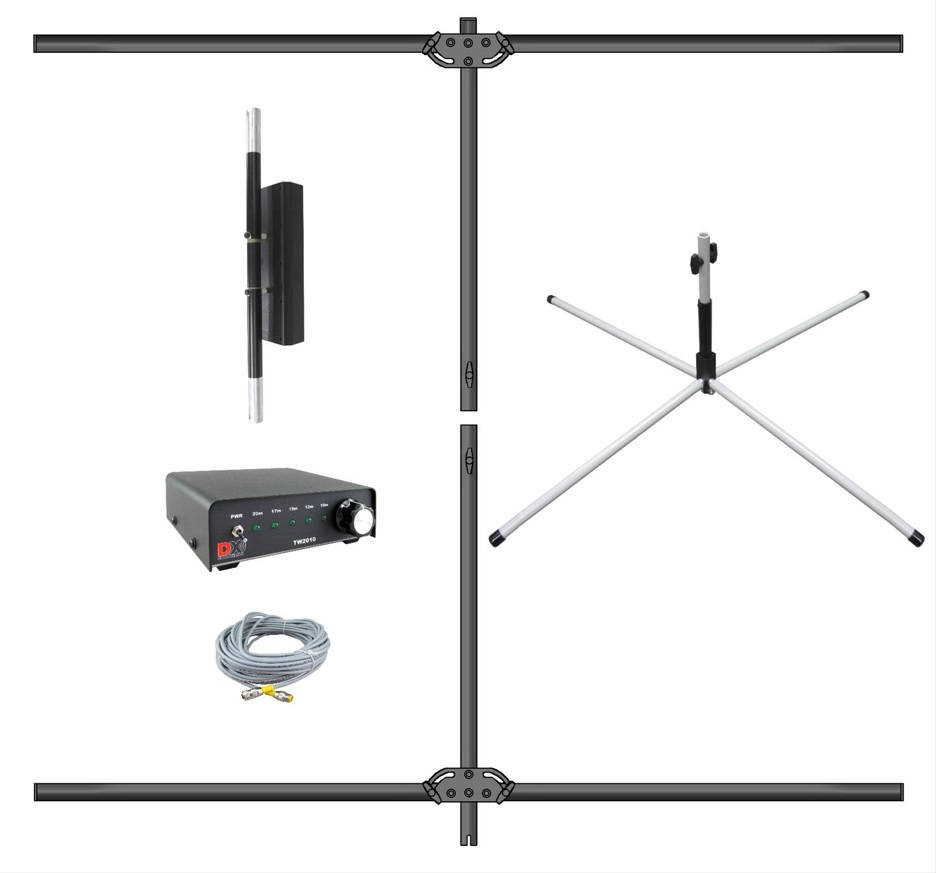
- Portable wire and vertical antennas, including DX Engineering TW Antenna packages like the one below:

Here’s the DX Engineering TW Antenna 5-Band (20-10M) Globetrotter Package. DX Engineering has manufactured and sold these highly portable, simple-to-install, and proven antennas ever since acquiring the TransWorld Antennas brand ten years ago. (Image/DX Engineering) Watch how fast and easy it is to deploy a TW antenna in this video from the DX Engineering YouTube channel:
Some good advice for Field Day newbies: Don’t wait until the day before the event to make sure you’ve got everything on your prep list. DX Engineering has everything you could possibly need to maximize your group’s performance on Field Day, no matter what your goals are for the weekend. While the weather and band conditions are out of our hands, here are a few other products you may want to add to your Field Day shopping list:
- Coaxial connectors
- Transceivers
- Portable masts
- Antenna analyzers
- Gear for improved audio (headsets, microphones, etc.)
- Coaxial cable prep tools
- Power supplies
- Equipment cases
- SWR/Wattmeters
Join the Star-Spangled Celebration!
This year’s Field Day theme combines America’s 250th birthday with amateur radio’s continuing role in emergency communications and public service: “Amateur Radio: A National Resource.” You can help promote amateur radio wherever you go with Field Day 2026 swag from the ARRL. Available at DX Engineering, Field Day 2026 T-shirts, ball caps, mugs, and other items let you show off your pride in America and the amateur radio service:

(Image/ARRL) 
(Image/ARRL) 
(Image/ARRL) Also find the ARRL 2026 Field Day patch, drawstring bag, pin, notebook, and bucket hat (below) at DX Engineering.

(Image/ARRL) Contest Time!
While you’re gathering what you’ll need for a successful Field Day 2026, be sure to take some time to keep your skills sharp by participating in an array of contests in June.
- ARRL International Digital Contest: June 6, 1800Z to June 7, 2400Z. Amateurs worldwide contact and exchange QSO information with other amateurs using any digital mode (excluding RTTY) that supports the 4-digit grid square exchange—attended operation only—on 160, 80, 40, 20, 15, 10 and 6 meters. Technicians are limited per FCC Rules to 10 and 6 meters.
- VK Shires Contest: June 6, 0000Z to 2359Z. Per the contest website, the objective of this CW/SSB contest, sponsored by the Wireless Institute of Australia, is for amateurs around the world to contact as many “VK shires as possible in the contest period. VK amateurs are to work the world including VK, whilst the rest of the world can only work VK.”
- Atlantic Canada QSO Party: June 7, 1400Z to June 8, 0100Z. This is a fun, no-pressure contest that encourages Atlantic Canada stations to work everyone, and non-Atlantic Canada stations (U.S./Canada/DX) to work Atlantic Canada stations. Atlantic Canada stations are located in the provinces of Newfoundland, Prince Edward Island, New Brunswick, and Nova Scotia—amateur radio prefixes VO1/2, VY2, VE9, and VA/VE1.
- Portugal Day Contest: June 13, 1200Z to June 14, 1200Z. This SSB/CW 80-10M event, sponsored by the Redo dos Emissores Portuguesses, is held annually in honor of Portugal Day. Portugal Day commemorates the life of poet and national literary hero Lus de Cames, who died June 10, 1580. He is most remembered for his epic poem about Portuguese history and achievements, “Os Lusiadas.” This National Day of Portugal is celebrated in communities around the globe, including several U.S. cities. The contest is open to hams worldwide.
- ARRL June VHF Contest: June 13, 1800Z to June 15, 0259Z. The objective is for amateurs in the U.S. and Canada to work as many stations in as many different 2-degree x 1-degree Maidenhead grid squares as possible using authorized frequencies above 50 MHz. All legal modes are permitted.
- ARRL Kids Day: June 20, 1800Z to 2359Z. Here’s a great chance to introduce a son, daughter, or grandchild to the thrill of ham radio. Why not let the young people in your life experience the same excitement you felt when making your first QSOs? ARRL Kids Day is also an important time to remind ourselves that the future of ham radio rests in getting youth pumped up about the fun and practical aspects of this great hobby.
For some great advice on encouraging young operators, read “Strategies Beyond Recruitment: A Plan to Engage Newly Licensed Hams” by OnAllBands blogger Violetta, KN2P.
- All Asian DX Contest, CW: June 20, 0000Z to June 21, 2400Z. Sponsored by the Japan Amateur Radio League, this annual event is for both Asian and non-Asian stations making CW QSOs on 160, 80, 40, 20, 15, and 10 meters.
- Stew Perry Topband Challenge: June 20, 1500Z to June 21, 1500Z. Hams can enter this annual 160 meter, CW-only contest as single operator or multi-operator; high, low, or QRP power. High power is 1,500 watts output or whatever you can legally run in your country, whichever is less. Low power is 100 watts or less output. QRP is 5 watts or less, per the Stew Perry website. The challenge uniquely awards QSO point values based on distance between stations. Click here for complete rules.
Also check out these state QSO parties:
- Kentucky: June 6, 1300Z to June 7, 0100Z
- West Virginia: June 20, 1600Z to June 21, 0400Z
The post A Guide to June 2026 Ham Radio Contests—Field Day Edition appeared first on OnAllBands.
OnAllBands
-
C91RU – Mozambique
[QRV ] – Slav, OK8AU and Vasily, R7AL recently arrived Maputo, capital city of Mozambique, and will be active as C91RU for a few days. This is not a full-scale DXpedition, however they plan to QRV on 80-10m; CW and FT8 when time permits. — More info to follow on DX-World. This post appeared first on: DX-World Want to know more about it? Read More
-

TX9W Marquesas Islands Wrap-Up: DX Engineering Coaxial Cable Plays Major Role
The TX9W DXpedition from Hiva Oa in the Marquesas Islands (April 19-30) is in the books!
The TX9W team, which included members of the Oklahoma DX Association, logged more than 26,600 CW, SSB, FT4, FT8, and RTTY QSOs from the village of Atuona during their stay on this second largest of the Marquesas Islands, an overseas territory of France in French Polynesia. It stood as the 63rd Most Wanted DXCC Entity worldwide (43rd in Europe) when the DXpedition began.
Hiva Oa, the final resting place of artist Paul Gauguin, measures 124 square miles and has a population of around 2,300, most of whom live in Atuona.

(Image/TX9W) 
(Image/TX9W) 
(Image/TX9W) (Image/TX9W)
DX Engineering was among several sponsors who helped to make this operation possible. As with many prominent DXpeditions, TX9W relied on DX Engineering branded coaxial cable as a critical component of their stations. Here’s what DX Engineering provided:
- DX Engineering RG-8X PL-259 Low-Loss 50-Ohm Coax Assemblies in lengths of 100, 50, 18, 6, and 2 feet
About DX Engineering RG-8X
This cable features a stranded copper center, braided copper shield and a non-contaminating Type IIa PVC jacket, which is good for direct bury applications. The 8X DX Series cable assemblies are intended for moderate-power HF stations or mobile applications where short runs and flexibility are key factors. Slightly larger than RG-58 cable, DX Engineering RG-8X offers better handling characteristics and very good shielding. Plus, this is the new type of foam that cannot gather moisture and has lower loss than old RG-8X foam cables.

DX Engineering RG-8X PL-259 Coax Assembly. (Image/DX Engineering) Looking to upgrade your coaxial cables for 2026 Field Day and beyond? Click here for a wide selection of high-performance, long-lasting DX Engineering branded coax.
DX Engineering also provided a Chelegance JHEX-6 HF Six-Band Hex Beam Antenna.

(Image/Chelegance) 
(Image/TX9W) 
(Image/TX9W) 
We spy a DX Engineering Radial Plate being put to good use. (Image/TX9W) Read much more about TX9W from its Facebook page and official website. From all of us at OnAllBands and DX Engineering, congratulations on a job well done!
The post TX9W Marquesas Islands Wrap-Up: DX Engineering Coaxial Cable Plays Major Role appeared first on OnAllBands.
OnAllBands
-
J51A – Guinea Bissau
[QSL PREVIEW / STATUS] – by Ben, DA1DX. The paper QSL cards have been ordered from the printshop. If the cards are delivered in time, the first 7000 (direct) paper QSL cards will be processed on 13-14 June 2026 and mailed out the day after. All OQRS requests and donations that were received before 06-Jun-2026 […] This post appeared first on: DX-World Want to know more about it? Read More