Aki, 7M1KJW announces that he will be active from Chichi-jima, Ogasawara Islands as 7M1KJW/JD1 during June 13-16, 2026. This will be a holiday-style activity on HF bands + 6m using mainly FT8 and vertical antenna. QSL via LoTW, eQSL. This post appeared first on: DX-World Want to know more about it? Read More
Author: Source Author
-

SafecomLink Live AI Weather Over HF Radio
The following is a message from SafecomLink:
SafecomLink has published a new case study documenting live AI-based weather routing over HF radio north of the Arctic Circle. Sailor Harley Soltes (LA/KN7H) used SafecomLink with a Pactor 4 link to access the Safie AI assistant from his vessel off the Norwegian coast — establishing a connection to a land station in Austria (OE3FQU) on 14.120 MHz, then reaching the open internet, with no cellular coverage, no satellite service, and no shore-side infrastructure.
The real-time two-way AI conversation provided wind forecasts and a day-by-day crossing comparison for the passage to Lofoten, Norway. After completing the passage, Soltes reported the AI forecast was more accurate than his usual weather apps and far faster than the WinLink email method he previously used.
This is pretty game-changing — to have fast Pactor 4 communication from sea to a real-time internet AI connection. — Harley Soltes, LA/KN7H
Full case study: https://www.safecomlink.com/post/safecomlink-case-study-maritime
Source: SafecomLink
Amateur Radio Daily
-
DX-World’s Cup 2026
[UPDATE] – Thanks for participating! We now have 48 teams chosen corresponding with your callsigns. How did this format work? Basically, using this link, we started at Group A (with Mexico being #1) all the way down to Group L (with Panama being #48). Table below shows each call and your team. As the days […] This post appeared first on: DX-World Want to know more about it? Read More
-
EZ/DL7ZM – Turkmenistan
[NEWS UPDATE] – by David, DL7ZM: I plan to be active mainly on 6m on 7, 8, 9, 13, 14 June, maybe in between. No FT8. Shortwave probably more around 8 AM (local time Ashgabat). Please be kind, I am not an experienced DX expedition OM, this is a propagation study using amateur radio frequencies, […] This post appeared first on: DX-World Want to know more about it? Read More
-
KH0/AJ6VJ – Saipan
Ken, JO1VRK will again be active from Saipan, Northern Mariana Islands as KH0/AJ6VJ during December 29, 2026 to January 3, 2027. QRV 40-20-17-15-12-10m, possibly 80m. QSL via LoTW, Club Log, eQSL. This post appeared first on: DX-World Want to know more about it? Read More
-
How Ham Radio Teaches Young People to Communicate
When I got my amateur radio license at ten years old, communication was still very much a weak spot for me. I was terrified of having a speaking role in the school play, and presentations in front of my class still made me exceptionally nervous.
Now, I really enjoy public speaking, and I have gotten significantly better at it—almost entirely thanks to amateur radio. The hobby has taught me how to communicate articulately and precisely, something that no other extracurricular activity or experience has done.
While I’ve overcome most of my challenges with communication, many of my peers still have issues with good communication skills. As a result, how young people communicate is a frequently discussed topic among older generations. I’ve heard these questions and similar examples countless times:
- “How do young people communicate?”
- “The Snapchat photos they send each other—do those count as communication?”
- “Do young people communicate or do they just sit on their phones?”
While I can’t fully endorse all of my generation’s communication habits (I don’t think I’ll ever catch on to some of the current slang), I must say that despite the basic nature of some of these efforts (for example, half-face Snapchat photos and simply saying “six-seven” accompanied by the hand gesture, of course), they are still forms of communication. But in today’s world, verbal communication remains a very important skill regardless of your age. Amateur radio gives young people the opportunity to engage in more mature and coherent communication.
Part of the problem with young people’s communication is that when interacting with each other, they are (to an extent) forced to fit into the mold of someone their age. They feel like they must use the vocabulary and communication methods of their age group. If they do not, they will almost certainly be made fun of. More importantly, they won’t be able to effectively get their message across.
Amateur radio provides an environment in which young people can communicate with adults and practice articulating their point without using the typical slang words that are necessary in their everyday lives. It allows young people to learn how to communicate by treating the youth of the hobby like adults right out of the gate. For example, young people in amateur radio have numerous opportunities to present at events–opportunities that many other young people do not have.

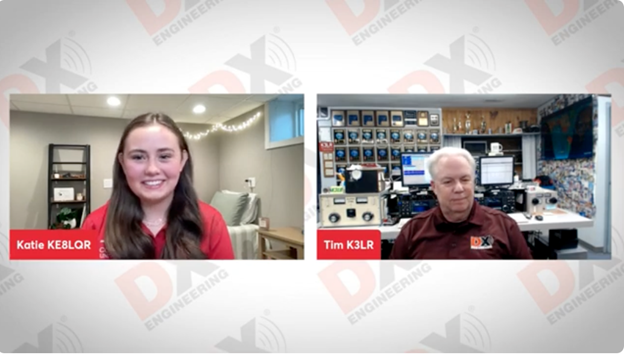
Katie, KE8LQR, talks ham radio with Tim Duffy, K3LR, DX Engineering CEO. (Image/DX Engineering) During my last few years of high school, I noticed that many of my classmates were scared to have a one-on-one conversation with a teacher or even just raise their hands to talk in front of the class. This fear disappears slightly when it comes to sending an email, but a whole new set of problems arise. Many young people today struggle to communicate in contexts that require a protocol to be followed, or that require formal speech to be used. This is where amateur radio can play a role in helping improve these deficits. When having an on-air QSO, the core of the contact is always the same: signal report, location, maybe a name or a number, and then the open opportunity to take the conversation a bit further. This “script” builds the connection between effective and efficient communication, which helps teach young people how to implement that in their daily lives.
Young people can also learn how to interpret social cues from simple on-air interactions. Getting on the air and making contacts itself can be incredibly intimidating at first. To ragchew with someone, you need to be able to read social cues without the benefit of body language. This can be challenging, especially when you’re trying to determine whether you should continue the conversation or cut it off. After getting on-air experience, though, reading subtle social cues becomes almost second nature. These skills can also be applied to in-person social interactions, making them even easier with the addition of body language clues.
With all of this in mind, the next time you criticize a young person’s communication skills, remind yourself that they’re still learning. The criticism may not be entirely wrong, but it’s directed only at young people. Unlike the generations before ours, the culture of communication does not revolve around “proper” communication—rather, it’s centered on efficiency and, occasionally, pop culture. Amateur radio provides an environment in which we can practice communication without screens or emojis. Our energy is much better spent making sure we maintain this environment and keep it inviting to youth rather than criticizing how young people communicate.
The post How Ham Radio Teaches Young People to Communicate appeared first on OnAllBands.
OnAllBands
-
V73RJ – Kwajalein Atoll, R.M.I
John, WA4IYB is currently residing on Kwajalein Atoll doing contract work, and mentions to DX-World that he’s not entirely sure how long he’ll be there, but it could be up to a year. When time permits look for V73RJ on 40-10m SSB using the island club station. QSL via LoTW & eQSL. NOTE: V73LM was […] This post appeared first on: DX-World Want to know more about it? Read More
-
Ohio NVIS Day 2026: A Tale of Two Different but Effective Antennas
There is so much talk in our hobby about making that rare DX or a faraway contact using resonant beams and vertical antennas. While that’s great—and I think most of us find these contacts exhilarating—there are so may rabbit holes in this hobby beyond DXing. As I often say about amateur radio, if you can’t find your area of interest, you better check your pulse.
One of my rabbit holes is highlighted every year on the fourth Saturday in April. That’s when the Ohio Section ARES sponsors NVIS Day.
You may have read my articles on EmComm—one of my amateur radio passions. Like many other niches, EmComm has some quirks about it that require unique equipment and skills. We’re not trying to reach around the world; we’re making contacts around the corner.
The antenna is at the heart of what’s different about the EmComm arena. You’re longer looking for a very low angle of takeoff but rather a steep takeoff angle. Enter the NVIS (Near Vertical Incidence Skywave) antenna. Note: “Near vertical” refers to the radiation angle, not the antenna configuration.
The idea here is first-mile communications. That means getting messages and traffic “out to” and “in from” a non-affected area to the affected area of a bad day incident. This may be a state or regional relay station, your state Emergency Operations Center, or a National Traffic System net. In this situation, we’re not talking about getting the signal to the farthest station. It’s about getting it to the “right” station.
I often explain NVIS as being like a garden hose. If you take the hose and point the nozzle just a little above horizontal, you can, with great accuracy, spray your little sister sitting under a tree with her friends 35 feet away. However, if you take that same hose and nozzle and turn it 90 degrees vertically, the results are vastly different. Now everyone within ten feet gets wet, but your sister and her friends remain dry.
In the ham radio world, it works like this. I have always used horizontal wire antennas, usually in a sloper configuration of some sort. They have served me very well. I am able to check into state traffic nets, regional MARS nets, and even national CAP nets. I can pretty easily get DX contacts in North, Central and South America, Europe, and Western Africa. But Southeast Asia and VK land have eluded me.
If you’ve been reading my articles, you know I recently erected a DX Commander Signature 18 Nebula eXtreme HF Multiband Vertical Antenna. The first contact I made on it was an Australian station. Then reality set in. Time came that day to check into the Ohio Single Side Band Net, which is a part of the National Traffic System. Opening time came and went and I could hear nothing. I could not hear a single station in the state of Ohio.
It hit home: Most of my day-to-day operating was done using NVIS! Don’t get me wrong—I am super glad to have the DX Commander and will continue to enjoy making those DX contacts with it, but it must be an addition to my NVIS system. It’s like that wrench you use less regularly but could not do without.
So this year for NVIS day, we decided to focus on two styles of antenna. We would erect the DX Engineering 8040 NVIS and the Alpha Antenna HF/VHF/UHF MagLoop EmComm. We were able to electrically separate them far enough away to have two stations operate without any complications.

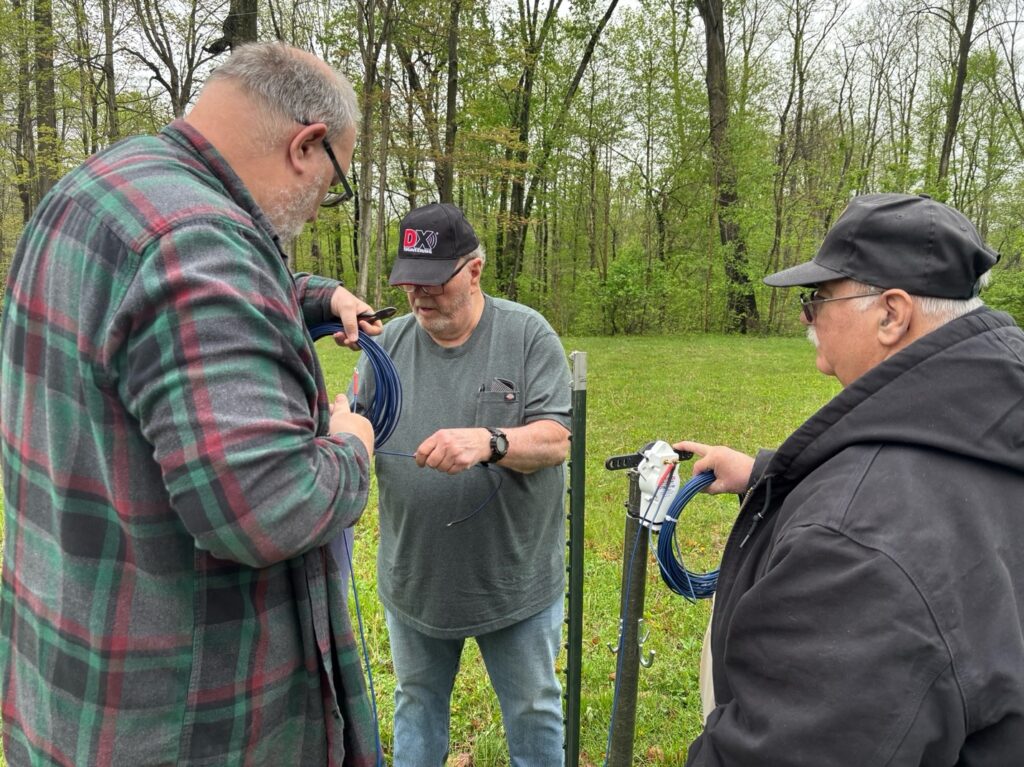
Installation begins on the DX Engineering 8040 NVIS Antenna. Available in shortened and full-sized versions, the kits come with or without a 15-foot fiberglass mast. (Image/AC8OW) 
The DXE-NVIS-8040NM Full-Size NVIS Antenna comes with the above contents, mast not included. (Image/DX Engineering) 
The DXE-NVIS-8040S above is a shortened NVIS wire antenna kit that features loading coils to make the 80-meter dipole legs the same length as the 40-meter dipole legs, 34 feet. Full-size kits come with 67-foot wire dipole antenna legs for 80 meters and 34-foot legs for 40 meters. (Image/DX Engineering) 
The Alpha Antenna HF/UHF/VHF MagLoop EmComm model. (Image/AC8OW) The Alpha went up quite easily and worked very well. Within minutes, we were able to start making contacts. It was easily tuned, and some new loop users were able to see the benefits of its directionality. Win number one!
The DX Engineering antenna was a kit, so it took longer to erect. But being a kit, there was much opportunity for discussion and education. I will say this: If you are considering this antenna, just account for the sheer size of the footprint it has on the ground, especially the 80M dipole portion. I would say lay out an area 150 feet by 150 feet.
Being two resonant dipole antennas on one mast at 90 degrees to each other, it is very efficient. But you have to be willing to take the time to properly tune it. This is the part very few people enjoy, but it will provide you with years of enjoyment if you don’t take shortcuts. An antenna analyzer like the RigExpert STICK-PRO makes it much easier to tune the elements.
When it was all said and done, the DX Engineering antenna was erected and tuned. After lunch, final tuning was done and it was ready for use. Another nice feature of this antenna is that if your state’s EmComm plan is for, let’s say, 40 and 20M, you just tune the two dipoles for those bands. This is a great- performing antenna for making contacts all over the Midwest and beyond. Win number two!
When you start learning about antenna theory, antenna building can become addicting. I encourage you to start experimenting with building your own antennas. Wire antennas are extremely inexpensive to build, and you can learn a ton.
Until next time, 73 de AC8OW.
The post Ohio NVIS Day 2026: A Tale of Two Different but Effective Antennas appeared first on OnAllBands.
OnAllBands
-
DX-World Weekly Bulletin
[#666] The latest FREE NON-SUBSCRIPTION DX-World Weekly Bulletin written by Bjorn ON9CFG is available to download. Click below to get the newest jam-packed edition which this week runs to 16 pages. Previous bulletins can all be found here. Please contact Bjorn with any updates or errors. DOWNLOAD THE LATEST BULLETIN ===== This post appeared first on: DX-World Want to know more about it? Read More
-
T88SM – Palau
Mike JA6EGL will again be active from Koror, Palau as T88SM during January 8-14, 2027. QRV on 160-6m; CW, SSB, AM / FM; 160-6m. QSL via home calls. QTH: VIP Guest Hotel. This post appeared first on: DX-World Want to know more about it? Read More