[NEWS] by Santiago, LU2DUR. My temporary Falkland Islands amateur radio licence has now been issued, and my callsign will be VP8TOG. The licence is valid from 22 September 2026 to 22 March 2027, covering my planned visit in January. I will be in the Falkland Islands from 10 to 17 January 2027, operating as a […] This post appeared first on: DX-World Want to know more about it? Read More
Author: Source Author
-
A31AV – Tonga
Alan, K0AV will be active from Neiafu, Vava’u, Tonga (OC-064) as A31AV prior to and after the CQWW CW contest. During the contest he, along with Oliver W6NV, will participate as A31W. QSL via H/c. This post appeared first on: DX-World Want to know more about it? Read More
-
Guide to Amateur Radio Amplifiers 2026: Part 6, Toptek UHF, VHF, UHF/VHF Power Amplifiers
DX Engineering carries more amateur radio amplifiers than anyone in the industry. Need evidence? OnAllBands has reached Part 6 in our series on amplifiers available at DX Engineering. So far, we’ve covered products from these leading manufacturers:
Look for us to cover Palstar in a later post.
Toptek Communications Amplifiers
DX Engineering carries a great selection of feature-rich, well-engineered VHF, UHF, and VHF/UHF power amplifiers from Toptek Communications, a company that has been developing amateur radio solutions since 2003.
Available in models with maximum output power from 80 to 350W, these lightweight and compact units come with a host of ham-friendly features and benefits. Here are just a few (check specific models for exact features):
- Intuitive push-button controls
- Multiple protection circuits
- Large, easy-to-read green backlit screens (PA-350V, PA-150U)
- Front panel power and SWR metering
- Automatic fault for high SWR
- RF sense keying
- PTT input on SSB/CW models
- Selectable input ranges
- Mode switch for automatic SSB delay and peak power metering
- Built-in low-noise receive amplifiers
- Effective cooling from large, thermostatically controlled fans or heat sinks
Choose from these Toptek models at DXEngineering.com:
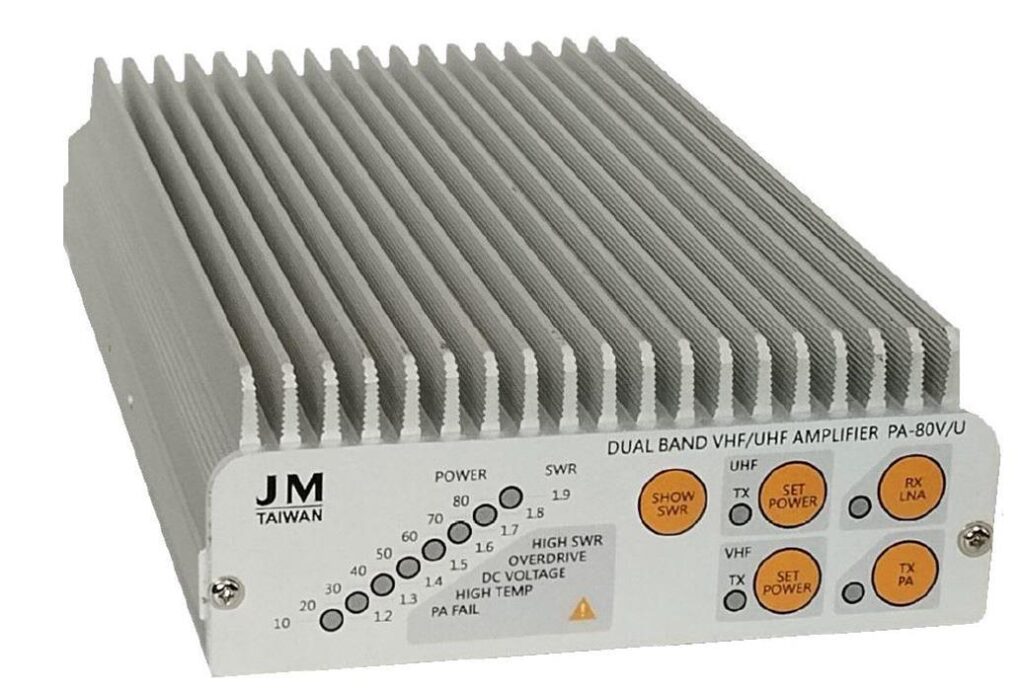
- TEK-PA-80V-U: 2M/70cm, 5-10W maximum input power, 80W maximum output power (PEP), FM, heat sink cooling

The PA-80V-U Dual Band FM VHF/UHF Power Amplifier is a flexible unit intended for analog use with dual-band handheld FM transceivers. (Image/Toptek) - TEK-PA-80U: 70cm, 5W maximum input power, 80W maximum output power (PEP), FM/SSB/CW, heat sink cooling

“I am very happy with the Toptek Communications PA-80U UHF Power Amplifier. Both amp and pre-amp seem to function very well, and it’s a joy to have some power. I have run both my AT-D878UV HT and AT-778UV radios through it to a seven-element Yagi and have received excellent signal quality reports from the field.” Robin, DX Engineering Customer (Image/Toptek) - TEK-PA-150U: 7ocm, 2-5W maximum input power, 160W maximum output power (PEP), FM/SSB/CW/Digital, cooling fans

PA-150U (Image/Toptek) - TEK-PA-85V: 2M, 3-5W maximum input power, 85W maximum output power (PEP), FM/SSB/CW, heat sink cooling

PA-85V (Image/Toptek) - TEK-PA-180V: 2M, 5W maximum input power, 180W maximum output power (PEP), FM/SSB/CW, cooling fan with shroud

“I’ve been extremely pleased with the Toptek Communications PA-180V. It’s a compact but very capable 2-meter amplifier that delivers impressive performance for its size. With only a few watts of drive it easily produces around 170-180 watts output, which provides a huge improvement in signal strength on both repeaters and simplex. I use an inline attenuator to carefully control the drive level going into the amplifier. This makes it easy to keep the input power in the safe range and ensures the PA-180V isn’t overdriven, which helps maintain a clean signal and reliable operation.” Richard, DX Engineering Customer (Image/Toptek) - TEK-PA-350V: 2M, 7.5/15W maximum input power, 350W maximum output power (PEP), FM/SSB/CW/Digital, cooling fans

“This VHF amplifier works well in all aspects. It has better and more safety circuits and is less expensive than most others in its class that I have owned in the past, and I have owned many. The display is customizable and easy to read at a distance. Quality workmanship and materials throughout. I have no problems recommending this amp to any of my fellow amateur radio friends.” James, DX Engineering Customer (Image/Toptek) Also check out the Toptek Power Amplifier Remote Control Panel for the PA-150U and PA-350V. This user interface duplicates the LCD display and push-button keypad operation of the front panel of the connected amplifier.

(Image/Toptek) The post Guide to Amateur Radio Amplifiers 2026: Part 6, Toptek UHF, VHF, UHF/VHF Power Amplifiers appeared first on OnAllBands.
OnAllBands
-
H44MS – Solomon Islands
[NEWS UPDATE] – Bernard, DL2GAC will again be QRV from the Solomon islands as H44MS during the following periods: October 3 to November 20, 2026. February 5 to May 7, 2027. Detailed info, including pictures of QTH listed below. [JANUARY 18] – Bernard, H44MS will again be active from Manakwai village, nearby Malu’u (northern Malaita island) […] This post appeared first on: DX-World Want to know more about it? Read More
-

DXing at Galactic Scale
By Bob Griffin (KC2JJM)
SETI — the Search for Extraterrestrial Intelligence.
Every ham’s logbook tells the same story in expanding circles. Across town on 2 meters. Across the country on 20. Across an ocean on a gray-line opening. Moonbounce, if you’re stubborn enough. Each ring is the same discipline — weak signals, patience, knowing your noise floor — applied to a longer path.
This is a story about chasing the outermost ring.
SIXTY-FIVE YEARS OF A DEAD BAND
First, the puzzle that drives the whole field. The Fermi paradox, in one line: a galaxy of hundreds of billions of stars, most of them billions of years older than the Sun, should be full of civilizations — so where is everybody? Enrico Fermi asked it over lunch in 1950, and it has not been answered since.
Since 1960, SETI has worked one way: point a big dish at a star and scan for a carrier near 1420 MHz, the hydrogen line — the natural calling frequency any radio-literate civilization could find. Project Ozma did it with one channel. SETI@home did it with millions of our PCs (I had that screensaver running in the shack for years; many of you did too). Breakthrough Listen does it today with billions of channels. Sixty-five years of better receivers have returned exactly one thing: silence. No confirmed carrier, ever.
Every ham knows what a dead band usually means. A band that sounds empty on a carrier scan can be carrying dozens of QSOs at 20 dB below the noise — you hear nothing because you’re listening for the wrong mode, not because nobody’s on the air. FT8 taught a whole generation of operators that lesson.
So here’s the question my project asks: what if the silence is a design feature? In the paper, we develop a new testable hypothesis, called Behavioral SETI, to explain the apparent radio silence.
THINKING LIKE THE SYSTEM DESIGNER
Suppose an advanced civilization wanted to reach emerging societies across the galaxy, over spans of millions of years. Design that system the way an engineer would and three decisions fall out. Build no transmitter — stars already radiate more power than any machine ever could; the cheap way to signal is to modulate sources already on the air. Write in ratios — a sender who shares no units with you can only use dimensionless relationships among measurements; the message isn’t on any one channel, it’s in how observables move together. Spend nothing on receivers who can’t act — gate the message behind a proof of capability.
If that’s the design, nobody hears it with a carrier scan. You find it by looking for behavior in sources that already exist — which means searching astrophysics archives, not the airwaves.
THE CRYPTOLOGICAL GATE
The strangest rule is the third one, and it deserves its own explanation. The framework predicts the message arrives locked: a short pointer tells you where to look, but the payload behind it is protected by what a cryptographer calls proof of work — a puzzle that is cheap to set, expensive to solve, and trivial to verify once solved. Why would anyone bother, across interstellar distances? Three reasons an engineer would insist on it.
First, the gate is a license exam that grades itself. A sender cannot proctor anything from thirty light-years away. Solving the puzzle certifies the receiver’s capability with no effort from the sender: if you opened it, you had the computers; if you had the computers, you have the industry and the science to act on what’s inside. Nobody unqualified can even read the question.
Second, it sets the timing automatically. Our own computing grew eight-billion-fold in one working lifetime — Cray-1 to Frontier, 1976 to 2022. A gate pitched at industrial-scale computing opens within a generation of a civilization first noticing it. The lock is a fuse, timed by the receiver’s own growth — no schedule, no appointments, nothing that can go stale over a million years.
Third, the unlock is authentication. When the receiver transmits the solved key back, that transmission proves the work was actually done — no spoofing, no accidental triggers, no energy wasted answering noise. In ham terms: the gate is the ultimate CTCSS. Except this tone can’t be looked up in a manual. It can only be earned.
WEAK-SIGNAL DISCIPLINE, APPLIED TO ARCHIVES
So that’s what I did: 49 searches across public archives — GOES X-ray satellites, neutron monitors, pulsar timing arrays, Voyager’s magnetometers, solar neutrino detectors. And here’s the part I’d defend at any club meeting: the methods are ham methods. Long integration to pull signals out of noise. Measuring the noise floor before claiming anything sits above it. And never trusting the rig without a test signal — every detection limit is verified by injecting synthetic signals and confirming the pipeline recovers them. The whole campaign’s positive control was recovering the Sun’s known five-minute oscillations from satellite data — the WWV of the project. If your system can’t hear the known signal, your silence means nothing.
The score: 45 nulls with measured limits, and no contact. In this business a calibrated null is the product.
THE EMAIL TO JAPAN
My favorite result wasn’t in any dataset. One channel needed solar-neutrino data from Super-Kamiokande, the great detector in a mine in Japan. The public link had been dead for years. So I wrote to the collaboration — callsign in the signature, one ham asking about data. The spokesperson answered the next day, pointed me to a public 22-year dataset better than the one I’d asked about, and committed to fixing the dead link. We ran the search within 48 hours. Null, with limits — and the first time anyone had asked that dataset an aperiodic question. QSL received, you might say.
HOW FAR DO OUR SIGNALS GET?
A 2025 SETI Institute study ran the honest numbers on Earth’s own detectability, and hams will appreciate the EIRP ladder: Arecibo’s planetary radar, at 20 terawatts EIRP, would stand out at 12,000 light-years. The Deep Space Network: 65. The combined mobile-phone leakage of the entire planet: 4. The loudest thing humanity ever put on the air was pinging asteroids. Everything we broadcast to each other barely leaves the neighborhood — one more reason silence proves so little.
And one thought I can’t shake, as an AM DX’er myself: the earliest thing any radio civilization transmits is its lowest bands. A designed listening post watching for emerging civilizations wouldn’t need to decode a 1930s 500 kW AM flamethrower like WLW — just detect the carrier, coherently integrated, far below any demodulator’s threshold. Carrier detection at absurd SNR is a very ham idea. The paper takes it seriously.
GOING DEEPER
The write-up, a six-minute animated version, and the full paper with every method and limit are here:
https://dxtra.com/static/galactic-dx/summary.html?src=hamdaily
Source: KC2JJM
Amateur Radio Daily
-
D4SAL – Cape Verde
Paco, EA7KNT is again active from Boa Vista island (AF-086), Cape Verde as D4SAL during September 19 to October 2, 2026. Activity so far has been on 20m SSB. QSL via H/c. This post appeared first on: DX-World Want to know more about it? Read More
-
San Ambrosio Project (CE0/X)
[NEWS] by Felipe, XQ7IR. The purpose of this press release is to share with the international amateur radio community about the progress and efforts made over the past several months regarding the San Ambrosio project. With great excitement, but also with a strong sense of responsibility, I am pleased to share the following information. PERMITS […] This post appeared first on: DX-World Want to know more about it? Read More
-

DX Engineering Sponsors XU7X Cambodia DXpedition—Its Branded Coaxial Cable to Play Critical Role
A team of more than 20 amateur radio operators from Brazil, the U.S., Ecuador, Bosnia and Herzegovina, Ireland, and Japan plan to be QRV 24/7 from Koh Rong Island off Cambodia’s coast for the XU7X DXpedition November 13-23, 2027.
DX Engineering will serve as a major equipment sponsor for the activation, which spotlights one of the most sought-after IOTA entities (AS-133) and World Wide Flora & Fauna references (XU-0008). The team plans to be active from 160M to 6M (including 60M) on SSB, CW, FT4/FT8, RTTY, and PSK31.

(Image/XU7X) Known for its white-sand beaches and clear turquoise water, Koh Rong Island—population 4,000— should offer excellent propagation to maximize QSO potential, per the XU7X team. At 30 square miles, it is Cambodia’s second-largest island and one of the locations within the Koh Rong Marine National Park. Reality TV fans will note that it was the location for seasons 31 and 32 of the American version of “Survivor.”
DX Engineering Supports XU7X with High-Performance Coax
DX Engineering provided XU7X with its branded coaxial cable (below). It’s the same high-quality cable that’s trusted by operators everywhere, from rag-chewers in your local club to DXpeditioners who have traveled to the world’s rarely activated locales.
- DX Engineering RG-8X PL-259 Low-Loss 50-Ohm Coaxial Cable Assemblies (various lengths)

(Image/DX Engineering) 
(Image/DX Engineering) Does it pay to buy better coax? Here are some thoughts from John, a DX Engineering customer, on his purchase of DX Engineering RG-8X coaxial cable assemblies:
“Wanting to save a few bucks, bought inexpensive coax for my antenna connections. Well, that didn’t work out too well. Interference issues and the cable got stiff after a few months inside my home. So, ordered RG-8X and replaced. Nice difference in my signal. Won’t be going the cheap route anymore.”
Read much more in this OnAllBands article about why DXpeditioners, DX chasers, contesters, and EMcomm specialists prefer DX Engineering coaxial cable.
Also, click this link to view Cambodia QSL cards from the collections of DX Engineering team members who have more than 1,000-plus years of amateur radio experience. It’s one of the reasons DX Engineering adopted the new company motto, Powered by Active Hams. And it’s why you should seriously consider the benefits of having active operators assist you with your cable and equipment purchases at DX Engineering.
Look for much more about XU7X on OnAllBands in the months ahead!
For up-to-date details, visit xu7x.net.
The post DX Engineering Sponsors XU7X Cambodia DXpedition—Its Branded Coaxial Cable to Play Critical Role appeared first on OnAllBands.
OnAllBands
-

POTA/SOTA Activation at Diamond Head Turns Into Real-World Emergency Response
The following is a press release from KH6ML:
HONOLULU, HAWAII — September 16, 2026 — What began as an early-morning Parks on the Air and Summits on the Air activation at one of Hawaii’s most recognizable landmarks unexpectedly turned into an opportunity for an amateur radio operator to put years of emergency preparedness and communications training to practical use.
A short video documenting the Diamond Head activation and emergency response is available here: https://youtu.be/_GO4as2CSvc
Michael Miller, KH6ML, began hiking the Diamond Head Summit Trail on Oahu at approximately 7:15 a.m. Wednesday morning. His plan was to complete a combined POTA and SOTA activation before heading to his full-time job as a partner at Tiki’s Grill & Bar in Waikiki.
Operating portable from the summit with an FX-4CR HF transceiver at approximately 20 watts, a small Bioenno battery, end-fed wire antenna and an AnyTone VHF/UHF handheld, Miller completed 11 contacts.
His activation included Diamond Head State Preserve, POTA US-6425; Diamond Head Summit State Trail, US-10913; and the Diamond Head SOTA summit, KH6/OH-025.
Moments after completing his 11th contact, a visitor approached Miller and asked if he could help. A woman had collapsed inside the observation bunker below the summit.
Miller immediately left his HF station behind, took his handheld radio and headed toward the patient while calling 911. Because of uncertainty about cellular coverage inside the reinforced structure, Miller also advised amateur radio operators with whom he had been communicating to stand by in case an alternate communications path became necessary.
The patient, a visitor from Japan, was traveling with her husband and adult daughter. Miller began gathering information from the family and relaying it to emergency dispatchers while Honolulu Fire Department personnel responded.
“The 911 dispatchers were extremely professional,” Miller said. “They were calm, direct and focused on getting the information the responding crews needed. The communication between dispatch and the field response was impressive.”
Honolulu Fire Department personnel reached the bunker and assumed care of the patient. Additional firefighters and rescue personnel followed with medical and rescue equipment. The difficult location required responders to develop a plan for moving the patient from the confined bunker and across the steep summit terrain.
A helicopter was subsequently brought into the response.
“The professionalism of the firefighters was remarkable,” Miller said. “They climbed Diamond Head carrying their equipment, immediately assessed the situation and went to work.
Miller later accompanied the patient’s daughter down the trail and helped her reconnect with her family and emergency personnel at the base of Diamond Head.
Later that afternoon, Miller received a message from the family thanking him for his assistance and reporting that the woman was doing well and the family had returned to their hotel.
For Miller, the incident also demonstrated how the skills developed through amateur radio can complement broader emergency-preparedness training.
“Did ham radio help? I think it was one piece of the puzzle,” Miller said. “Amateur radio teaches us to communicate clearly, know our location, pass information accurately and think about what happens when normal communications aren’t available. Add CERT training, Red Cross training, Scouting and other life experiences, and hopefully you’re a little better prepared when somebody needs help.”
Miller serves as a Deputy Coordinator for Radio Amateur Civil Emergency Service (RACES) for the City and County of Honolulu. He is also an Assistant Section Manager and Government Liaison for the ARRL Hawaii Section. Outside amateur radio and emergency communications, Miller is a partner at Tiki’s Grill & Bar in Waikiki.
The incident was a reminder that while POTA and SOTA provide amateur radio operators with opportunities to practice portable operations, antennas, low-power communications and field deployment, those same habits of preparedness can have applications far beyond making contacts.
“I went up Diamond Head looking for radio contacts,” Miller said. “The most important contact I made that morning wasn’t on the radio.”
73 from KH6ML
Source: KH6ML
Amateur Radio Daily
-
3X4U – Guinea DXpedition 2026
The Belgian Rockall DX Group is pleased to announce an upcoming DXpedition to Guinea. The team will be active as 3X4U from 11 November to 23 November from Lac de Koba, Guinea. The team received the License (vanity callsign requested) and permission to use 1KW on all bands. Guinea remains a sought-after DXCC entity for […] This post appeared first on: DX-World Want to know more about it? Read More