10-12 man team plan to be active as 9M8T from Talang-Talang Besar OC-165 sometime in June 2027. This is much the same team who had been very active as 9M8A in July / August 2025 and 9M1Z in September 2024. Full details are listed on QRZ.com or their website. QSL via 9W8ZZK or 9M8WIN, LoTW. This post appeared first on: DX-World Want to know more about it? Read More
Author: Source Author
-
NV1U/HR9 & HQ9X – Roatan Island, NA-057
During the CQWW SSB contest, James NV1U, will be active from Roatan Island (NA-057) as HQ9X. Outside of the contest he will sign NV1U/HR9 from October 18-26, 2026. QTH: DX Lodge. QSL via H’c, Club Log OQRS. This post appeared first on: DX-World Want to know more about it? Read More
-
FT4YM – Antarctica
[NEWS] by Mehdi, F5PFP. David, FT4YM hopes to be QRV during the 2026-27 summer Antarctic campaign as follows: FT4YM/P, Base Concordia – Antarctic Continent AN-016 (main activity) FT4YM/P, Base Little Dome C – Antarctic Continent AN-016 (ocasionally QRV) VK0/FT4YM/P, Camp North Patch – Antarctic Continent AN-016 (occasionally QRV) FT4YM, Base Dumont d’Urville – Petrels island […] This post appeared first on: DX-World Want to know more about it? Read More
-
7Q5C – Malawi
Chris, ZS6RI is currently working in northern Malawi, near Karonga, and operates as 7Q5C during spare time (generally early morning, late afternoon local). QRV mainly on CW; 40-10m using an EFHW antenna. QSL via LoTW. This post appeared first on: DX-World Want to know more about it? Read More
-
Tips on Getting Back Into Amateur Radio After Periods of Inactivity
Throughout most amateur radio “careers,” hams have a period or two of being less involved with the hobby or having to put it off to the side completely. It can be hard to get back into it after one of these periods. Maybe you feel like there’s not enough time, you’ve been away from it for too long, or you’ve lost all your interest and/or skills.
The good news is that while it can be difficult to overcome these hurdles, it’s definitely possible—no matter how long you’ve been away from amateur radio.
School and career commitments can make it challenging to stay active in amateur radio. These are frequent causes of hams taking a break from the hobby. There are plenty of ways to combat these conflicts, though. The first and easiest is to include amateur radio (or at least related topics) in your education or career.
For someone attending school, this could mean taking courses in which your amateur radio knowledge could be useful (this really applies to almost every course and subject area!). For someone who already has a job, finding ways to use your amateur radio knowledge for greater success at work can help you get back into the hobby.
For both students and those in the work force, joining a club with regular meetings and activities is a great plan. Most universities have amateur radio clubs. Joining one is not only a great option to get back into amateur radio, but also a way to become a more involved student and add another extracurricular activity to your resume! If you’re no longer in school, there are plenty of local clubs that will welcome hams of any level with open arms.
If you worry that you’ve been away from the hobby for too long, there are solutions for that too. First, you may need to make sure that your license is still valid. You are required to renew your license every ten years. If you exceed the ten-year mark, there is a two-year grace period during which using your callsign on the air is prohibited, but you can still renew your license without having to retake the test. After making sure your license is still valid, you’re ready to get on the air again!
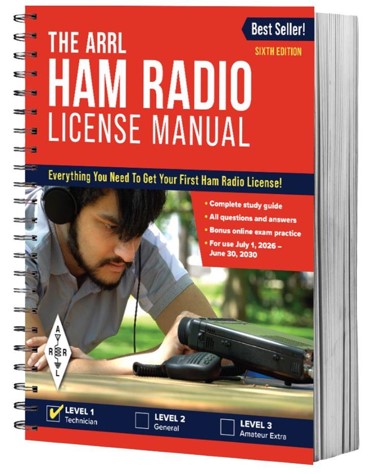
If your license has expired, you’ll need to retest. You may be able to simply take the exam again and pass it, but many people will need to study for the exam again. It’s important to remember that the question pool will probably have changed since you took your first exam. Fortunately, there are many resources to help you study, including online platforms like HamStudy and amateur radio license manuals.

The “ARRL Ham Radio License Manual” for the Technician exam contains the question pool good until June 30, 2030. (Image/ARRL) If you’re worried that you’ve lost your skills, start by forming small habits like getting on the air for 15 minutes every day, making at least one contact a day, or just listening on the air without transmitting at all. It can be hard when you feel like you’re starting from square one, but most amateur radio skills are like riding a bike—even when you don’t practice for a while, the skills will come back.
If you feel like you’re too busy, you could start by picking a certain amount of time one day a week reserved for amateur radio. Making this a habit will help you integrate times to enjoy the hobby into your schedule. You’ll probably always feel like you don’t have enough time for amateur radio—at least until you add it in small chunks throughout your schedule. It may also be helpful to schedule this time around a local net or club meeting. This way there is already structure in the times that you’ve set aside for the hobby, and you won’t have to spend extra time thinking about what you want to do.
It will always be at least a little bit challenging to get back into amateur radio (or any hobby) after some time away from it, but it’s possible with a little bit of effort and planning. The key to returning to the hobby is to start the process small—even 15 minutes a day can get you more involved and active. The small routines you create to achieve your goals will compound over time, and before you know it, you’ll be back to enjoying one of the best hobbies in the world!
The post Tips on Getting Back Into Amateur Radio After Periods of Inactivity appeared first on OnAllBands.
OnAllBands
-
News: Rockall DX Group
Recently posted on the Rockall DX Group Facebook page: “Where do we go next? Certainly a great book from famous DXer Martti, OH2BH. We wont release the official communication before the weekend but if you’re eager to know it, and you want to do some research or guess work, here’s 3 tips / hints: 1. […] This post appeared first on: DX-World Want to know more about it? Read More
-
News: Rebel DX Group
A recent post occurred on the Rebel DX Group Facebook page. We have edited the text a little but the general purpose of the post remains. Wondering if any reader(s) might just be tempted.. “Is there anyone willing to join a trip of a lifetime down to the Southern Ocean for 3 months? Vessel and […] This post appeared first on: DX-World Want to know more about it? Read More
-
T88FM, T88MK & T88XM – Palau
JM1LIG (as T88FM), JO3LVG (as T88MK) and JG1LFF (as T88XM) will be active from the Palau Radio Club / Shack during April 8-14, 2027. QRV on HF bands, various modes. QSL via H/cs. *Note, the team plan to carry out maintenance and installation of new antennas at the QTH in Koror. This post appeared first on: DX-World Want to know more about it? Read More
-
Can You Hear Me Now? Tips and Tools to Help Ham Radio Operators Affected by Hearing Loss
For years, my wife has questioned my hearing quality. I always dismissed it jokingly as “selective hearing.” It wasn’t until I noticed it affecting my ham radio operations that I began to take her seriously.
I say this jokingly, but it’s a fact: With age we start to lose our senses to one degree or another. And this can be compounded by what we have exposed our senses to over the years.
For years, I ran around the state in either a fire truck, ambulance, or police car with the siren blaring, never giving a thought to hearing protection. And what was one of my main hobbies at that time? Competitive shooting. What could go wrong, being in confined spaces with high-decibel noise for extended periods of time over the course of 30 years?
So, I admit that I have some degree of hearing loss. And it really is affecting my ability to pull out some weak signals over the air. Who wants to be the operator who needs to ask their contacts their call sign 12 times? So, I began exploring options.
I obtained some hearing aids. This helped immensely, but as you know when you amplify the good receive signal, you also amplify the noise. Some of it can be filtered out, but not all of it. I began my quest to lower the signal-to-noise ratio. Let me share a few steps I took to accomplish this.
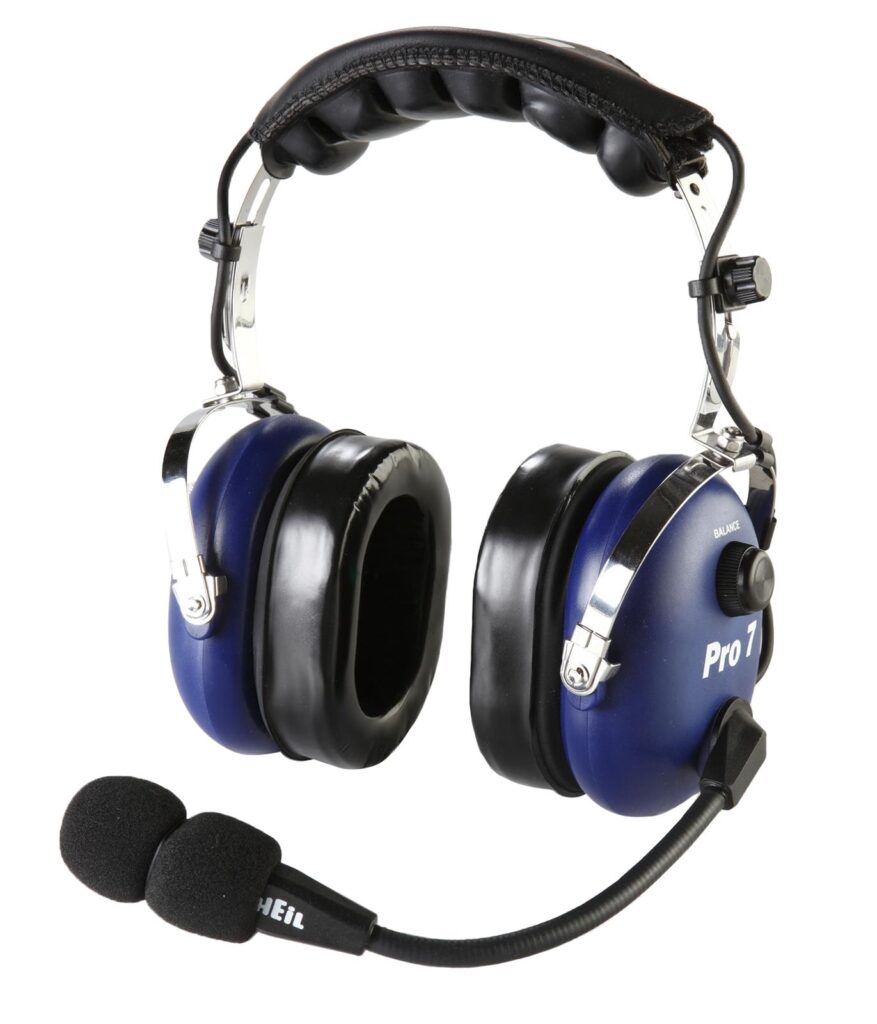
The first thing I did was to get a good headset. I tried a commercial broadcast headset, which was good, but the cable arrangement was not conducive to my body shape. When I turned my head, it would knock the earpiece from my ear with my shoulder. Then I tried the Heil PRO 7 Headset.

Heil PRO 7 Headset (Image/Heil Sound) The cable came off the earpiece at an angle avoiding my shoulder. I considered the fact that it stayed on my head a win. Beyond that, it was very lightweight and had plenty of adjustments to make it feel good. It was full stereo with balance control to allow me to listen to both VFOs in my radio simultaneously and adjust which one was louder. And finally, it has a phase reversal switch which is sometimes like magic when digging out a weak signal.
Next, I took a deep dive into the equalizer setting on my Yaesu FTDX-101MP and Yaesu FTDX-10. I watched videos and read information on how to tailor the sound to my hearing ranges. This was a great learning experience and really helped me with the way I hear my transceivers. I highly recommend that everyone who has a rig with equalizer settings do this.
In addition to the equalizer settings, it is vital to learn about the filtering built into your radio. In my mind, more is better, but that only applies to grandma’s biscuits and gravy. If you turn on too much internal filtering, you will distort the sound and filter out good signals. The Radio Today Guides from the Radio Society of Great Britain (RSGB) have been critical tools for learning about the settings on my rigs. They do a great job of explaining each setting and giving you a starting point.
Next, I decided to install a DX Engineering Receive Short Element Active Vertical Antenna (RSEAV). This is a low-to-ground receive-only antenna. It has a low third order intercept and is useful on 40 kHz to 30 MHz. You do need a means to add a dedicated receive antenna to your transceiver.

(Image/DX Engineering) I used the DX Engineering NCC-2 Receive Antenna Phasing System to integrate the RSEAV into my setup. This allowed me to phase the RSEAV against my main transmit antenna to null out some of the noise. Plus, it lets me add up to three additional RSEAV antennas in the future if I desire.

(Image/DX Engineering) DX Engineering offers a variety of audio-enhancing devices from manufacturers including bhi (digital sound processing (DSP) noise-canceling modules and speakers, parametric equalizers); Heil Sound (microphones, parametric receive audio equalizers, speakers, HT headsets); SOTAbeams (WOLFWAVE Advanced Audio Processor); and others.

(Image/SOTAbeams) Don’t make chasing that elusive DX any harder than it already is.
Until next time, 73 de AC8OW
The post Can You Hear Me Now? Tips and Tools to Help Ham Radio Operators Affected by Hearing Loss appeared first on OnAllBands.
OnAllBands
-
5Q7DX & OV2T – North Jutland, EU-171
A team consisting PA1SVM, PA7JWC and PD2R will again be active from Saeby (JO57GG), North Jutland (EU-171) as OV2T and 5Q7DX during September 16-23, 2026. QRV on CW, SSB and Digi; 160-6m, 2m. Also active on satellite QO-100, RS-44. QSL info OV2T via PA0ABM and 5Q7DX via PA7JWC or LoTW. – Pictures are of 2024 […] This post appeared first on: DX-World Want to know more about it? Read More