[#669] The latest FREE NON-SUBSCRIPTION DX-World Weekly Bulletin written by Bjorn ON9CFG is available to download. Click below to get the newest edition which this week runs to 15 pages. Previous bulletins can all be found here. Please contact Bjorn with any updates or errors. DOWNLOAD THE LATEST BULLETIN ===== This post appeared first on: DX-World Want to know more about it? Read More
Author: Source Author
-

SafecomLink Explores Cross-Band Multi-Station Data Exchanges Over HF
The following is a message from SafecomLink:
For decades, HF radio ARQ digital modes such as PACTOR has been governed by two “laws” everyone simply accepted:
❌ ARQ is point-to-point.
❌ Both stations must be on the same band with a viable propagation path.BUT what if neither of those limitations were actually true anymore?
Imagine:
🔹 A station on 40m having a live ARQ conversation with a station on 20m.
🔹 Operators on completely different bands exchanging data in real time.
🔹 Three, four, or even more stations participating in an error-free ARQ live chat.
🔹 An HF network where propagation barriers become routing opportunities instead of dead ends.This isn’t a future concept.
It’s already happening!The SafecomLink Cluster for PACTOR introduces something that has never existed before in HF ARQ data communications: a shared “”connected brain”” that bridges multiple independent nodes into a single intelligent system.
The result is a capability that fundamentally changes how we think about HF data networks.
🔴 Is it a repeater?
🔴 A router?
🔴 A bridge?
🔴 Or something entirely new?We recently documented the concept, architecture, and real-world use cases in a short case study.
If you’re involved in HF digital communications, emergency communications, Pactor, Winlink, or simply enjoy seeing old limitations challenged, this may be worth 5 minutes of your time.
Read the full article below and tell me:
What would YOU build if HF Radio ARQ digital mode was no longer limited to a single band and a single peer? 🚀
Link to the case-study: https://www.safecomlink.com/post/safecomlink-case-study-cluster
Source: SafecomLink
Amateur Radio Daily
-
VIDEO – ZS8W Marion Island
At the end of April 2025, Yuris YL2GM was active from Marion Island as ZS8W. The DXpedition was fully documented here often with breaking news items. Today, Yuris sends DX-World a video depicting the story of his activity, voiced over by his daughter, Liva. Congrats on a great DXpedition, Yuris. This post appeared first on: DX-World Want to know more about it? Read More
-

New Products Spotlight: Salty Walt’s Latest, Nomad Guy Rings, and an FTX-1 Field Tuner
OnAllBands is excited to announce a great selection of new portable-friendly products available from DX Engineering for June. You’ll find all the latest offerings by clicking on “What’s New” from the menu bar at DXEngineering.com. You’ll also discover big savings on open box and scratch & dent equipment.
Here are just a few of the hottest products you’ll want to put on your must-have list:
“Salty Walt’s Next Level Portable Antenna Sketchbook”: Salty Walt, K4OGO, has done it again! On the heels of his popular “Portable Antenna Sketchbook” comes 144 pages of practical, field-tested, easy-to-build antennas along with plenty of antenna theory, insights on maximizing your station setup, and techniques that can dramatically improve your signals. Note: Book does not include instructions on how to find that “lost shaker of salt.”
Whether you’re operating in the field, at home, or deep in the backcountry, these designs are built to perform. Explore military-inspired antennas, create efficient wire arrays with minimal supports, and discover new ways to maximize your station’s potential.
Antennas detailed in the book include:
- Three-element vertical beam
- Two-element quarter-wave vertical with reflector
- Two-element vertical Yagi with director
- Half-square Bobtail curtain
- Co-phased vertical whips
- Corner-fed cubical quad
- Portable rhombic
- Terminated end-fed V
- V-beam tuned transmission line trap
- Vertical Moxon
- Vertical phased arrays
- Portable magnetic loops
- Variations on the telescopic whip

(Image/ARRL) Also, take a moment to watch the interview below with K4OGO from the DX Engineering YouTube Channel. And check out Salty Walt’s YouTube channel, Coastal Waves & Wires, here.
DX Engineering Nomad Guy Ring Kit: Here’s a reliable solution for stabilizing DX Engineering Nomad Portable Masts in a variety of operating conditions. Designed as durable guy rings specifically for Nomad masts, these kits feature precisely placed holes that enable secure three-way guying for improved support. They are engineered to fit both 0.260- and 0.855-inch outside diameter mast tubes. Each kit includes six convenient hooks for attaching guy ropes. Offered in a two-pack, these guy ring kits help ensure the stability and performance that operators depend on in the field.

(Image/DX Engineering) mAT-TUNER mAT-1F Automatic Antenna Tuner: This tuner is designed specifically for the Yaesu FTX-1 Field HF/50/144/430 MHz SDR All Mode Base/Portable Transceiver. Capable of matching the 10W output of the FTX-1 Field, it draws power from the radio via the included control cable. Providing frequency coverage from 160-6M, the mAT-1F has a BNC jack for an antenna as well as a pair of banana jacks for long wire antennas.
The bottom of the mAT-1F has jacks for the coax in from the radio and the control cable. An LED indicator shows if the tuner is tuning, online, or in bypass mode. Control of the tuner is accomplished from the FTX-1, which sees the tuner as if it were a Yaesu FC-90 tuner. The unit measures a portable-friendly 5.590″ x 2.638″ x 1.102″ and weighs in at 12.5 ounces.

(Image/mAT-TUNER) Check into OnAllBands regularly for more products and more ways to improve your on-air experience.
The post New Products Spotlight: Salty Walt’s Latest, Nomad Guy Rings, and an FTX-1 Field Tuner appeared first on OnAllBands.
OnAllBands
-
S79/OL1T – Seychelles
Rudi, OK2ZA and David, OK6DJ will be active from the Seychelles as S79/OL1T during December 28, 2026 to January 8, 2027. QRV on various bands and modes. Full details to follow in coming months. QSL via LoTW. Logsearch / OQRS here. This post appeared first on: DX-World Want to know more about it? Read More
-

Amateur Radio EmComm Prep—A Look at What Equipment You’ll Need When the Worst Happens
In previous articles, I’ve looked at necessary software to be used for EmComm. But really, what equipment do we need to have at the ready for when that “bad day” happens? Many operators are of the mindset that they will use their POTA setup as their EmComm setup. In some cases that will work, but EmComm requires a little different flair.
With POTA, we are looking to easily set up and get on the air. In most cases we will only be in a park for a couple of hours. We want to quickly get on the air, make as many good contacts as possible, load our gear in the car, and head out.
With EmComm, depending on the event, we could be there for an extended period. I was set up after Hurricane Katrina for nearly six months. I realize that is the extreme, but isn’t that what we train for? Most disaster scenarios would probably not extend past a few days in our current climate, but those few days could be crucial.
Assuming you have your radio, antenna, and power, let’s walk through an EmComm setup focusing on the not-so-obvious items.
First, you will need shelter. It doesn’t matter whether the sun is shining or the snow is blowing, you will need protection from the elements to be effective. You cannot assume you will be able to operate from your local EOC or other building, as it may be just as affected as the rest of the community you are serving.
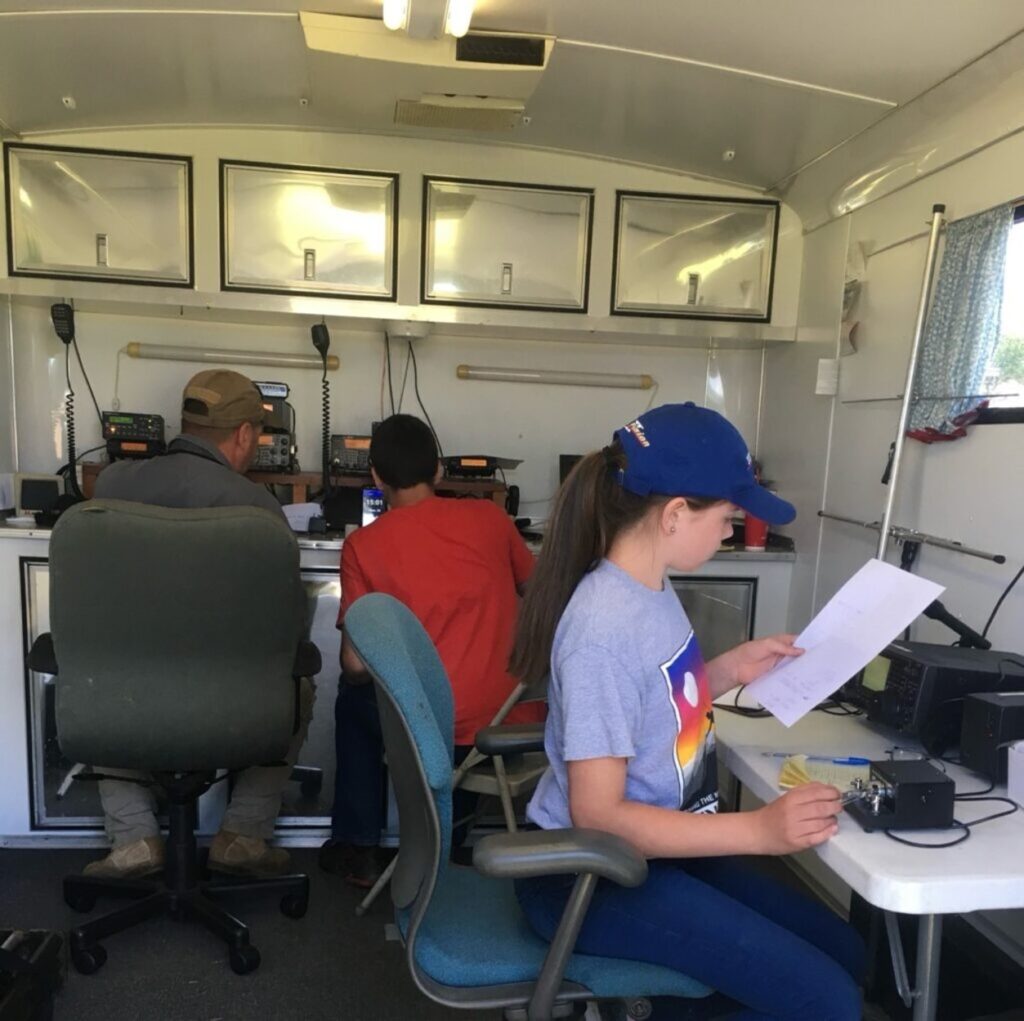
I have seen some elaborate mobile communications vehicles and trailers for this very purpose. Everything necessary to deploy is set up inside the vehicle and ready at a moment’s notice. Desks, chairs, radios and antennas—even food and water—are usually part of these setups.
However, most of us are not quite that fortunate. I keep these things handy in a corner of our home. These are staged to quickly throw into the Jeep. Also, just as important as having the supplies is practicing with them. At a minimum, I use this setup at NVIS Day, Field Day, and International Lighthouse and Lightship Weekend. In the heat of battle is not the time to make sure you have everything and know how to use it proficiently.
I use a pop-up style tent for my portable shack. Measuring 10-foot x 10-foot x 8-foot, it has a front porch canopy, 360-degree windows, and a top vent that can all be covered during bad weather. All of the poles are internal. It is erected by simply pulling a tab on each wall and the roof. It has an integral floor to keep water and critters from entering, plus a weatherproof cable pass-through for coax and power cables.
I have a ¼-inch floor covering that folds up nicely for transport and storage. This protects the tent floor and insulates from the elements. A compact folding table serves as the desk and is accompanied by a pair of folding “director’s chairs.” I have a few battery-operated lights and a battery-operated fan that I have tested to make sure they are RF quiet. A Buddy heater makes operating in cold weather more bearable, and I also have a folding cot that fits along one side for extended operations.
Now we have a well-thought-out, well-executed space to deploy our radio equipment and operate for as long as needed. I will now go through what I use for EmComm. It’s my POTA setup with a couple of enhancements. The enhancements are a computer and digital interface, as I do not attach a computer to my rig for POTA.
I use the Yaesu FT-891 as the center of the shack. It is rich in features given how small and lightweight it is. I know there is a lot of talk about the menu system, but like anything else, if you use it enough, it is a non-issue. I protect the rig with the Armoloq Tactical Protective Armor for the 891. This protects the radio, knobs, and connections at home, on the scene, or anywhere in between.

(Image/Yaesu) 
Armoloq Tactical Protective Armor Modular Radio Mounting Frame for the FT-891. (Image/Armoloq) I also have a Yaesu FT-2980 for 2M operations. My 2M antenna is the Comet SBB- 7 atop a DX Engineering Nomad Mast connected with the DX Engineering Portable VHF/UHF Antenna Mount.
I use the Carlson Drive-On Mast Mount if no other suitable mast mount is available. If I need 2M/70cm operations, I can always use an HT and crossband repeat through the Yaesu FTM-300 in my Jeep.

DX Engineering Portable VHF/UHF Antenna Mount. (Image/DX Engineering) 
Carlson HD Drive-On Mast Mount Car Stand Package, (Image/Carlson) The operating station is powered by a homebrew power box. The box contains a Samlex 1235P-M Power Supply and a Bioenno 1220A LiFePO4 Battery.
These two power sources are brought together with a West Mountain Radio Epic PWRgate and a West Mountain Radio RIGRunner DC Outlet Panel. A Bioenno Solar Panel is attached. I have operated for days on this setup. It allows for use of commercial power if available or solar/battery power if not available.

Samlex 1235P-M Desktop Switching Power Supply. (Image/Samlex) 
Bioenno Power Battery and Charger Combo. (Image/Bioenno Power) 
West Mountain Radio Epic PWRgate Battery Backup System. (Image/West Mountain Radio) My go-to EmComm antenna is the Alpha Antenna Portable MIL EmComm Enhanced Antenna. This antenna has a vertical element for distant communications, but more importantly, it has four NVIS wire elements for near-field communications. This antenna provides some resonance from 80-6M without a tuner. However, depending on frequency used and environmental influences, you may want a tuner to clean things up a bit.

Alpha Antenna Portable MIL EmComm Enhanced Antenna. (Image/Alpha Antenna) I use the mAT-TUNER MAT-Y200. It provides a wide tuning range with ample memories and low power consumption. As a bonus, it attaches nicely to the top of the 891 with some Velcro straps.

mAT-TUNER MAT-Y200 Automatic Antenna Tuner for Yaesu transceivers. (Image/mAT-TUNER) Finally, I connect a Microsoft Surface to the rig via a Digirig Digital Mode Interface Kit. This provides for seamless soundcard and CAT control integration. It is vital that you have the rig and the computer working together along with WinLink and NBEMS before you are needed to perform in the field. Trying to download drivers and software updates with poor or no internet service is a formula for failure.

Digirig Digital Mode Interface Kit for the FT-891. (Image/Digirig) Please do not look at this list and think you must get it all at once. This article and list are the result of years of failures both in training and real-world events. Take your time, consult with others in your area, and don’t be afraid to call DX Engineering just to get advice on what might work in your situation.
As stated earlier, I practice with this several times a year and have a system in place for mob and demob. Also, I have used it enough to know where I like everything on the desk and how it all fits in the space provided. Remember, people are counting on you to professionally meet their needs. Trial and error should not be done during a real-world event.
Until next time, 73 de AC8OW
The post Amateur Radio EmComm Prep—A Look at What Equipment You’ll Need When the Worst Happens appeared first on OnAllBands.
OnAllBands
-
ZL7DX – Chatham Islands
Chris ZL7DX is again QRV from Waitangi, Chatham Islands having not been on air since February. Active on FT8; various bands using a DX Commander antenna (after his Hexbeam was broken in recent high winds). QSL via M0OXO. This post appeared first on: DX-World Want to know more about it? Read More
-

Special Event Station will Activate Barra Lighthouse
The following is a message from the International Amateur Radio Association (AIRA):
On July 18, 2026, from 10:00 AM to 6:00 PM, AIRA will be activating the Barra Lighthouse in Ílhavo, Aveiro- Portugal. We warmly invite radio amateurs to join us in this special activation. The designated callsign will be CS5AIRA.
The activity will operate across the 20 and 40-meter bands, as well as VHF and UHF frequencies. Communications will include links via Echolink-LUSOFONA, LART Network, the QO-100 satellite, and DMR via Talkgroup 268 (10:00 – 12:00) and Talkgroup 91 (14:00 – 18:00) on the BrandMeister platform.
See the event website for more information.
Source: International Amateur Radio Association
Amateur Radio Daily
-

A Young Hams Guide to Amateur Radio Scholarships
As one becomes involved with amateur radio, it becomes apparent that “community” and “support” are two of the most important values of the hobby. These are closely followed by teaching and learning. With these being the key values of amateur radio, it’s only natural that various organizations within the hobby offer scholarships to young hams pursuing higher education.
With scholarships ranging from $500 to $25,000, the generosity of amateur radio clubs and groups is virtually unmatched by any other hobby. Providing scholarships seems to be the perfect way to give back to the community.
If you’re a young ham heading to college soon, or even just considering it, looking into the various scholarships in the amateur radio community is well worth your time. Just meeting the first requirement— having an amateur radio license—narrows the pool of applicants immensely. This gives you a better chance of being selected for an amateur radio scholarship compared to the random scholarships that you find on websites where thousands of your peers are applying!
Many of the amateur radio scholarships have further requirements beyond being licensed. For example, the YLRL (Young Ladies Radio League) offers two scholarships for female amateur radio operators who are pursuing a four-year degree, and one for female amateur radio operators pursuing a two-year degree. Read more about YLRL scholarships here.
Fortunately, the application process for almost all amateur radio scholarships is incredibly streamlined. The vast majority of scholarships offered for amateur radio use a common application facilitated by the ARRL Foundation and their scholarship committee—this is where all young hams should start their journey. To apply for all of the scholarships that are managed by the ARRL, you should fill out the ARRL Foundation application in the online program “Kaleidoscope.”
The first few pages of the application consist of questions about your plans for school. These are followed by questions that determine your eligibility for specific scholarships. For example:
- “Are you proficient in CW?”
- “Are you interested in/active in contesting?”
- “What class of license do you have?”
After answering these questions, you’ll have the opportunity to elaborate on your amateur radio experience, what the hobby means to you, and how you plan to incorporate it into your studies or life in college. In addition to answering these questions, you’ll be asked to submit a few letters of recommendation from people in your community and/or former/current educators. After submitting your application, you may also be invited to virtually interview for some of the larger scholarships.
While the ARRL manages the vast majority of scholarships in amateur radio, there are a few managed by clubs and organizations. For example, the YLRL scholarships mentioned above are run by the YLRL, and the application is separate from the ARRL Foundation application. To apply for the YLRL scholarship, fill out and submit the online application on their website.
The ARRL Foundation typically takes applications from fall until late December (the 2026 scholarship cycle ran from October 30, 2025, to December 30, 2025). The YLRL scholarship application for next year opens on February 1, 2027.
Click here for descriptions of available scholarships through the ARRL Foundation.

A description of the ARRL Scholarship to Honor Barry Goldwater from the ARRL website. (Image/ARRL) Here are a few tips for young hams applying for amateur radio scholarships:
- While the only “requirement” for many of them is that you have a license, the more active you are in amateur radio, the more likely you are to receive a scholarship. Get licensed, stay licensed, and get involved.
- Make sure you stay on top of deadlines and keep in touch with anyone who is also contributing to your applications (e.g., those providing recommendations). Late applications will not be accepted, and your recommenders are just as busy as you— just be sure to send a few reminders if needed.
- Ensure that you complete all parts of your application. Many require your transcript to be uploaded, and almost all require letters of recommendation.
- If you have questions or need something clarified, don’t be afraid to reach out! Sending an email to the support person is definitely worth what you could receive in scholarships—and it only takes a few minutes.
Amateur radio opens plenty of doors for those who knock. An amateur radio scholarship opportunity is another door in a sense—one backed by incredible generosity and hope for success from the groups that contribute. If you’re a young ham considering or planning on higher education, I strongly recommend that you take a look at the various scholarships that are available and apply for them.
The post A Young Hams Guide to Amateur Radio Scholarships appeared first on OnAllBands.
OnAllBands

-
HB0/OI5AY – Liechtenstein
HB0/OI5AY will be active from Liechtenstein during June 21-27, 2026. QRV initially on FTx then CW & SSB as the week progresses, and finally RTTY near the end. All QSOs uploaded to LoTW with a a special QSL card also to be printed. NOTE: This is not a CEPT operation. The license and callsign is […] This post appeared first on: DX-World Want to know more about it? Read More