[#680] The latest FREE NON-SUBSCRIPTION DX-World Weekly Bulletin written by Bjorn ON9CFG is available to download. Click below to get the newest edition which this week runs to 19 pages. Previous bulletins can all be found here. Please contact Bjorn with any updates or errors. DOWNLOAD THE LATEST BULLETIN ===== This post appeared first on: DX-World Want to know more about it? Read More
Author: Source Author
-
A35TV – Tonga
Between 28th November 2026 to 4th December 2026 Australian DXers Tommy Horozakis (VK2IR) and John (VK3YP) are heading to the Kingdom of Tonga for a highly anticipated DXpedition under the callsign A35TV. Tommy and John will be targeting 160M to 6M bands on FT8/CW/SSB modes. The operation aims to give operators across Oceania, Asia, Europe, […] This post appeared first on: DX-World Want to know more about it? Read More
-

“Active” call sign probably isn’t what you think
By Rob Rosenberger (K4HST)
Do this: visit the FCC call sign lookup and search for W0QUF. It says right there on the page: “Status: Active.” Except it’s not. Look farther right and you’ll see its grace period started in January. Now search for it at the ARRL call sign lookup. They give you no hint it’s in a grace period.
Do an FCC lookup on KD0NZJ. It’s long expired, right? Except it’s not. Look to the left and you’ll see a “PA” icon, which means it remains active pursuant to FCC rule 1.62. If you look it up on ARRL, it’ll say “(Administrative Update Applied)” below the expiration date. They give you no hint you can lawfully communicate with them.
Neither FCC nor ARRL offer visual cues on their search pages when you look up a call sign. You must inspect the data with your calibrated eyeballs to confirm its status.
So, let’s go over what you need to know. We’ll break it down into five categories:
A “live” call sign is marked active and can transmit. It has not reached its expiration date. Roughly 90% of all “active” call signs fall into this category.
A “dagger” call sign is marked active and can transmit regardless its expiration date. A “pending application” extends its life. Roughly 430 call signs fall into this category (a scant 0.05%) and the FCC often spends years resolving them.
A “grace” call sign is marked active yet cannot transmit. It exceeded its expiration date, lies within its two-year grace period, and has no pending application. Roughly 10% of all “active” call signs fall into this category.
A “zombie” call sign is marked active yet cannot transmit. It exceeded its grace period with no pending application, yet the ULS database failed to mark it expired. The most recent example is KI4FHE. (If you run an FCC lookup, do not have any liquids in your mouth! You’ve been warned.) Zombies might pop up for a day or two if the second anniversary of their expiration date falls on a holiday Monday.
A “dead” call sign is marked canceled, expired, or terminated. Enough said.
You might ask “where did these five terms come from?” The short answer: The interwebs apparently had no terms for them and I needed a taxonomy for the niche PDF amateur radio call books I produce. My searches of online amateur radio literature, developer repositories, and the FCC’s ULS documentation revealed no similar published model … so I offer this to the public domain:
Terminology FCC Status ULS LicenseStatus Expiration Date Additional Condition Output / Action Live Active A Future None Standard black text Dagger Active A Past (Any length) Pending application Superscript dagger (†) e.g. WQXN317 since 2021-04-20 Grace Inactive A Past (< 2 years) No pending app Dark red text e.g. WA4RHD Zombie Inactive A Past (>= 2 years) No pending app Triggers logging warning e.g. KI4FHE from 2026-04-26 to 2026-09-09 Dead Inactive Non-A N/A None Excluded from output Ta da! You now understand what “active” means when you look up a call sign on a search page. Calibrate your eyeballs for the FCC, shame the ARRL webmaster for me, and 73!
Source: Rob Rosenberger (K4HST)
Amateur Radio Daily
-
9J2NE – Zambia
John, A2NEW will soon be going on a trip to Zambia and when time permits he’ll QRV as 9J2NE on HF bands, FT8. While there is not much info yet published on this trip keep an eye on either A2NEW or 9J2NE QRZ pages. QSL via LoTW, Club Log etc. This post appeared first on: DX-World Want to know more about it? Read More
-
Substitutes for Ground in Portable Ham Radio Operations
Portable amateur radio operation is all about freedom and mobility. One day you’re operating from a mountain summit, the next from a state park, and the next from a picnic table that looks like it survived three hurricanes, two family reunions, and possibly a bear.
One challenge that follows portable operators everywhere is grounding. Unlike a home station where you can drive ground rods into the earth and install elaborate radial systems, portable operators often have to get creative. Eight-foot ground rods aren’t exactly backpack-friendly, and airline baggage handlers tend to frown on them.
The good news is that a traditional earth ground is not always necessary. In many cases, practical substitutes work just as well.
Understanding Ground Requirements
Before discussing substitutes, it is important to understand what ground means in amateur radio. Many operators think of ground as a direct connection to the earth, but in radio frequency (RF) terms, ground often serves as a return path for antenna currents. For portable stations, an RF counterpoise or artificial ground can frequently replace a true earth ground.
Many modern portable operations can function effectively without a traditional ground rod. But the choice of a substitute depends on the antenna type, operating frequency, and environment. As with many things in ham radio, the answer is often, “It depends.”
Counterpoise Wires
One of the most common substitutes for a ground system is a counterpoise wire. A counterpoise is a conductor connected to the antenna system that acts as the missing half of the antenna.
For portable vertical antennas, a counterpoise wire laid on the ground can dramatically improve performance. These wires can be cut to resonant lengths for the desired amateur bands. Many portable operators carry several lightweight wires that can be deployed in minutes.
Advantages include:
- Lightweight and inexpensive
- Easy to transport
- No tools required
- Excellent efficiency when properly sized
A quarter-wave counterpoise is often sufficient for portable operations, though multiple radials usually provide even better results. If space is an issue, several 1/8-wave radials are a good alternative.
Callum McCormick, M0MCX, owner of DX Commander, recommends that 3-meter (approximately 10-foot) radials are an ideal length for his vertical antennas. Instead of laying long single wires, make several 3-meter radials and bundle them in groups of four. This allows for incredibly fast setup and teardown in the field.
The only downside is that they occasionally become trip hazards. Nothing says “experienced radio operator” quite like explaining to a curious hiker why you’re untangling yourself from 20 feet of wire while insisting everything is going according to plan.

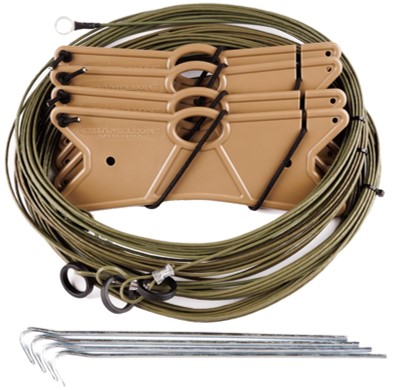
Chameleon Antenna Counterpose Kits come with four 25-foot radials, isolating O-rings, wire winders, and steel tent stakes. (Image/Chameleon Antenna) Elevated Radials
Elevated radials are another effective alternative. Instead of laying wires directly on the ground, operators suspend them a few feet above the surface.
Elevated radials often perform better than ground-level radials because they experience less loss from the surrounding soil. Two to four elevated radials can provide excellent performance for portable vertical antennas. This method is especially useful during Field Day, emergency communications exercises, and park activations.
Just remember to mark them with caution tape to avoid accidental collisions with humans and wildlife.
Vehicle Ground Plane
When operating mobile or portable near a vehicle, the vehicle itself can serve as an effective ground substitute. The metal body of a car, truck, or trailer provides a large conductive surface that can act as a counterpoise.
Many portable operators mount antennas on:
- Vehicle roofs
- Trailer hitches
- Drive-on pole bases
- Portable mast systems attached to vehicles
The vehicle body effectively becomes part of the antenna system, reducing the need for separate ground wires. As a bonus, if band conditions suddenly improve, you can confidently tell your friends that your pickup truck is now a highly sophisticated RF enhancement platform. They don’t have to know it was already that way.
Artificial Ground Units
Artificial ground devices are specifically designed to simulate a ground connection when a true earth ground is unavailable. These devices typically use adjustable inductors and capacitors to create a low-impedance RF return path. By tuning the artificial ground, operators can reduce RF currents in unwanted areas and improve antenna performance.
Artificial grounds are particularly useful in:
- Portable HF operations where ground stakes are prohibited
- Apartment stations
- Hotel room operations
- Temporary emergency communication setups
Although not as efficient as a well-designed radial field, they often provide a practical solution in difficult locations. They’re also one of those accessories that make non-hams nod politely while having absolutely no idea what you just said.
Wire Antennas that Require Little or No Ground
Many wire antennas operate effectively without a traditional ground system.
Examples include:
- Dipoles
- Inverted-V antennas
- Doublets
- End-fed half-wave antennas with matching transformers
- Loop antennas
A resonant dipole, for example, is a balanced antenna that contains both halves of the radiating system. Because of this design, it does not require an earth ground for operation.
Portable operators often favor wire antennas because they are lightweight, inexpensive, and can be supported by trees, telescoping masts, or fiberglass poles. Trees remain the preferred choice, assuming they cooperate and don’t decide to keep your throw line as a permanent souvenir.

DX Engineering’s TWIG End-Fed Half-Wave QRP Antenna Kit includes a 49:1 transformer that matches the high feedpoint impedance of the half-wave radiator to a standard 50-ohm coaxial feedline. (Image/DX Engineering) Metal Screens & Ground Mats
Some portable operators use metal screens, wire mesh, or portable ground mats beneath their antennas.
A ground mat provides a conductive surface that acts similarly to a radial system. While not as effective as a large buried radial field, it can improve performance on difficult terrain such as rocky ground, pavement, or sandy beaches.
Portable ground mats are commonly constructed from:
- Hardware cloth
- Wire mesh
- Aluminum screening
- Lightweight conductive fabric (Faraday cloth)
These materials can be rolled up for transport and deployed quickly in the field. They also have an uncanny ability to collect every pine needle within a 50-foot radius.

Magic Carpet—Chameleon Antenna’s Faraday Strip Radial System offers an innovative approach to radials. It replaces tangled messes of thin wire with wide, high-surface-area conductive strips of Faraday cloth. (Image/Chameleon Antenna) Water as Nature’s Ground System
When operating near water, nature can provide an excellent alternative to a conventional ground system. Saltwater, in particular, is highly conductive and greatly enhances antenna performance.
Portable operators often notice significant signal strength when operating:
- Along ocean shorelines
- Near salt marshes
- On boats
Vertical antennas positioned near saltwater frequently outperform identical antennas located inland. Many contest and DX operators intentionally seek out these operating locations for the performance advantage they offer.
Freshwater lakes and rivers generally don’t provide the same benefits, but they’re still nice places to spend an afternoon making contacts.
Portable Ground Stakes
While not a complete substitute, portable ground stakes offer a compromise between a permanent ground rod and no ground at all. Lightweight aluminum or copper stakes can be driven into the soil quickly and connected to the station equipment.
These stakes are useful for:
- Static discharge protection
- Temporary RF grounding
- Emergency operations
Their effectiveness depends greatly on stake size, soil conditions, and moisture content. They’re easy to carry and deploy, though sometimes the biggest challenge is finding ground that isn’t solid rock—or discovering that an exceptionally determined tree root occupies the only soft spot. Note that some parks may have rules limiting their use.
Balanced Antenna Systems
Balanced antennas often eliminate the need for extensive grounding. Systems using balanced feed lines and antenna tuners are designed to keep RF currents balanced and minimize dependence on earth ground.
Examples include:
- Ladder-line-fed doublets
- Full-wave loops
- Folded dipoles
Portable operators who use balanced antennas often experience fewer grounding issues and reduced RF interference, leaving more time to operate and less time wondering why the tuner suddenly became too hot to touch.

Yaesu YA-30 Broadband HF Folded Dipole Antenna. (Image/Yaesu) Choosing the Best Ground Substitute
Portable amateur radio operators have many alternatives to traditional grounding systems. Counterpoise wires, elevated radials, vehicles, artificial grounds, balanced antennas, and even nearby water can provide effective substitutes. The best choice depends on the operating location, antenna type, and personal preferences.
The beauty of portable ham radio is adapting to whatever conditions you encounter. Whether you’re operating from a park, mountain summit, campground, or beach, there is usually a practical solution available. Every outing teaches you something.
And remember: If someone asks why wires are running everywhere, poles are sticking into the sky, and mysterious boxes are spread across a picnic table, smile and explain that you’re talking to people around the world without using the internet. They’ll either think you’re a genius or ask if you’re with the government. Either way, you’ve started an interesting conversation.
The post Substitutes for Ground in Portable Ham Radio Operations appeared first on OnAllBands.
OnAllBands
-
V6XG – Chuuk, F.S.M
Haru, JA1XGI informs that he will be active from Chuuk, F.S.M as V6XG during January 14-22, 2027. He says the main purpose of this dx-vacation is to make QSOs with stations in Europe, North America, and South America on 160 meters, but he will also be setting up antennas for other bands covering 80 meter […] This post appeared first on: DX-World Want to know more about it? Read More
-
A Few Words from Alpha Antenna about the HOA Buster Antenna Matching Unit
OnAllBands spent time with many fascinating hams at Dayton Hamvention® 2026, from globetrotting DXpeditioners to leading manufacturers whose innovations are making a difference for operators everywhere. Today’s post focuses on the latter. We were thrilled to spend a few minutes talking tech with Alpha Antenna founder Steven Deines, N0TES.
DX Engineering proudly carries an impressive lineup of Alpha’s proven antennas and accessories, including:
- HF/VHF/UHF MagLoop EmComm Antenna
- HexTenna Deluxe Multiband Rigid Dipole and Vertical Antenna
- JPole SR HF Multiband EmComm End-Fed Antenna
Noting its many positive reviews, OnAllBands was most intrigued by Alpha Antenna’s HOA Buster Antenna Matching Unit on display. The device transforms existing gutters and downspouts into efficient radiators, covering HF, VHF, UHF, GMRS, and CB frequencies, including 80-10 meters, 2 meters, 70cm, and 900 MHz (depending on the gutter and environment).
Here’s what users have said:
“WAY better than I expected. My gutters are only eight feet off the ground, and I am making contacts across this country and others. Another surprise—SWR doesn’t change one iota in the pouring rain! With a setup time of less than a minute, this antenna is a no brainer for someone in an HOA or just looking for an inconspicuous antenna that performs really well. Hats off to Alpha Antenna!” Jim, DX Engineering Customer

(Image/Jim, DX Engineering Customer from five-star review at DXEngineering.com) 
(Image/Jim, DX Engineering Customer from five-star review at DXEngineering.com) “I was expecting to work some bands, but this antenna exceeded my expectations. At first, I thought I was having issues with it but checked it on my VNA and it appears this antenna works across everything except 80 in my case. The only band that spiked wasn’t a ham band anyway, so for me this antenna is a huge win. If you have an HOA situation like me, this antenna clearly works as advertised. Just make sure your gutters are metal and you have a solid connection. I am not using a tuner for these results.” Timothy, DX Engineering Customer
OnAllBands caught up with Steven, N0TES, to ask a few questions about the HOA Buster.
What was the genesis of the HOA Buster Antenna Matching Unit?
“The HOA Buster came up from an idea that I had to help people who were in wheelchairs because they couldn’t get out and put up antennas. I knew they could roll over to a downspout and shove a spike in the ground. That’s just step one. Step two is you clip a wire from that HOA Buster onto the downspout and now you’ve got a random end-fed wire antenna that goes up your downspout and across your gutters, which happens to be the largest antenna you own. Why not use the largest antenna you own?
“The science behind it is quite simple. The gutters and the downspout are all capacitive values. And we created an inductor that matches capacitance for an end-fed antenna system.
“You’ll find that the HOA Buster also provides tuner-free operations on 10 through 80 meters. And it does that because the gutter is a wide element. So, you have wider bandwidth. This gives you increased coverage including GMRS, VHF, CB and a lot of other frequencies. It’s a very low-profile system.”
Can you talk a bit about the antenna’s stealthiness in restricted environments?
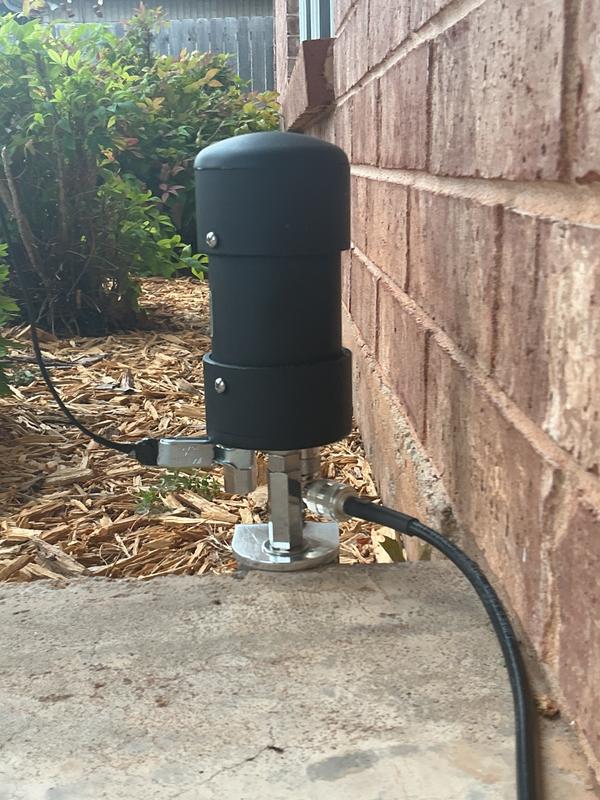
“A lot of people compare it to their sprinkler system controls. This is what it looks like when you put it out there. It attracts no attention, and I sometimes joke that if you have somebody who says, ‘You shouldn’t have anything attached to your house,’ say, ‘That’s the lightning arrester; you should probably get one too’.”

The HOA Buster features an SO-239 RF connector and is rated for up to 250 watts PEP SSB; 125 watts CW; and 25 watts for digital, AM, or FM modes. The unit comes with the HOA Matching Network, a ground spike and mount, and an eight-foot jumper wire. An optional 60-foot end-fed HF element enables portable operation in locations such as beaches, mountains, or parks. (Image/Alpha Antenna) What about its flexibility for portable operating?
“Really, NVIS is where the HOA Buster shines. It also works great as an end-fed antenna system if you use a 60-foot wire for Parks On The Air®. For POTA activators, they pretty much want the parks in the U.S. So, the HOA Buster converts easily to an end-fed antenna. Now you’re using a random end-fed wire—not so random because we already know 60 feet is the magic number. If it’s built right, it can be deployed very easily and quickly. A weighted end is included; it throws it up over a tree, and you just yank it down.
There have been a lot of positive reviews of the antenna. What feedback have you received?
“We do get a lot of people that give us feedback from Handiham. They appreciate us making a system that a blind ham can go out, attach to his downspout, flip a wire on, and run coax too.”
For more details and to place your order for the Alpha Antenna HOA Buster Antenna Matching Unit, visit DXEngineering.com.
The post A Few Words from Alpha Antenna about the HOA Buster Antenna Matching Unit appeared first on OnAllBands.
OnAllBands
-

brugtgrej.dk is Denmark’s Premier Marketplace for Used Ham Radio Gear
The following is a message from brugtgrej.dk:
Since the year 2000 I have been running a site for announcing used ham radio gear here in Denmark. It has since grown to be the one and only place for buying and selling used ham radio gear and has also become the biggest discussion forum here in Denmark.
Earlier this year, I released generation II of the platform to make it more contemporary, and I added a lot of features for daily ham use. The site is called brugtgrej.dk. The language can be switched between Danish and English. My latest added feature is a Shack display intended to run on a PC in the shack to show relevant live information on DX, aurora, satellites, weather, lightning etc.
The best value is provided if you create a user because that way we know your location to show more relevant information.
73 DE OZ1DW
ChristianeSource: brugtgrej.dk
Amateur Radio Daily
-
OC100ISL – San Lorenzo Island, SA-052 – Peru
Eduardo, OA4BSA; César, OA4CLU; Diego, OA4DKN; Giancarlo, OA4DSN; Carlos, OA4EBQ; Manuel, OA4ECK and Juan Carlos, OA4EEE will operate as OC100ISL from San Lorenzo Island (IOTA SA-052 and ARLHS PER-006) during September 25 – 27. QRV on 80-10m; CW, SSB, Digi . More info here. This post appeared first on: DX-World Want to know more about it? Read More
-
Ham Radio Portable Operating Insights: Planning & Executing a POTA Rove
There are all manner of ways to participate in portable operating. Some folks like to stay home and hunt, while others prefer to hit the field and put a signal on the air from a location that normally has no amateur radio presence.
There’s not much I like better than heading out to a park and lighting it up (radio-wise) for Parks on the Air® (POTA) or World Wide Flora & Fauna (WWFF). But sometimes activating one park just isn’t enough. I enjoy the planning and logistics of picking multiple parks in an area and figuring out the best way to activate them.
A few years ago, I set a goal of activating every POTA reference in Ohio. Since I’d already earned the Activated All Ohio State Parks Award, that only left me with a couple hundred locations to activate. Easy, right?
Several new POTA references had just been added in Ohio, so this seemed like a good time to do it. I spent lots of time analyzing maps and creating spreadsheets to calculate my best routes.
When traveling two or three hours to reach a park, it makes sense to activate as many as possible while you’re in the area. Sometimes there’s even good logic in staying overnight someplace along the way.
You may imagine an activator waking up on Saturday morning, looking at the POTA map and saying, “I think I’ll activate six parks today.” That’s great if you can do that, but experience has shown me that there is a lot more planning involved in a successful rove. It’s more than simply stringing a bunch of parks together and hitting the road.
Step one is to pick your target area. One of my roves was into southeast Ohio. That takes in a lot of real estate, so I chose a single park for my home base and picked several parks in the surrounding area to add to my “hit list” for each trip. Even after limiting the area, it still took a few trips to activate them all.
Once your hit list is established, you can use Google Maps and other mapping resources (see my article on “Mapping Resources for POTA”) to identify possible operating locations.
Once those operating locations are identified, it’s time to plug them all into Google Maps and figure out your route. Move the order of the stops around and look for ways to reduce unnecessary driving and backtracking.
Don’t forget to add a reasonable amount of time for setup, teardown, operating, and breaks. Remember: If a proposed route only allows 20 minutes at each stop, it is doomed to fail!
If you’re also active in the WWFF program, you’ll want to note whether any of your stops qualify for that program as well. If so, you’ve found a dual park. You can check for dual-park status by going to CQParks.net and performing a simple lookup.
POTA # WWFF # Description Coordinates
(or Map links)US-8911 KFF-6208 PA 214 State Game Land 41.605, -80.3792 US-8910 KFF-6207 PA 213 State Game Land 41.55, -80.1854 US-8964 KFF-6800 PA 269 State Game Land 41.7908, -80.2318 US-8850 KFF-6781 PA 152 State Game Land 41.8473, -80.2266 US-8800 KFF-6162 PA 101 State Game Land 41.8596, -80.488 One example of my info sheet for a rove in Pennsylvania. I keep this information in the Notes app on my phone, where I can easily refer to it during the trip. For POTA, 10 contacts are required for a valid activation, while WWFF requires 44. One important difference between the two programs is that you can accumulate your 44 WWFF contacts over several trips, while your 10 POTA contacts must be made during the same UTC day.
Because I frequently activate references that qualify for both programs, I note both reference numbers in the worksheet I create when planning a rove.
If, for some reason, you can’t get 10 contacts at a reference, you should still submit them. The contacts are still valid, even if you didn’t reach the required number for a complete activation.
I normally don’t pull the plug immediately after QSO number 10. Instead, I prefer to make at least 12 to 15 contacts before moving on. That gives me a little breathing room in case I’ve made a logging mistake or discover another problem later.
Or, if I have a pileup going, I try to work as many callers as possible until the crowd eases. I hate leaving callers waiting, but, unfortunately, it does sometimes happen. After all, there are more parks waiting.
A Rove is 1 Situation Where Simplicity Really Pays Off.
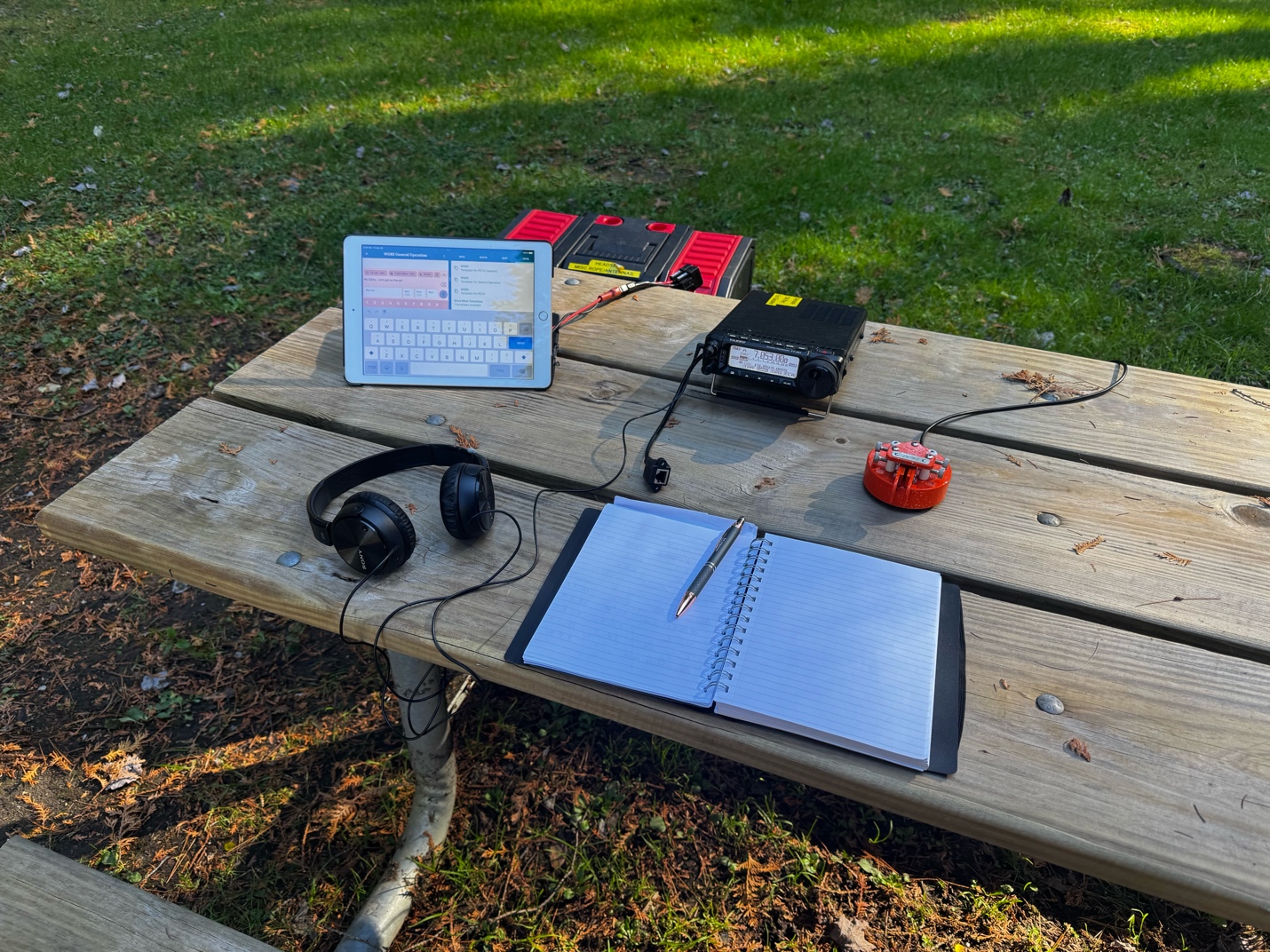
In my case, I use a Yaesu FT-891 and a Yaesu ATAS-120A Auto Active Tuning Antenna. The radio sits on a small desk that rests on my truck’s center console—when the truck isn’t in motion, of course. This allows me to set up quickly when I arrive.
I park, attach the antenna to the mobile mount, get the radio ready, and start operating.
When I’m finished, the radio gear gets moved to the passenger seat, and I head to the next location. If I’m traveling only a few miles, I’ll leave the ATAS-120A mounted. Otherwise, it gets stowed for the drive.
There are certainly times when I’ll put up a wire antenna during a portable activation, but that changes the timetable considerably. I normally don’t use a wire antenna unless I plan to be at that location for a couple of hours.
The best antenna for a rove isn’t necessarily the antenna that will produce the strongest signal. Sometimes it’s the antenna that gets you on the air in five minutes instead of 20.
Another time-saving trick is to drive into the target area the evening before the rove. A hotel room or campsite the night before can help you hit the ground running without spending a significant part of your activation day driving to your first stop.
I’ll occasionally drive into the area Friday evening, stay overnight, and begin the rove Saturday morning only a short distance from my first activation. This can turn an overly ambitious itinerary into a very comfortable one.
Of course, it’s always a good idea to let someone know where you’re planning to be, particularly if the rove takes you into remote areas. Having a reasonably detailed itinerary makes that easy. Someone at home can know the general area where you should be at different points during the day.
And remember that the schedule is a plan, not a contract. If I’m running behind, I would rather drop a park from the day’s itinerary than spend the entire afternoon rushing from one activation to another.
Enter AI
When I started doing these roves, the planning was done manually. I’d study maps, make lists, enter destinations into Google Maps, move them around, recalculate driving times, and try another combination.
Today, there’s another tool available: artificial intelligence (AI).
For a recent experiment, I gave AI a list of parks I wanted to activate and supplied the same kinds of constraints I would normally use when planning a rove: my starting location, activation locations, expected operating time at each stop, and the fact that I wanted an efficient route with as little backtracking as possible.
Then I asked it to build the itinerary.
Here’s the interesting part: I had already planned the route myself, so I had something to compare the AI-generated route against. The result was remarkably close to the route I had developed myself—but AI did it in seconds. What a time-saver!
You could give an AI assistant a list of POTA references and say something along these lines: “I’m starting from home and want to activate these five POTA references. Allow 45 minutes at each park, minimize unnecessary driving and backtracking, and give me a proposed order and timetable.”
You can take that even further by asking AI to identify an itinerary that’s too ambitious or suggest which park should be dropped if the available time isn’t sufficient.
But there’s an important warning attached to this:
Don’t Blindly Follow the AI-Generated Route.
AI can help arrange the pieces, but the operator still needs to verify the results. Check the coordinates. Verify your intended activation locations. Look at the roads. Confirm access restrictions and operating rules. And make sure the itinerary actually makes sense when you look at it on a map.
Think of AI as another planning tool; not as the person responsible for getting you safely from point A to point F. That’s still your job.
Sometimes the Best Rove Is the One You Don’t Make
There’s one last lesson I’ve learned after doing a lot of these trips.
You can spend hours putting together the perfect rove. You can map every stop, calculate every mile and have all the equipment sitting by the door. Then the day arrives and you just don’t feel like doing it. So…don’t.
Remember that this is a hobby. Don’t force yourself through an all-day rove when you’d rather be somewhere else.
A western Pennsylvania rove I recently completed is a perfect example. I originally planned it several months earlier. I had the route. I had the activation locations. I knew the order in which I wanted to visit them. For one reason or another, the trip kept getting postponed. The plan I put together in June didn’t actually get used until August.
And you know what? The parks were still there.
That’s another advantage of doing your planning ahead of time. Save the itinerary. Keep your notes. When the weather, your schedule and your enthusiasm finally line up, grab the radio and go.
After all, the object isn’t simply to see how many parks you can check off a list. It’s supposed to be fun.
And that’s it for this time. Next time, I’ll talk about making POTA activating a group effort. So, for now, let’s get out and activate something—or maybe a lot of somethings!
73 DE WG8X
The post Ham Radio Portable Operating Insights: Planning & Executing a POTA Rove appeared first on OnAllBands.
OnAllBands