From time to time, look for Paul KA4WPX to be active as either V7/KA4WPX or V73AX (Kwajalein Club station). QRV on 160-10, CW. Paul says: I can be found 3-4 nights (local) per week between 0730-0930 UTC on the lower 60 kHz of the CW portions of 80m, 30m, 17m, 15m, 12m, and 10m. I […]
Author: NA4DA
-
Live NASA Audio
My UHF repeater, 442.775 is broadcasting the mission audio from NASA’s Artemis mission. It is a receive only feed, allowing us to listen in on the ground to spacecraft communications. Local comms are still possible, and won’t be heard by NASA. Just know that the NASA comms will just pop on as they occur. Hope you enjoy. This Ham radio stuff is fun.
-
V6D F.S.M DXpedition
[LoTW INFO] – by Rolf DL7VEE. As of today, all QSOs from the V6D log have been uploaded to LoTW. If you are missing any, please contact our QSL manager DL4SVA. Additionally, in April we will begin sending the requested bureau QSL cards to the DARC office for forwarding. [QSL NEWS, OCTOBER 16] – Our […]
-
Guide to April 2026 Ham Radio Contests: Lightning Edition
April marks the beginning of severe weather season in the U.S. It also signals a good time to get your station ready for lightning season (typically June, July, and August). While more than 60% of annual lightning strikes occur during the summer months, April and May are no slouches when it comes to harsh weather that can damage expensive equipment and potentially cause physical harm to operators.
Thunderstorms can affect both your outdoor and indoor operations. It is important to follow all safety guidelines when lightning is present or anticipated. These include:
- Stop operating immediately if you hear thunder or see lightning. As a general rule, don’t resume operations until 30 minutes after the last flash of lightning or sound of thunder.
- Unplug coaxial and power cables from the radio before the storm hits, if possible. Move these cables away from the radio to avoid possible arcing. Disconnect control lines for accessories like rotators and tuners. It is also a smart idea to connect the disconnected antenna lead directly to an external ground rod.
- As POTA guidelines note when operating outdoors, “Be aware of your surroundings. The weather can change quickly. Be ready to shut down your activation if conditions threaten your safety.”
- If you must remain on the air, switch over to a battery-powered handheld transceiver.
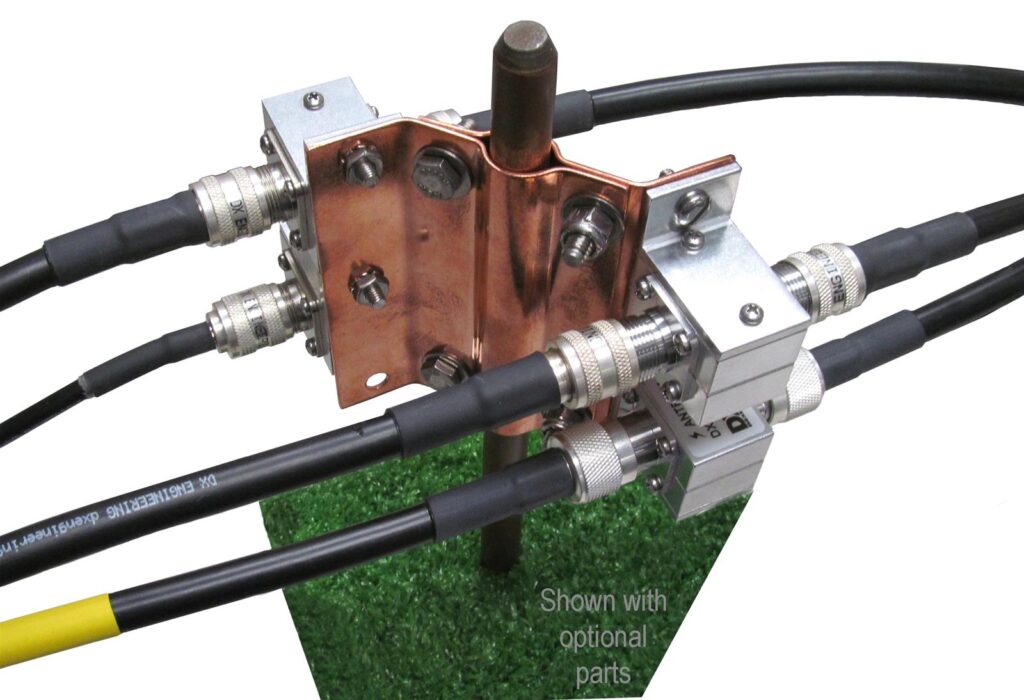
- Install inline lightning arrestors where the feedline enters the building. (You’ll find several models of lightning/surge arrestors at DX Engineering.com from Alpha Delta, CITEL, Diamond Antenna, DX Engineering, NexTek, and PolyPhaser.
- To keep equipment at the same potential, ensure your station’s antenna ground is properly bonded to your home’s electrical service ground as required by the National Electrical Code (in the U.S.).
In addition to lightning arrestors, find everything you need for proper grounding and bonding at DX Engineering, including:
- Wire to Ground Rod Clamps
- Ground Rods
- Copper Grounding Straps
- Grounding Clamps, including DX Engineering’s UCGC-Z Universal Grounding Clamp

(Image/DX Engineering) - Grounding Bars, Utility Enclosures, Radio RF Ground Plane Kits
- Coax Shield Grounding Kits
- Tinned Copper Braid Assemblies
- DX Engineering Rotator Control Line Protector

DX Engineering Rotator Control Line Protector. (Image/DX Engineering) 
DX Engineering Ladder Line Surge Protector. (Image/DX Engineering) - Antenna Disconnect Actuators
- DX Engineering Shack Grounding Package, which includes coaxial cable surge protector, copper ground bus wall mount, radio RF ground plane kit, tinned copper braid assemblies, universal copper grounding clamps, and ground rod.

DX Engineering Shack Grounding Package. (Image/DX Engineering) Plus, here are two books you’ll want to add to your amateur radio library:
- “Grounding and Bonding for the Radio Amateur 2nd Edition” by Ward Silver, N0AX: Get the details on ensuring that your station follows current standards for lightning protection and communication systems. You’ll learn effective grounding and bonding techniques for home stations (including condos and apartments), portable and mobile stations, towers, and outdoor antennas.

(Image/ARRL) - “Lightning Protection: A Comprehensive Guide for Amateur Radio” by Ron Block, NR2B: Targeted specifically to hams, the book presents the theory behind the protection scheme starting with lightning theory and our vulnerability to its destructive effects and continues with a practical implementation guide. It covers what needs to be protected, your zone-of-protection, the creation of a Single Point Ground Panel (SPGP), bonding of that SPGP to an external ground system, and more. Numerous examples and drawings included.

(Image/NR2B) ***
While you’re getting your station’s grounding and bonding in order, here are a few April contests, including a deluge of State QSO Parties and state park activations, to mark on your calendar:
- JIDX CW Contest: April 11, 0700Z to April 12, 1300Z. Visit the Japan International DX Contest page for complete details.
- IG-RY Worldwide RTTY Contest: April 11, 1200Z to April 12, 1800Z. The Interest Group RTTY (IGRY) was founded in January 2017 to promote radioteletype. All amateur operators are invited to contact as many stations as possible using RTTY Baudot Mode (45, 45) on 3.5, 7, 14, 21, and 28 MHz.
- QRP ARCI Spring QSO Party: April 11, 0000Z to 0600Z. QRP Amateur Radio Club International—a club for low-power enthusiasts worldwide—sponsors this annual spring event for hams who strive to do more with less. The HF CW-only contest offers all-band, single-band, high-band, and low-band entrance categories.
In addition, the EA-QRP CW Contest (sponsored by the EA-QRP Club) will be held April 18-19. Find details here.
For a comprehensive look at QRP operating, DX Engineering carries these reference books from the Radio Society of Great Britain:
- QRP Scrapbook—a collection of articles from UK’s G-QRP Club’s journal, SPRAT, featuring the latest low-power techniques and loads of projects (paperback, 240 pages)
- QRP Basics, 3rd Edition—solid advice on choosing QRP equipment, simple antennas and operating tips, and practical wisdom on building your own gear (paperback, 208 pages)
- International QRP Collection—noted hams from around the globe explore everything QRP, including building your own devices, modifying equipment, reviews of gear, QRP theory, and operating (paperback, 173 pages)
- ARRL Rookie Roundup, SSB: April 19, 1800Z to 2359Z. Rookies exchange information with as many other stations as possible on the 80-, 40-, 20-, 15-, and 10-meter bands. If you’re new to the game, the ARRL recommends that you read the article, HF Contesting-Good Practices, Interpretations and Suggestions.
U.S. State and Canadian QSO Parties
- Mississippi: April 4, 1400Z to April 5, 0200Z
- Louisiana: April 4, 1400Z to April 5, 0200Z
- New Mexico: April 11, 1400Z to April 12, 0200Z
- Missouri: April 11, 1400Z to April 12, 0400Z; April 12, 1400Z to 2000Z
- Georgia: April 11, 1800Z to April 12, 0359Z; April 12, 1400Z to 2359Z
- North Dakota: April 11, 1800Z to April 12, 1800Z
- Michigan: April 18, 1600Z to April 19, 0400Z
- Ontario: April 18, 1800Z to April 19, 0300Z; April 19, 1200z to 2000Z
- Quebec, April 19, 1300Z to 2400Z
- Florida: April 25, 1600Z to April 26, 0159Z; April 26, 1200Z to 2159Z
- Nebraska: April 25, 1400Z to April 27, 0200Z
State Parks on the Air
- Florida: April 17, 18, 19, 20 (1200Z to 2359Z all days)
- Georgia: April 18, 1200Z to April 19, 2359Z
- Texas: April 18, 0000Z to April 19, 2359Z
The post Guide to April 2026 Ham Radio Contests: Lightning Edition appeared first on OnAllBands.
-
V4/SP9FIH – St Kitts & Nevis
[UPDATE] – by Janusz, V4/SP9FIH. During the weekend of 4-5 April I plan to make some changes in my antenna setup, probably as follows: 10m will be changed to 12m. 17m will be changed to 20m. 30m will be changed to 40m. [INITIAL INFO] – Janusz, SP9FIH (recently QRV as VP2EWE) will be active from […]
-
DX Engineering Unveils a Ham Radio Game-Changer—the All-New Antenna Encabulator
After decades of research, DX Engineering has perfected the balance of inverse reactive current and the automatic syncrization of ham radio grammeters thanks to the all-new high-performance Antenna Encabulator.
In this cutting-edge DX Engineering product, instead of power being generated by the relative motion of conductors and fluxes, it is produced by the modial interaction of magneto-reluctance and capacitive diractance.
You can get a detailed explanation of the process in this video.
Why not celebrate the April 1 release of the Antenna Encabulator by sharing the video with your amateur radio friends? We’re sure they’ll appreciate the laugh, uh, vital information.
Or get into the innovative spirit by checking out REAL station-enhancing gear from DX Engineering, including Butternut Vertical Antennas, ISO-PLUS Ethernet RF Filters, the RT4500HD Heavy-Duty Rotator, and Flux Capacitors (just kidding).
The post DX Engineering Unveils a Ham Radio Game-Changer—the All-New Antenna Encabulator appeared first on OnAllBands.
-
What It’s Like Living with Active Amateur Radio Operators
The vast majority of my younger ham friends got into the hobby because a family member had their license. I became involved in amateur radio through a mix of influences: my school club and my grandpa and mom, both of whom were hams. (It’s always an entertaining story when I explain to people that my mom and I both had our licenses before my dad, though he rectified that shortly after I got mine.)
That being said, amateur radio is the perfect hobby to pursue as a family. There are seemingly endless different subcategories of interests within it, so nobody will ever get bored. The hobby also manages to help bridge generational gaps easier than any other hobby that I know of. Since getting my license in 2019, my two sisters have also gotten their licenses. Our family now enjoys the hobby together.
Sharing amateur radio as a family hobby is very rewarding, but it can also come with oddities here and there. Let’s start with some of the amateur radio equipment that can be visible around the house. Suddenly there are wires strung through the trees in the backyard, maybe a tower and a beam, and perhaps even a radio sitting in the living room. Depending on which family member you ask, these are either great parts of living with hams or, perhaps, a “less glamorous” aspect of having a family of operators.
My mom had never really used her license before I got mine, despite also earning her callsign in early middle school. This meant that my parents had to get used to having an active ham in the house. Now, there was a rather loud, static-emitting HT sitting next to me when I did my math homework, in the hopes that someone would get on our local repeater.
Saturday nights became net nights, where the family computer or one of my parents’ cell phones would be occupied by EchoLink. Headphones were quickly instated since, apparently, my little sisters didn’t care to hear what was going on with my 25 other young ham friends checking into the net. (Eventually, they also became interested and ended up both checking into the same net.)
Once I learned Morse code, there wasn’t an evening—for a while—where my father didn’t hear me practicing or getting on the air while he was in the family room directly above trying to watch TV. Even better than overhearing CW seeping through the ceiling, my parents had the privilege of learning the respective callsign prefix per country—like they would be tested on them. Our dinner table conversations consisted of which states and countries I had worked that day.
As we all became progressively more involved in the hobby and I got into contesting, it became normal for me to spend full weekends on the radio, forgoing sleep to get the best score possible. Contest Online ScoreBoard became a frequently used website in our house, though we wouldn’t have it any other way. When it wasn’t a contest, it wouldn’t be out of the ordinary for someone to have a remote station running on their phone or laptop in the living room, trying to work a DXpedition.
Between the lovely sounds of Morse code floating through the air, the very aesthetically pleasing equipment dispersed around the house and yard, and the very odd operating windows that occasionally reached far into times of the day reserved for sleep, living with an active ham can be quite an interesting experience…but a rewarding one as you bond together as a family.
While some of these aspects can take getting used to—even with just one active ham in the family—it won’t be long before you’ll all be using Q signals in your texts with each other and discussing propagation over coffee.
The post What It’s Like Living with Active Amateur Radio Operators appeared first on OnAllBands.
-
VOA Museum Announces Expanded Hours During Hamvention
The following is a press release from VOA Museum:
The National Voice of America Museum of Broadcasting in conjunction with the West Chester Amateur Radio Association announce expanded hours for the museum during the 2026 Hamvention. We will be open for the following:
- Thursday May 14th from 12:00 to 9:00PM
- Friday May 15th from 12:00 to 9:00 PM
- Saturday May 16th from 12:00 to 9:00 PM
- Sunday May 17th from 12:00 to 5:00 PM
Admission is $10.00 at the door. Our Amateur Radio station WC8VOA will be on the air to operate. The museum is a short drive from Hamvention down either Interstate 75 or Route 42 from Xenia. GPS use Crosley Blvd.
Exhibits include a dedicated room for vintage Amateur Radio and shortwave equipment. See the first transmitter for the VOA from 1942. A disc jockey’s station from a vintage radio station. Our Amateur Radio Shack with state-of-the-art equipment from Yaesu, Icom, Elecraft and Mosley. Docents and ARS operators will be available to enhance your visit to the museum.
For further information you can visit us at voamuseum.org or wc8voa.org on the web. You can also find us on Facebook at National Voice of America Museum of Broadcasting. Our regular hours are Fridays, Saturdays and Sundays 12:00 until 4:00 PM. We are located at
8070 Tylersville Road
West Chester, Ohio 45069Phone 513-777-0027
Source: VOA Museum
-
April Fools’ Day 2026 Round-up
April Fools’ Day wouldn’t be complete without several attempts at mischief among the amateur radio community and 2026 has been no exception! Here are links to several April Fools’ Day events that made their way across the Amateur Radio Daily news desk.
DX Engineering Unveils a Ham Radio Game-Changer—the All-New Antenna Encabulator
After decades of research, DX Engineering has perfected the balance of inverse reactive current and the automatic syncrization of ham radio grammeters thanks to the all-new high-performance Antenna Encabulator. See the related video.The RetroRig by N6ARA Electronics
RetroRig offers the least-modern discomforts optimized for the traveling ham. View the video or Place your order.U.S. Administration Supports Ham Radio Homebrew
In a decision that puzzled many analysts, the Federal Communications Commission has come out with a new policy that seems to support the at home construction (“homebrew”) of amateur radio equipment.POTA Platinum — new paid tier for POTA!
To maximize profits, we’re introducing POTA Platinum. New rules, new benefits — for a price. See this video explanation.Source: Amateur Radio Daily
-
The Most Overlooked Ham Radio Skills
In this digital age of ham radio licensing exam preparation, many hams learn the answers, but few take it to the next step and learn the whys and wherefores behind the questions. As a result, they get frustrated in “putting it all together.” We are going to look at a few basic skills that will make amateur radio much more enjoyable for you.
Antenna Theory & Building
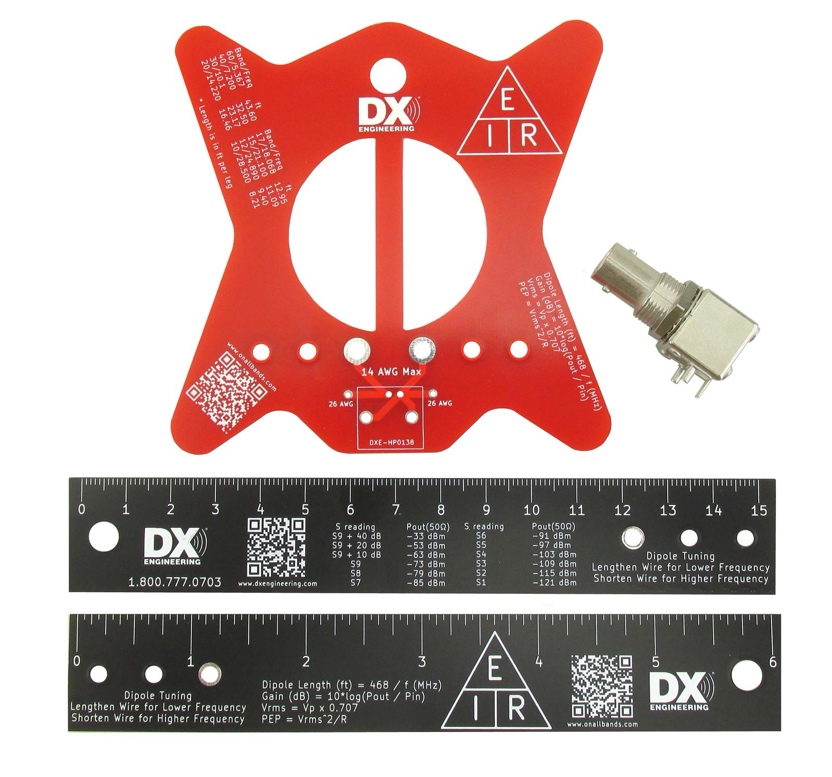
Antenna building is not rocket science. The basic idea is to make the RF energy inside the radio radiate outside the radio in the most efficient manner possible. I often suggest starting off by building simple dipole or long wire antennas. Wire antennas are a great low-cost method of learning basic antenna theory. To make it easy, I suggest the DX Engineering Single-Band Low-Power Dipole Kit or one of the DX Engineering Low-Power Portable Dipole and Winder Kits. “Salty Walt’s Portable Antenna Sketchbook” is a great resource to get you started.

DX Engineering Single-Band Low-Power Dipole Kit. (Image/DX Engineering) 
DX Engineering Low-Power Portable Dipole and Winder Kit. (Image/DX Engineering) 
“Salty Walt’s Portable Antenna Sketchbook.” (Image/ARRL) Cable Preparation
I am thankful I learned early on to make my own coaxial cable assemblies. DX Engineering makes some of the best Coaxial Cable Assemblies in the business. If you can’t find an assembly that meets your needs, the exclusive DX Engineering Custom Cable Builder lets you choose your desired cable from many options, select the precise length you need up to 300 feet, and choose what connectors you want on both ends.
But for do-it-yourselfers, learning the basic skills and investing in a quality tool kit lets you make practically any cable you need.
I recommend using the DX Engineering Next Generation Crimp/Solder PL-259s. These are quality connectors, and there’s plenty of installation support from the manuals and videos showing how to use the DX Engineering cable prep tools.

(Image/DX Engineering) To make cable preparation a breeze, I use the DX Engineering Cable Prep Tool Kit for Crimp Connectors. It cuts all levels of the coax to the precise measurements in one smooth action.

DX Engineering Cable Prep Tool Kit for Crimp Connectors. (Image/DX Engineering) Finally, I use the DX Engineering Ultra-Grip 2 Crimp Tool Kit to ensure the proper crimp around the shield of the coax . I finish off the center conductor with the Milwaukee M12 Soldering Iron.

DX Engineering Ultra-Grip 2 Crimp Tool Kit. (Image/DX Engineering) Soldering
Which leads me to the skill of soldering. I am the first to admit that I’m not an expert in the art, but I can do what needs to be done. Whether you’re considering battery, butane, or electric models, take some time to review a variety of soldering guns and irons. Think about how you will most use it and what fits your needs and budget. It should be paired with the right solder for the job. And remember, flux is your friend. It helps the solder flow nicely and where you want it to go.

CAIG Rosin Soldering Flux available at DX Engineering. (Image/CAIG) Sometimes to get to the problem or solve an issue, you need to remove the solder. This is also a skill that takes some finesse. There are a couple of desoldering tools available to make that job easier. Always remember, whether putting it down or picking it up, soldering in the wrong place can be a very bad thing.
These are just a few skills that are not a part of the amateur radio exam, but will, nonetheless, make your time in the hobby more enjoyable and less expensive.
Until next time, 73 de AC8OW
The post The Most Overlooked Ham Radio Skills appeared first on OnAllBands.